
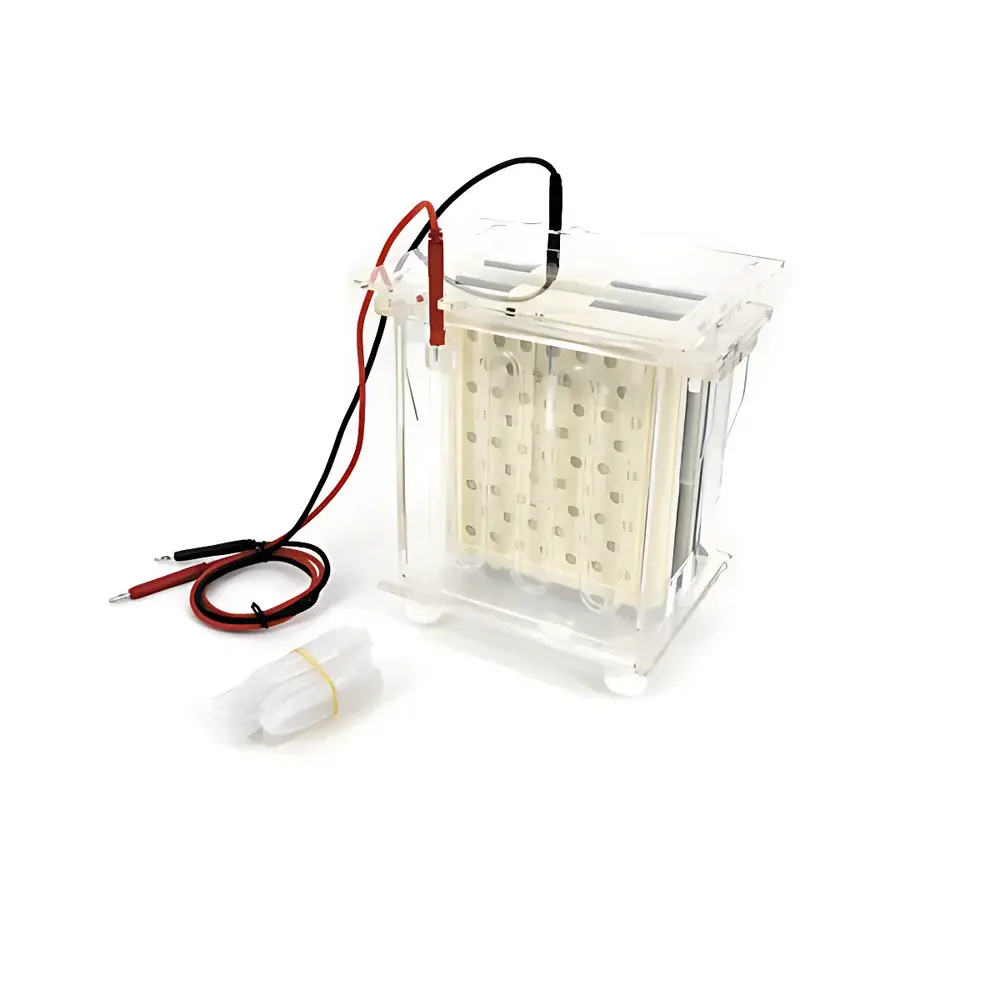
LY DYCZ-40B Semi-Dry Electrophoretic Transfer Apparatus
| Brand | LY |
|---|---|
| Origin | Beijing, China |
| Manufacturer Type | Authorized Distributor |
| Product Category | Domestic |
| Model | DYCZ-40B |
| Instrument Type | Semi-Dry Electrophoretic Transfer System |
| Main Unit | Electrophoresis Transfer Apparatus (with buffer chamber and cooling rack) |
| Gel/Transfer Plate Dimensions | 120 × 115 mm |
| External Dimensions | 170 × 160 × 150 mm |
| Weight | 1.5 kg |
| Buffer Capacity | 1200 mL |
| Cooling | Integrated aluminum cooling rack |
| Included Components | 1× main unit, 1× lid, 2× transfer plates, 4× gel support pads, 2× latex tubes, 1× cooling rack, 1× pair of electrode leads |
Overview
The LY DYCZ-40B Semi-Dry Electrophoretic Transfer Apparatus is a compact, benchtop electrophoretic blotting system engineered for reliable and reproducible protein or nucleic acid transfer from polyacrylamide or agarose gels to solid-phase membranes—including nitrocellulose (NC), polyvinylidene difluoride (PVDF), and nylon membranes. Unlike traditional wet-transfer systems, the DYCZ-40B employs a semi-dry configuration: sandwiched gel-membrane assemblies are placed between two parallel electrode plates immersed in minimal buffer volume (≤1200 mL), enabling rapid, low-resistance current flow and efficient electroblotting within minutes. This architecture minimizes Joule heating while maintaining high field homogeneity across the 120 × 115 mm active transfer area—critical for uniform molecular migration and retention of epitope integrity during Western blot workflows. The apparatus integrates an aluminum cooling rack to dissipate thermal load during extended or high-current runs, supporting consistent transfer efficiency under variable experimental conditions.
Key Features
- Compact semi-dry design with footprint of only 170 × 160 × 150 mm—optimized for space-constrained biosafety cabinets and shared core facilities.
- Dual transfer plate configuration (2× included) enables parallel processing of identical or comparative samples without cross-contamination.
- Integrated aluminum cooling rack ensures passive thermal management; compatible with chilled buffer recirculation when paired with external chillers (not included).
- Robust construction using corrosion-resistant ABS housing and precision-machined stainless-steel electrodes for long-term stability and electrical consistency.
- Modular component set includes four gel-support fiber pads (pre-cut to match plate dimensions), two latex tubing connectors for optional buffer circulation, and one pair of shielded electrode leads with secure alligator clips.
- Designed for compatibility with standard mini-gel formats and common membrane sizes used in immunodetection assays per ISO/IEC 17025–accredited laboratories.
Sample Compatibility & Compliance
The DYCZ-40B supports transfer of proteins (3–200 kDa) and nucleic acids (0.1–10 kb) from slab gels up to 1.5 mm thick. It accommodates both pre-cast and hand-cast gels and is validated for use with NC, PVDF, and charged nylon membranes. All materials in direct contact with buffer or samples comply with USP Class VI biocompatibility standards. While the apparatus itself does not carry CE or FDA 510(k) certification, its operational parameters align with widely adopted protocols referenced in ASTM E2928-22 (Standard Guide for Electrophoretic Transfer of Proteins) and ISO 13845:2021 (Molecular biology—Requirements for electrophoresis equipment). When operated under GLP-compliant SOPs—including documented calibration of external power supplies and traceable buffer preparation—the system meets audit requirements for preclinical biomarker validation studies.
Software & Data Management
The DYCZ-40B is a hardware-only transfer platform and does not incorporate embedded microcontrollers or digital interfaces. Voltage, current, and time control are managed externally via a compatible programmable DC power supply (e.g., 0–300 V, 0–500 mA, timer-enabled units commonly used in academic and industrial labs). This analog architecture ensures electromagnetic compatibility in sensitive imaging environments and eliminates firmware-related validation overhead. Users maintain full traceability by logging instrument ID, buffer lot numbers, ambient temperature, and power supply settings in electronic lab notebooks (ELNs) compliant with 21 CFR Part 11 when configured with appropriate audit-trail modules.
Applications
- Western blotting: High-efficiency transfer of SDS-PAGE-separated proteins for subsequent antibody probing and chemiluminescent detection.
- Southern and Northern blotting: Reproducible DNA/RNA immobilization onto membranes prior to hybridization with labeled probes.
- Post-electrophoresis validation: Rapid confirmation of protein expression changes in pharmacological studies—e.g., dose-dependent modulation of ERK phosphorylation following kinase inhibitor treatment.
- Clinical research: Blot-based quantification of disease-associated isoforms (e.g., tau truncation fragments in Alzheimer’s CSF samples) where transfer fidelity directly impacts diagnostic sensitivity.
- Teaching laboratories: Robust, low-maintenance platform for undergraduate molecular biology courses emphasizing hands-on blotting technique development and troubleshooting.
FAQ
What power supply is required to operate the DYCZ-40B?
A programmable DC power supply capable of delivering 10–150 V and 0–500 mA with adjustable timer functionality is required. LY recommends pairing the unit with a certified laboratory-grade supply meeting IEC 61010-1 safety standards.
Can the DYCZ-40B be used for wet transfer?
No—the DYCZ-40B is specifically engineered for semi-dry transfer. Its buffer capacity (1200 mL) and electrode geometry are optimized for low-volume, high-field applications; it lacks the reservoir depth and cooling circulation ports required for conventional wet-tank systems.
Is the cooling rack compatible with external chillers?
Yes—the aluminum cooling rack features standardized 6-mm tube ports allowing connection to external recirculating chillers (e.g., Huber Ministat) for sub-15°C operation during high-throughput or heat-sensitive transfers.
How often should the electrode leads and pads be replaced?
Electrode leads should be inspected before each use for insulation integrity and clip corrosion; replace if discoloration or pitting is observed. Gel-support pads are single-use consumables and must be discarded after each transfer run to prevent carryover contamination.
Does LY provide calibration services or documentation for GMP compliance?
LY supplies a Certificate of Conformance with each unit. For regulated environments, users must perform in-house calibration of associated power supplies per ISO/IEC 17025 procedures and retain records as part of their quality management system.




