
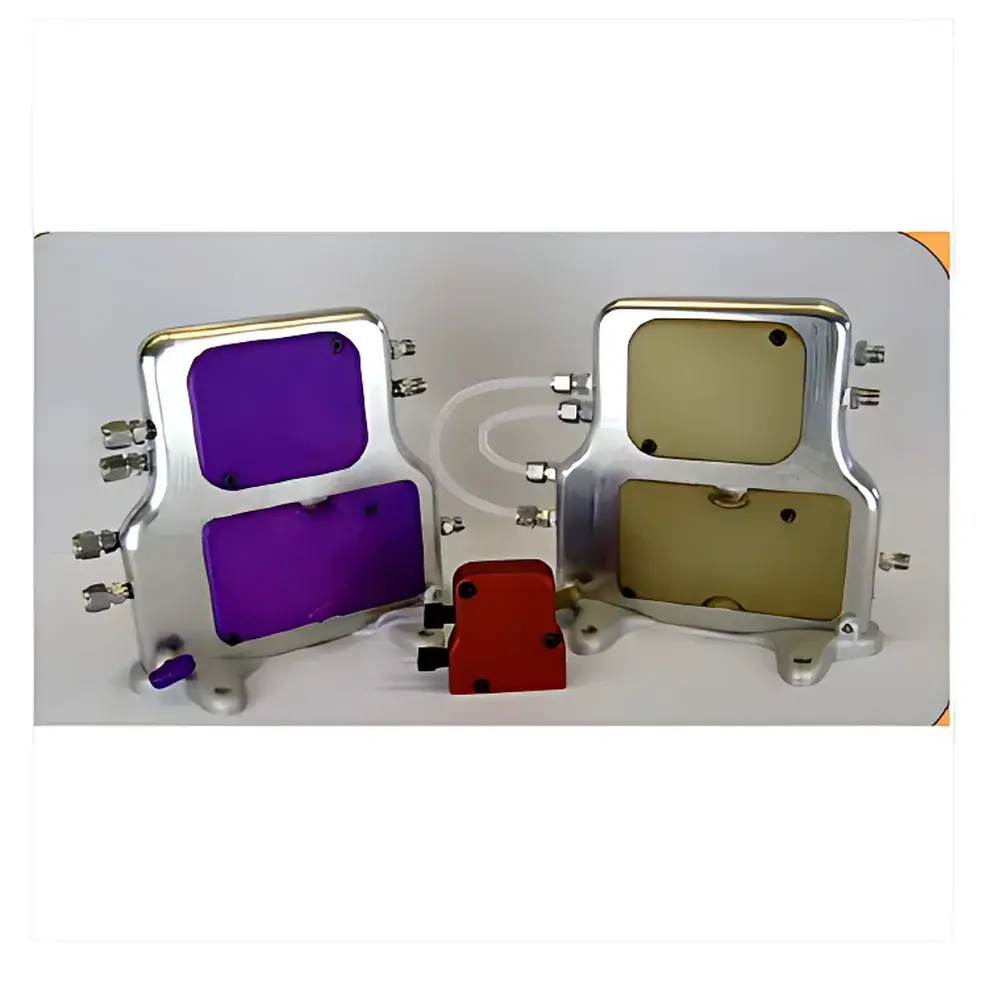
Corning Zaiput High-Efficiency Liquid-Liquid Separator SEP-10
| Brand | Corning |
|---|---|
| Origin | USA |
| Manufacturer Status | Authorized Distributor |
| Origin Category | Imported |
| Model | Zaiput SEP-10 |
| Pricing | Available Upon Request |
Overview
The Corning Zaiput High-Efficiency Liquid-Liquid Separator SEP-10 is an engineered membrane-based continuous-phase separation device designed for real-time, inline segregation of immiscible liquid streams—most commonly aqueous and organic phases—without reliance on gravitational settling or density differentials. It operates on the principle of selective membrane wetting: a hydrophobic, chemically resistant porous membrane preferentially wets the organic phase while repelling the aqueous phase (or vice versa, depending on membrane surface chemistry), enabling phase-selective permeation under controlled transmembrane pressure differentials. A built-in dual-pressure regulation system actively maintains a precise, stable pressure balance across the membrane interface—critical for preventing phase breakthrough, emulsion carryover, or membrane flooding. This architecture delivers robust, reproducible separation performance in flow chemistry, multistep synthesis, and continuous manufacturing environments where residence time sensitivity, intermediate stability, and solvent economy are paramount.
Key Features
- Membrane-driven separation independent of interfacial tension or density contrast—enabling reliable partitioning of low-density organics (e.g., ethers, hydrocarbons) from water
- Effective handling of stabilized emulsions and microemulsions common in catalytic reactions or acidic/basic aqueous workups
- True continuous-flow operation compatible with syringe pumps, HPLC systems, and automated flow reactors
- Ultra-low internal volume (~400 µL) minimizing hold-up time—essential for thermally labile, photo-sensitive, or oxidatively unstable intermediates
- Chemical resistance across broad pH range (0–14) and compatibility with aggressive solvents including concentrated acids, bases, halogenated compounds, and nitriles
- Pressure-rated design (up to 2 MPa) supporting high-throughput operation and integration into pressurized flow manifolds
- Modular, plug-and-play mechanical interface with standard 1/4″-28 UNF ports and Swagelok-compatible tubing connections
- Scalable architecture: SEP-10 serves as the laboratory-scale validation unit; its operating principles and membrane module geometry directly inform larger-format SEP-200 and SEP-3000 systems
Sample Compatibility & Compliance
The SEP-10 accommodates liquid streams with viscosities up to 50 cP and suspended particulate content <5 ppm (filtered feed recommended). Its all-perfluoropolymer wetted path (including membrane, housing, and seals) conforms to USP Class VI biocompatibility requirements and exhibits no detectable leachables per ASTM D4296. The device supports GLP- and GMP-aligned workflows through traceable pressure logging (when paired with external digital gauges) and is routinely deployed in API intermediate purification steps compliant with ICH Q5, Q7, and FDA Guidance for Industry on Continuous Manufacturing. No regulatory filings are required for standalone use; however, full system integration into regulated processes must adhere to site-specific validation protocols per ISO 9001 and 21 CFR Part 11 data integrity standards.
Software & Data Management
As a passive, non-electronic separation module, the SEP-10 requires no embedded firmware, drivers, or proprietary software. Pressure monitoring, flow rate control, and process documentation are managed externally via compatible instrumentation—such as Bronkhorst EL-FLOW Select mass flow controllers, Parker IQ+ digital pressure transducers, or LabVIEW- or Python-controlled pump systems. When integrated into validated platforms, audit trails for pressure setpoints, flow durations, and maintenance logs may be captured within existing LIMS or electronic lab notebook (ELN) infrastructure. Firmware-independent operation eliminates cybersecurity vulnerabilities and simplifies 21 CFR Part 11 compliance for electronic records.
Applications
- In-line quenching and phase separation in Pd-catalyzed cross-coupling reactions (e.g., Suzuki, Heck)
- Continuous extraction of acid-labile heterocycles during deprotection sequences
- Integrated workup of Grignard or organolithium adducts without cryogenic handling
- Solvent recycling loops in telescoped syntheses—reducing THF, EtOAc, or DCM consumption by >40% versus batch extraction
- Purification of peptide coupling intermediates susceptible to racemization or hydrolysis
- Separation of fluorinated phases in pharmaceutical fluorochemistry workflows
- Preparative isolation of natural product glycosides from aqueous fermentation broths
FAQ
Does the SEP-10 require pre-wetting or conditioning before first use?
Yes—membrane activation with the intended organic phase for ≥5 minutes at operational flow rate is mandatory to establish stable wetting front and prevent aqueous phase intrusion.
Can the SEP-10 handle biphasic mixtures containing solids or precipitates?
No—particulates >1 µm will foul the membrane. In-line filtration (0.45 µm or finer) upstream is strictly required.
Is membrane replacement user-serviceable?
Yes—the SEP-10 employs a field-replaceable cartridge design; full replacement takes <90 seconds with standard hex tools and requires no recalibration.
What is the typical service life of the membrane under continuous operation?
Under nominal conditions (clean feeds, ≤1.5 MPa, ambient temperature), expected lifetime exceeds 500 hours; lifetime decreases proportionally with halogenated solvent exposure or pH extremes outside 2–12.
How does the SEP-10 compare to centrifugal or gravity-based separators in terms of scalability?
Unlike rotor-dependent systems, SEP-10’s linear scale-up path preserves residence time distribution, pressure drop profile, and interfacial shear—enabling direct translation from 10 mL/min (SEP-10) to 3 L/min (SEP-3000) without re-optimization.



