
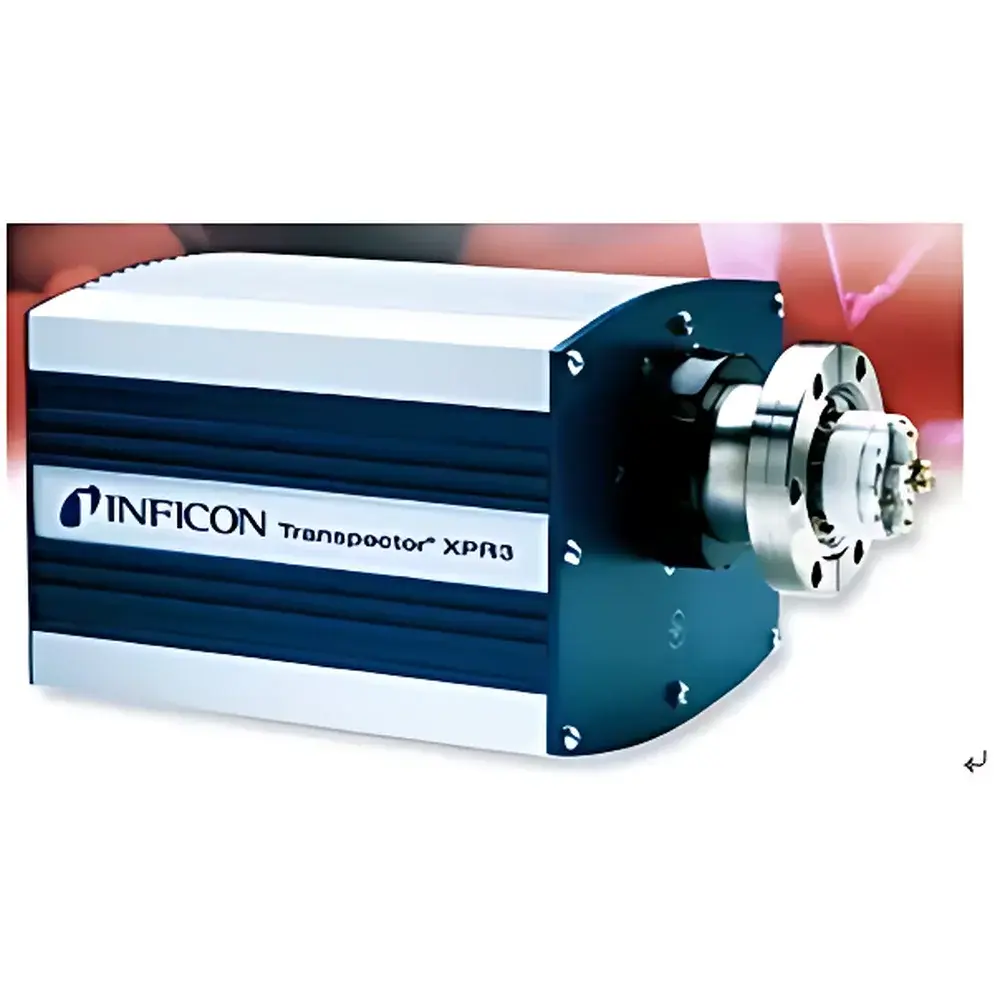
Transpector XPR3 Residual Gas Analyzer System
| Origin | USA |
|---|---|
| Manufacturer Type | Authorized Distributor |
| Origin Category | Imported |
| Model | Transpector XPR3 |
| Pricing | Available Upon Request |
Overview
The Transpector XPR3 is a high-performance residual gas analyzer (RGA) system engineered for real-time, quantitative mass spectrometric analysis in demanding high-pressure vacuum environments—specifically optimized for operation up to 20 mTorr. Based on quadrupole mass filter technology, the XPR3 employs a robust electron ionization (EI) source and a precisely tuned RF/DC voltage-driven quadrupole mass separator to deliver stable, reproducible detection of gases and vapors across the 1–100 amu mass range. Its design targets applications where rapid response, long-term signal stability, and operational resilience under dynamic process conditions are critical—particularly in physical vapor deposition (PVD) chambers used in semiconductor fabrication, flat-panel display manufacturing, and thin-film photovoltaic production.
Key Features
- Redesigned ion source with minimized surface area and optimized electron trajectory—reducing hydrocarbon contamination buildup and extending operational lifetime while enhancing signal-to-noise ratio.
- Integrated high-gain electron multiplier detector capable of operating continuously at pressures up to 20 mTorr without requiring manual switching between Faraday cup and multiplier modes—ensuring seamless, consistent data acquisition during pressure transients.
- Elongated quadrupole rod assembly with extended field length—improving mass resolution in the low-mass region (particularly <10 amu), enabling enhanced isotopic separation (e.g., 12C vs. 13C, 14N vs. 15N) and significantly improved sensitivity for hydrogen (H2, m/z = 2) and helium (He, m/z = 4).
- Built-in capacitance manometer (CDG) with analog output and digital interface—providing real-time chamber pressure feedback for closed-loop process control and hardware interlock activation to protect the filament during overpressure events.
- Compact, conflat-flanged vacuum-compatible housing rated for UHV-compatible bake-out (≤150 °C) and designed for direct integration into PVD tool foreline or chamber-side ports.
Sample Compatibility & Compliance
The Transpector XPR3 is compatible with reactive, inert, and condensable process gases—including H2, He, N2, O2, Ar, CO, CO2, H2O, and common PVD sputter byproducts (e.g., TiClx, AlClx). It meets mechanical and electrical safety requirements per UL 61010-1 and IEC 61010-1. While not certified as a standalone safety device, its integrated CDG and interlock logic support compliance with SEMI S2-0215 (safety guidelines for semiconductor manufacturing equipment). Data integrity features—including timestamped spectral logging and user-accessible calibration history—align with GLP/GMP documentation expectations for process validation in regulated environments.
Software & Data Management
The system operates with proprietary RGA Control Suite v4.x, a Windows-based application supporting real-time spectral display, peak tracking, partial pressure trending, and customizable alarm thresholds. Raw data is stored in HDF5 format with embedded metadata (instrument ID, acquisition time, pressure reading, filament emission current). Export options include CSV, ASCII, and XML for integration with MES/SCADA platforms. Audit trail functionality records all parameter changes, user logins, and calibration events—supporting 21 CFR Part 11 readiness when deployed with validated Windows OS configurations and domain-authenticated access controls.
Applications
- Leak detection and localization in high-throughput PVD tools using helium or hydrogen tracer gas, with sub-1×10⁻⁹ std cm³/s sensitivity achievable via background-subtracted m/z = 4 monitoring.
- In-situ gas purity verification prior to sputtering—detecting trace H2O (<10 ppm), O2 (<5 ppm), and hydrocarbons that compromise film stoichiometry and adhesion.
- Process endpoint determination during reactive sputtering (e.g., TiN, SiO2) via real-time tracking of reactant depletion (e.g., N2 at m/z = 28) and byproduct generation (e.g., NO at m/z = 30).
- Contamination forensics following chamber excursions—identifying organic residues (m/z = 43, 57, 71) or metal halides indicative of target poisoning or pump oil backstreaming.
FAQ
What vacuum compatibility does the Transpector XPR3 support?
It is rated for continuous operation from 1×10⁻¹⁰ Torr to 20 mTorr, with full sensitivity maintained up to 10 mTorr; higher pressures require optional pressure-reduction orifice kits.
Can the XPR3 be integrated into existing tool automation frameworks?
Yes—it provides Ethernet/IP and RS-232 interfaces with Modbus TCP and SECS/GEM protocol support for OEM-level integration into factory host systems.
Is filament replacement a user-serviceable procedure?
Filament exchange requires vacuum break and alignment verification; it is recommended as a qualified technician procedure per the Maintenance Manual (P/N XPR3-MNT-001).
Does the system support quantitative analysis without external calibration standards?
Relative partial pressure quantification is enabled via built-in sensitivity factors for common gases; absolute quantification requires periodic calibration with certified reference gas mixtures.
How is data security managed during remote diagnostics?
Remote access is restricted to authenticated TLS 1.2–encrypted sessions; no data is stored on vendor servers, and all diagnostic logs remain local unless explicitly exported by authorized personnel.







