
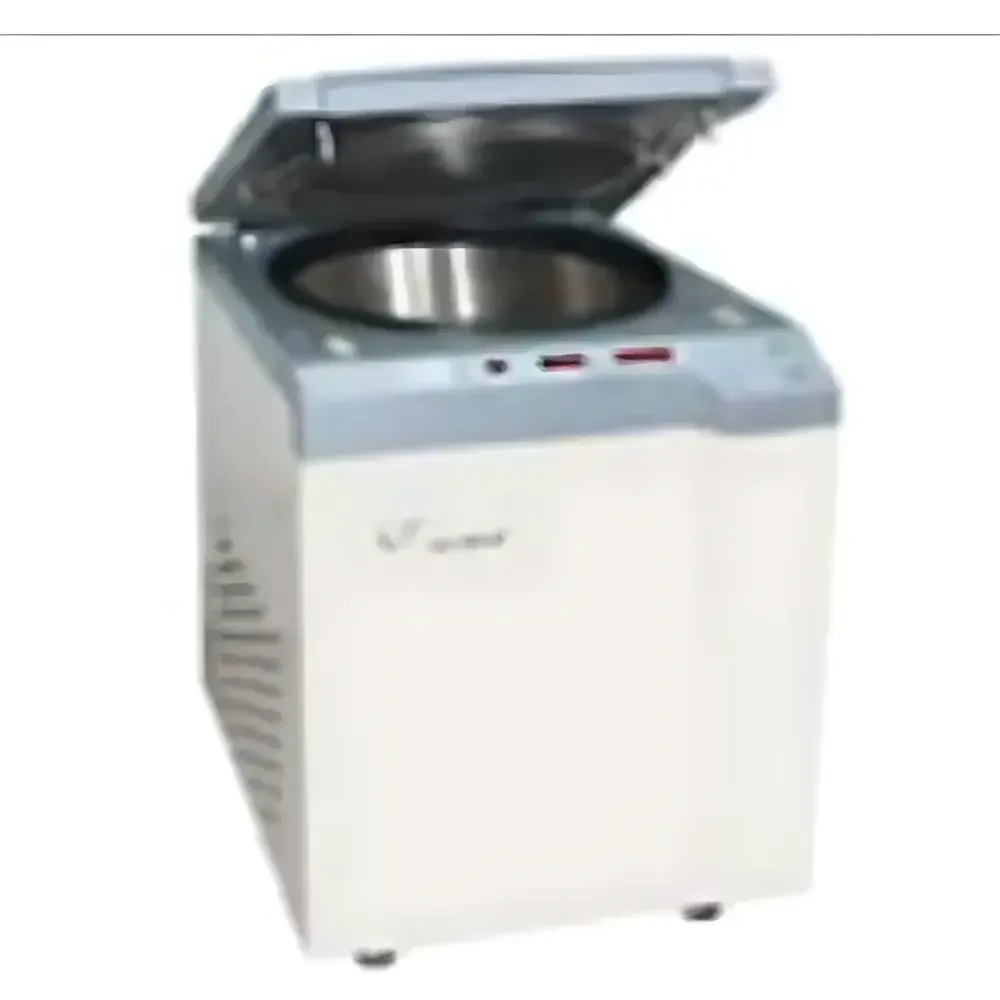
AnTing GL-16G-II High-Speed Refrigerated Centrifuge
| Brand | AnTing |
|---|---|
| Origin | Shanghai, China |
| Model | GL-16G-II |
| Type | Benchtop Refrigerated Centrifuge |
| Speed Range | Up to 16,000 rpm |
| Max RCF | 17,000 × g |
| Capacity | 12 × 10 mL (angular rotor) |
| Temperature Range | −20 °C to +30 °C |
| Timer Range | 0–99 min |
| Power Consumption | 1.5 kW |
| Dimensions (L×W×H) | 600 × 505 × 770 mm |
| Weight | 111 kg |
| Rotor Type | Fixed-angle |
| Safety | Electronic door lock |
| Construction | Reinforced polymer housing |
Overview
The AnTing GL-16G-II is a benchtop high-speed refrigerated centrifuge engineered for precise, reproducible separation of biological and chemical samples under controlled thermal conditions. It operates on the principle of sedimentation acceleration via rotational force—generating up to 17,000 × g at its maximum speed of 16,000 rpm—to resolve particles based on density, size, and shape in liquid suspensions. Designed for routine use in academic laboratories, quality control environments, and small-scale production facilities, the GL-16G-II supports critical workflows including cell pelleting, nucleic acid extraction, protein purification, and subcellular fractionation. Its integrated refrigeration system maintains sample integrity by stabilizing temperatures between −20 °C and +30 °C during operation—essential for thermolabile biomolecules such as enzymes, antibodies, and RNA. The unit’s reinforced polymer housing contributes to structural rigidity while minimizing vibrational transmission, ensuring operational stability even at elevated speeds.
Key Features
- High-speed performance with digitally controlled brushless motor delivering consistent rotational accuracy across the full speed range (0–16,000 rpm).
- Active refrigeration system with independent compressor-based cooling, enabling rapid temperature stabilization and precise setpoint maintenance (±2 °C tolerance).
- Fixed-angle rotor configuration optimized for 12 × 10 mL tubes—compatible with standard polypropylene and polycarbonate conical tubes meeting ISO 8573-1 Class 3 purity requirements.
- Electronic interlocked safety door with automatic rotor recognition and imbalance detection; halts rotation immediately upon lid opening or load asymmetry exceeding 5 g.
- Digital timer with programmable duration from 0 to 99 minutes, supporting both continuous and timed run modes with audible end-of-run alert.
- Low-noise design (<65 dB[A] at 1 m), compliant with ISO 15744:2020 laboratory acoustic emission standards.
- Robust mechanical architecture featuring precision-balanced stainless-steel chamber and vibration-damping feet for long-term reliability under daily use.
Sample Compatibility & Compliance
The GL-16G-II accommodates common laboratory tube formats including 10 mL conical centrifuge tubes (e.g., Eppendorf Safe-Lock, Thermo Fisher Nunc) and microcentrifuge adapters for smaller volumes. It is suitable for aqueous buffers, saline solutions, ethanol precipitations, and low-viscosity organic solvents—provided compatibility is verified per manufacturer tube specifications. While not certified for biosafety level (BSL)-3 containment or explosive atmospheres, the unit meets CE marking requirements under Directive 2014/30/EU (EMC) and 2014/35/EU (LVD). Its thermal management and mechanical design align with general-purpose laboratory equipment guidelines outlined in ISO/IEC 17025:2017 for accredited testing laboratories. For regulated environments, users may implement procedural controls—including logbook entries, calibration verification against traceable tachometer standards, and periodic rotor inspection—to support GLP/GMP documentation frameworks.
Software & Data Management
The GL-16G-II operates via an embedded digital interface with LED display and tactile membrane keypad—no external software or PC connectivity required. All operational parameters (speed, time, temperature, acceleration/deceleration profiles) are stored locally in non-volatile memory and retained after power cycling. Though lacking networked data export or audit trail functionality out-of-the-box, the device supports manual recordkeeping compatible with FDA 21 CFR Part 11-compliant documentation practices when paired with standardized lab notebooks or LIMS-integrated entry protocols. Optional third-party data loggers can be interfaced via analog voltage outputs (0–10 V) for RPM and temperature monitoring, facilitating integration into facility-wide environmental monitoring systems.
Applications
- Cell culture harvest: Pelleting mammalian and microbial cells at 12,000–16,000 rpm with minimal shear-induced lysis.
- Nucleic acid isolation: Clarifying lysates prior to column-based or magnetic bead purification steps.
- Protein subfractionation: Separating soluble fractions from inclusion bodies or membrane pellets in recombinant expression workflows.
- Clinical diagnostics: Preparing serum/plasma from whole blood samples within CLIA-recognized processing windows.
- Pharmaceutical QC: Validating suspension homogeneity and particulate content in formulation development batches.
- Environmental analysis: Concentrating waterborne microorganisms or nanoparticles for downstream microscopy or spectroscopic analysis.
FAQ
What is the maximum allowable rotor imbalance for safe operation?
The GL-16G-II triggers automatic shutdown if mass asymmetry exceeds ±5 g across opposing tube positions—verified during factory calibration using certified test masses.
Can this centrifuge accommodate swing-bucket rotors?
No—the GL-16G-II is configured exclusively for fixed-angle rotors; no swing-bucket or vertical rotor options are available or supported.
Is routine calibration required, and what standards apply?
While not mandatory, annual verification of speed (via handheld tachometer traceable to NIST SRM 2034) and temperature (using calibrated PT100 probe) is recommended per ISO/IEC 17025 Annex A.3.
How does the refrigeration system perform at ambient temperatures above 30 °C?
The compressor-based cooling maintains setpoint only when ambient conditions remain ≤28 °C and relative humidity <75%; sustained operation above these thresholds may reduce cooling efficiency and trigger thermal protection.
What maintenance intervals are specified for the drive motor and refrigeration unit?
Brushless motor requires no scheduled lubrication; refrigeration service—including oil change and refrigerant pressure check—is advised every 24 months by authorized technicians using R134a-compatible tools.



