
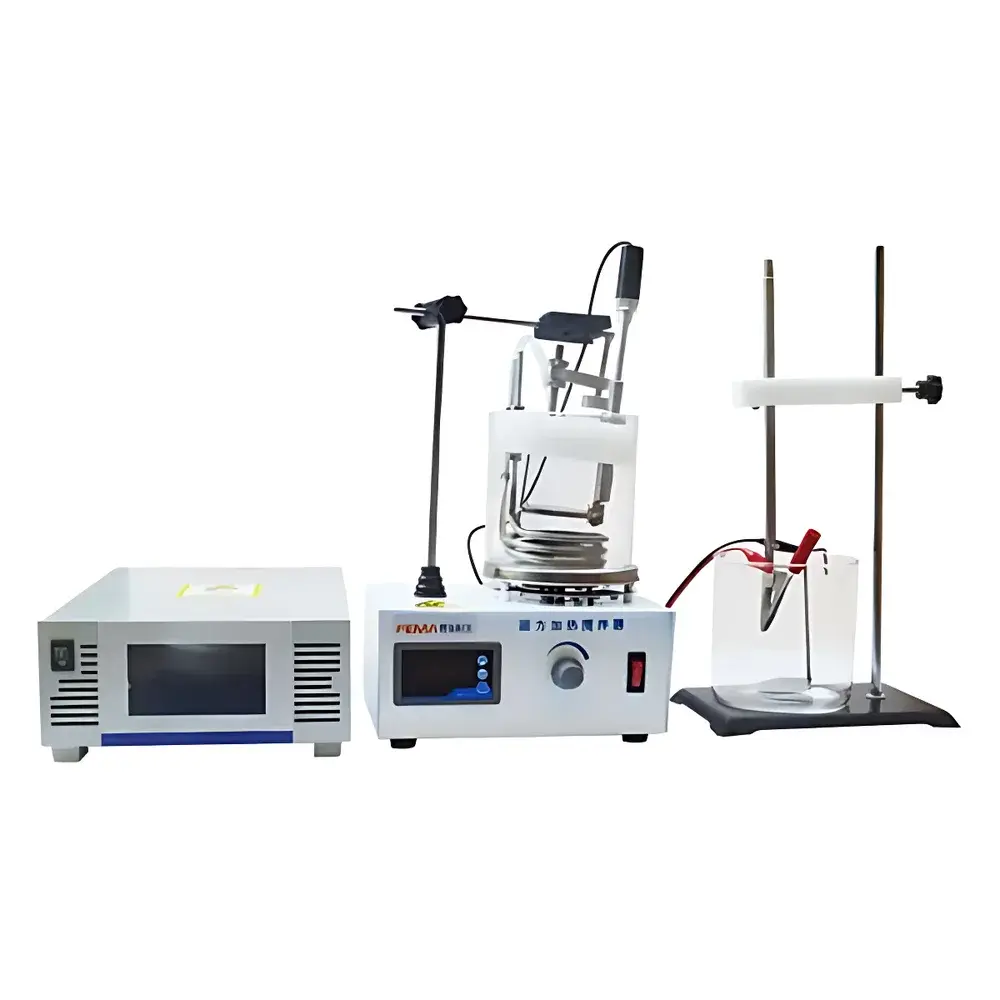
FEMA FEP 30 Electrolytic Polishing and Etching Instrument
| Brand | FEMA |
|---|---|
| Origin | Jiangsu, China |
| Manufacturer Type | Direct Manufacturer |
| Model | FEP 30 |
| Output | DC 0–100 V / 0–6 A (customizable) |
| Voltage Resolution | 0.01 V |
| Current Resolution | 0.001 A |
| Temperature Control Range | Ambient to 100 °C ±1 °C |
| Timer Range | 0–99 h |
| Electrolyte Volume Capacity | 800 mL |
| Cooling | External water-cooled coil |
| Stirring | Integrated magnetic stirrer |
| Sample Exposure Apertures | 15 mm, 20 mm, 30 mm |
| Power Input | AC 220 V, 50 Hz |
| Total Power | 900 W |
| Dimensions (Power Unit) | 292 × 380 × 120 mm |
| Dimensions (Stirrer/Heater Unit) | 240 × 190 × 130 mm |
| Weight | 15 kg |
Overview
The FEMA FEP 30 Electrolytic Polishing and Etching Instrument is a precision-engineered electrochemical workstation designed specifically for metallographic specimen preparation via controlled anodic dissolution. It operates on fundamental principles of electrochemical kinetics—leveraging Faraday’s laws and polarization behavior—to selectively remove surface material without introducing mechanical deformation, smearing, or subsurface damage. Unlike conventional mechanical polishing, which generates a disturbed layer that obscures true microstructural features, the FEP 30 enables artifact-free surface generation essential for high-fidelity optical microscopy, SEM imaging, EBSD analysis, and quantitative metallography. Its dual-mode architecture supports both electrolytic polishing (for surface planarization and relief reduction) and controlled etching (for grain boundary delineation, phase contrast enhancement, and selective phase removal), making it particularly suited for stainless steels, aluminum alloys, titanium, nickel-based superalloys, and other corrosion-resistant or work-hardening materials where mechanical preparation compromises structural integrity.
Key Features
- High-resolution digital control interface with capacitive touchscreen for intuitive parameter setup, real-time monitoring, and graphical display of voltage vs. time and current vs. time profiles.
- Dual operating modes: constant-voltage (potentiostatic) and constant-current (galvanostatic), each configurable with independent upper limits and ramp rates.
- Programmable polarization curve acquisition (optional IV-C software suite), enabling empirical determination of optimal polishing/etching potentials based on material-specific passivation behavior and current density thresholds.
- Stable DC output with 0–100 V / 0–6 A range (custom configurations available up to 500 V / 60 A); voltage regulation accuracy ±0.01 V, current regulation accuracy ±0.001 A.
- Integrated temperature-controlled electrolyte bath with PID-regulated heating (ambient to 100 °C ±1 °C) and external water-cooled coil for thermal stability during extended runs.
- Modular sample masking system with interchangeable apertures (15 mm, 20 mm, 30 mm diameter) to standardize exposed area and ensure reproducible current density across specimens.
- Programmable timer (0–99 hours) with automatic shutdown and audible alert; compatible with GLP-compliant logging when interfaced via RS232/RS485 or wireless module.
- Robust safety architecture including overvoltage, overtemperature, overcurrent, and mains under/overvoltage protection circuits.
- Onboard magnetic stirring ensures uniform electrolyte composition, temperature, and ion concentration at the electrode interface—critical for consistent mass transport and repeatable surface finish.
Sample Compatibility & Compliance
The FEP 30 is validated for use with a broad spectrum of metallic specimens, including austenitic and duplex stainless steels (e.g., AISI 304, 2205), aluminum alloys (e.g., 6061, 7075), copper and brass, titanium grades (e.g., Ti-6Al-4V), and nickel-chromium alloys (e.g., Inconel 625, Hastelloy C-276). Its operational parameters align with ASTM E407 (Standard Practice for Microetching Metals and Alloys), ASTM E3 (Standard Guide for Preparation of Metallographic Specimens), and ISO 16700 (Metallographic examination — Electrolytic polishing and etching). When equipped with audit-trail-enabled communication modules and IV-C software, the system supports compliance with FDA 21 CFR Part 11 requirements for electronic records and signatures in regulated environments.
Software & Data Management
The optional IV-C Polarization Curve Analysis Software provides a complete electrochemical data acquisition and interpretation platform. Running on Windows OS, it captures synchronized voltage, current, temperature, and time data at user-defined sampling intervals (down to 10 ms resolution). Export formats include CSV, XLSX, and ASCII for post-processing in MATLAB, Python (NumPy/Pandas), or commercial statistical packages. The software includes built-in curve fitting tools for Tafel extrapolation, corrosion rate calculation (mm/year), and passive film characterization. All instrument settings, run logs, and operator annotations are stored with timestamps and user IDs—enabling full traceability required under GLP and GMP laboratory quality systems.
Applications
- Routine preparation of stainless steel samples for intergranular corrosion assessment per ASTM A262 Practice E.
- Electrolytic thinning of TEM foils from bulk alloys using controlled voltage ramping protocols.
- Phase-selective etching of multiphase aluminum alloys to reveal β-phase (Al₃Mg₂) or Fe-rich intermetallics.
- Surface activation of titanium implants prior to anodization or biofunctionalization studies.
- Failure analysis workflows requiring deformation-free surfaces for crack path mapping and inclusion characterization.
- Research into localized corrosion mechanisms (pitting, crevice, stress corrosion cracking) through potentiodynamic scanning.
- Quality assurance in additive manufacturing labs for evaluating as-built microstructure homogeneity and porosity distribution.
FAQ
What electrolytes are compatible with the FEP 30?
Common electrolytes include oxalic acid (for aluminum), perchloric acid–ethanol (for stainless steels), and glycerol–phosphoric acid mixtures (for titanium). Compatibility must be verified per material and desired surface outcome.
Can the FEP 30 be integrated into an automated lab workflow?
Yes—via RS232, RS485, or optional Wi-Fi interface, the instrument supports SCADA-level integration, remote scheduling, and centralized data aggregation in LIMS environments.
Is temperature control mandatory during electrolytic polishing?
For reproducible results—especially with alloys prone to thermal runaway (e.g., austenitic stainless steels)—active temperature regulation within ±1 °C is strongly recommended to maintain consistent conductivity and reaction kinetics.
Does the system support multi-step sequential protocols?
While the base firmware executes single-stage programs, IV-C software enables multi-segment voltage/current ramps, dwell periods, and conditional triggers—facilitating complex polishing–etching–passivation sequences.
How is calibration traceability maintained?
Voltage and current outputs are factory-calibrated against NIST-traceable standards; annual recalibration services—including certificate issuance—are available through FEMA’s certified service centers.
Related Products





