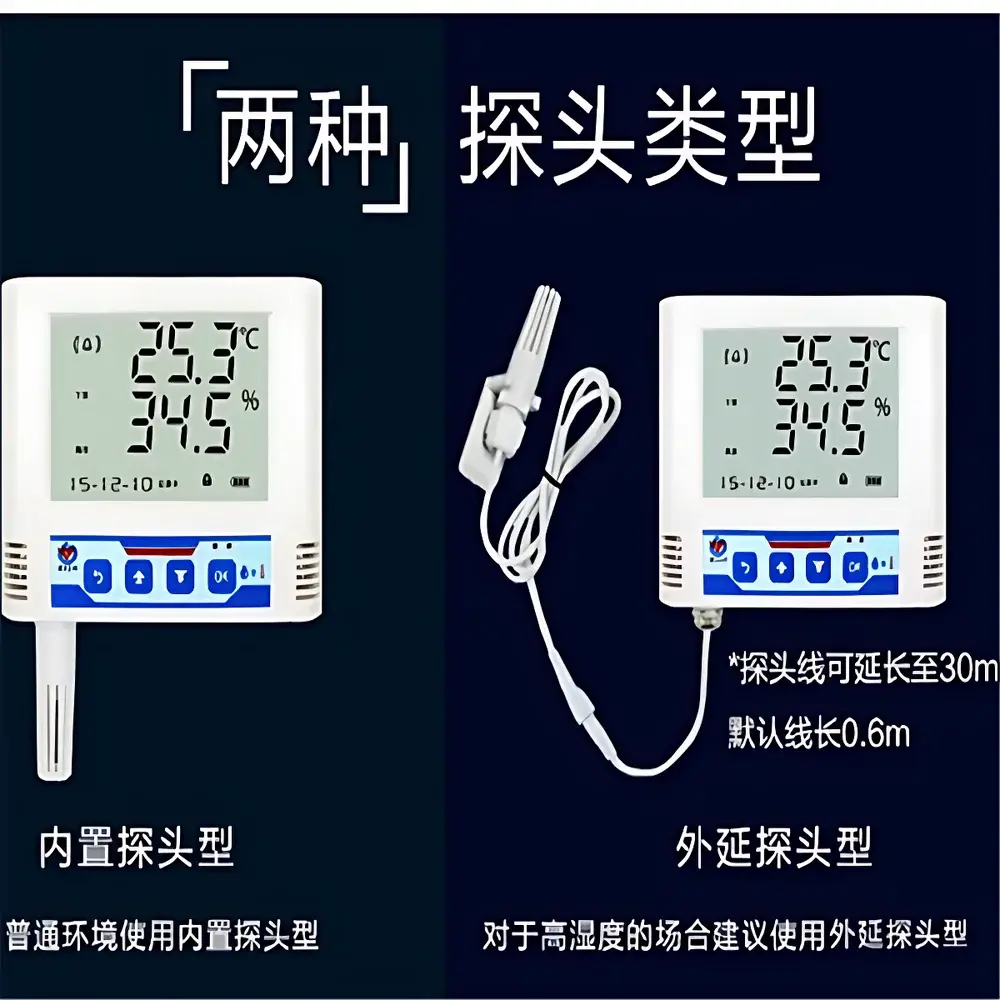
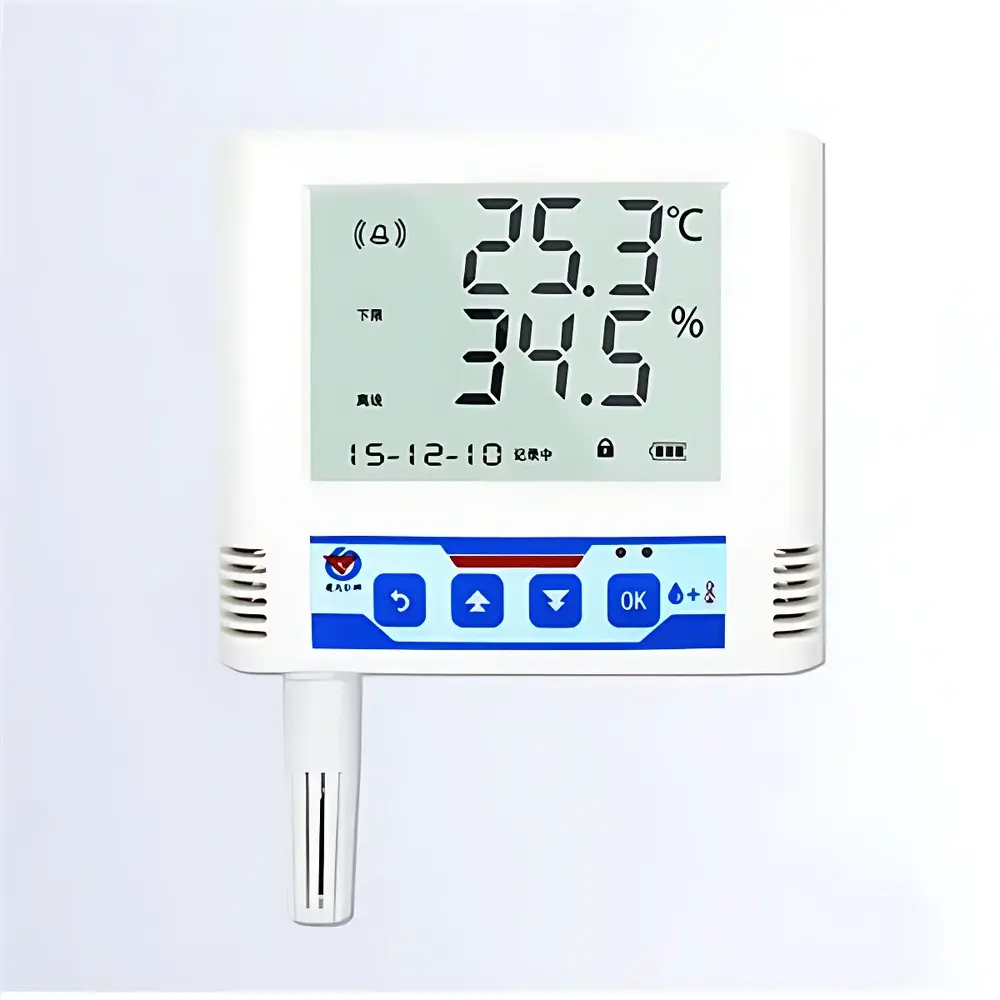
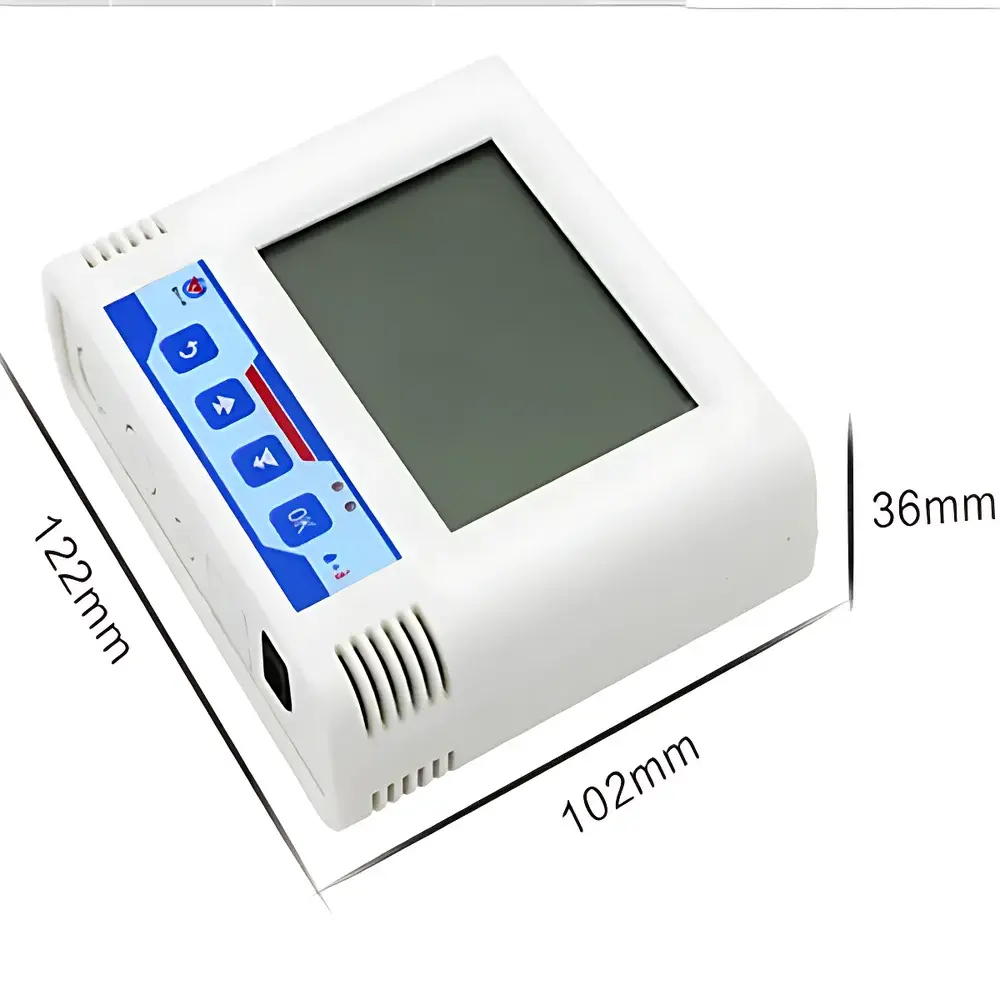
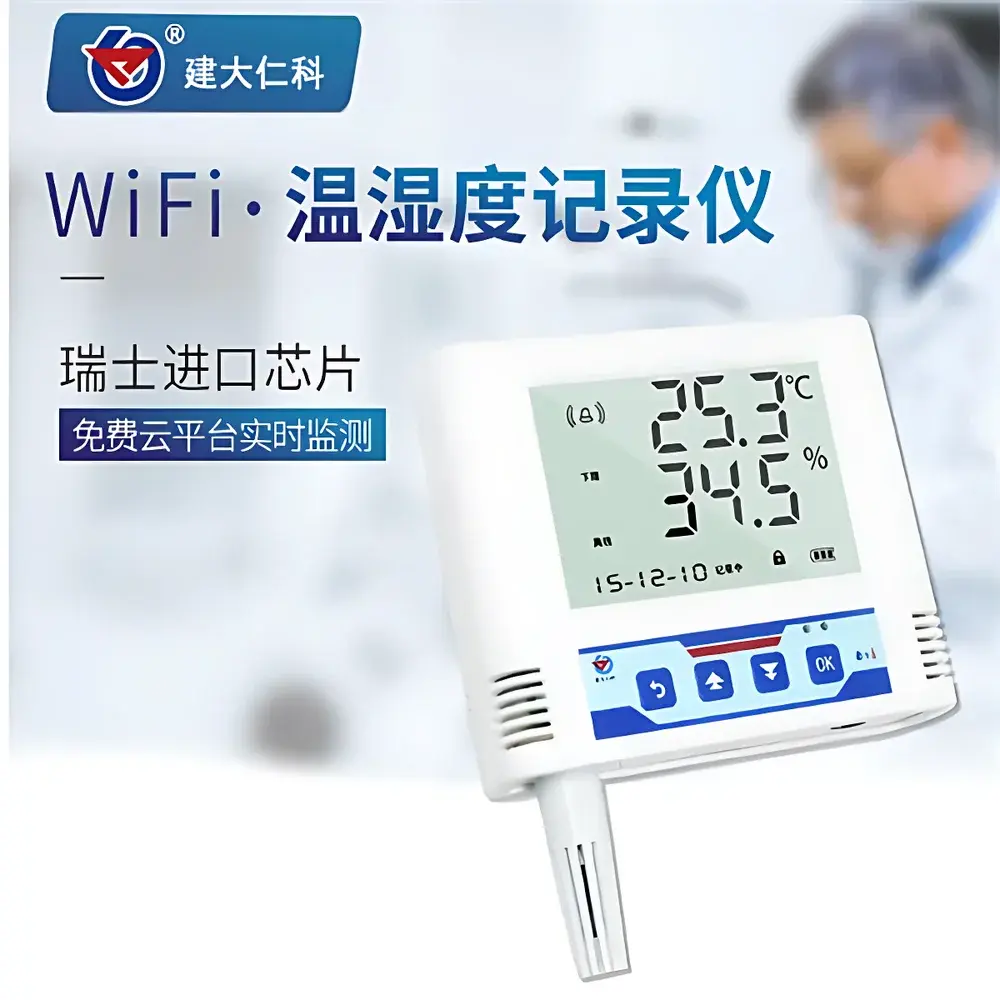
RenKe RS-WS-DY Wireless Temperature and Humidity Data Logger
| Brand | RenKe |
|---|---|
| Origin | Shandong, China |
| Manufacturer Type | OEM/ODM Manufacturer |
| Country of Origin | China |
| Model | RS-WS-DY |
| Communication | FHSS Radio (868 MHz ISM Band) |
| Display | 2.8" LCD with Real-Time Temp/RH/Time/Address/Storage Status |
| Power Supply | 10–30 V DC (AC/DC Adapter Included for 220 V AC Input) |
| Operating Temperature (Electronics) | −20 °C to +60 °C |
| Operating Humidity (Electronics) | 0–80 %RH |
| Sensor Operating Range (Standard Probe) | −40 °C to +80 °C, 0–99 %RH |
| Sensor Operating Range (Optional −B Wide-Temp Probe) | −40 °C to +120 °C |
| Accuracy (Class A) | ±0.4 °C @ 25 °C, ±2 %RH @ 25 °C (5–95 %RH) |
| Accuracy (Class B, Default) | ±0.5 °C @ 25 °C, ±3 %RH @ 25 °C (5–95 %RH) |
| Resolution | 0.1 °C / 0.1 %RH |
| Long-Term Drift | ≤0.1 °C/year, ≤1 %RH/year |
| Response Time (Standard Probe) | ≤25 s (Temp), ≤8 s (RH) at 1 m/s airflow |
| Response Time (−B Probe) | ≤18 s (Temp), ≤6 s (RH) at 1 m/s airflow |
| Data Storage Capacity | 65,535 records |
| Recording Interval | 1–65,535 minutes (configurable, default 30 min) |
| Storage Duration (at 30-min interval) | ~4 years |
| Storage Mode | Auto-cyclic overwrite |
| Alarm Outputs | 2 programmable relay outputs (NO/NC), 1 internal buzzer (85 dB), optional external sound-light alarm interface |
| Calibration | Password-protected on-device offset calibration for temperature and humidity |
| Compliance | FCC Part 15 Subpart C, CE RED Directive 2014/53/EU, RoHS 2011/65/EU |
| Wireless Protocol | Proprietary FHSS (Frequency-Hopping Spread Spectrum), 868 MHz, 100 kbps data rate |
| Line-of-Sight Range | ≥800 m |
| Wall Penetration | 3–4 reinforced concrete walls |
| Max Nodes per RS-JSQ-W Gateway | 200 units |
| Enclosure Rating | IP65 (housing), IP67 (optional −B and −6 waterproof probe variants) |
Overview
The RenKe RS-WS-DY is a self-contained, wireless temperature and humidity data logger engineered for continuous environmental monitoring in regulated and mission-critical infrastructure. It operates on a proprietary Frequency-Hopping Spread Spectrum (FHSS) radio protocol in the 868 MHz ISM band—designed specifically for high-reliability, low-interference operation in industrial and institutional settings where legacy wired networks are impractical or cost-prohibitive. Unlike conventional RS-485 or LoRa-based loggers, the RS-WS-DY integrates real-time local visualization, onboard non-volatile memory (65,535 records), dual relay control logic, and multi-layered alarm activation—all within a single compact enclosure. Its measurement architecture centers on a Swiss-sourced capacitive humidity sensor and precision NTC thermistor, calibrated traceably to NIST-traceable reference standards during final production testing. The device meets baseline metrological requirements for routine environmental validation under ISO 14644-1 (cleanrooms), ISO 13485 (medical device storage), and USP <1079> (good storage and distribution practices), making it suitable for use in GxP-aligned workflows when deployed with documented configuration and periodic verification.
Key Features
- Integrated 2.8-inch monochrome LCD displaying real-time temperature, relative humidity, timestamp, device address, channel ID, and remaining storage capacity—no external software required for basic status verification.
- On-device parameter configuration via tactile keypad: adjustable recording intervals (1–65,535 minutes), alarm thresholds (independent upper/lower limits with hysteresis), date/time, and relay activation logic.
- Dual programmable relays (SPDT, 5 A/250 VAC resistive load) supporting fail-safe or latching output modes; configurable to trigger on temperature-only, humidity-only, or combined deviation events.
- Local audible alarm (≥85 dB internal buzzer) plus dedicated terminal block for external sound-light alarm integration—enabling immediate visual/auditory notification without network dependency.
- Internal flash memory with auto-cyclic overwrite ensures uninterrupted logging even during extended gateway outages; data retention verified across thermal cycling (−20 °C to +60 °C) and humidity stress (0–80 %RH).
- Power-flexible architecture: accepts 10–30 V DC input, with included 220 V AC-to-DC adapter—eliminating battery replacement cycles and associated drift risks common in long-term deployments.
- Proprietary FHSS modulation provides robust co-location tolerance in dense RF environments (e.g., server rooms, pharmaceutical warehouses), minimizing packet loss under concurrent Wi-Fi, Bluetooth, or Zigbee traffic.
Sample Compatibility & Compliance
The RS-WS-DY supports multiple probe configurations to match application-specific thermal and chemical exposure requirements. Standard models feature a stainless-steel housing with an integrated sensing element rated for −40 °C to +80 °C and 0–99 %RH. Optional probe variants include the −B wide-temperature variant (−40 °C to +120 °C) for autoclave pre-chamber monitoring or oven validation, and the −6 IP67-rated waterproof probe for cold-chain transport or humidification duct applications. All probes comply with IEC 60529 ingress protection specifications where applicable. From a regulatory standpoint, the device conforms to FCC Part 15 Subpart C (unlicensed intentional radiator), CE RED Directive 2014/53/EU, and RoHS 2011/65/EU. While not intrinsically safe, its low-power design (0.4 W typical) and non-sparking relay contacts permit deployment in Class I, Division 2 hazardous locations when installed per NEC Article 500 guidelines. For GMP/GLP environments, the device supports audit-ready configuration logs and time-stamped alarm event records—though full 21 CFR Part 11 compliance requires integration with a validated third-party platform such as RenKe’s RS-RJ-K central management system.
Software & Data Management
Data retrieval occurs via RS-485 serial interface using RenKe’s RS-RJ-K centralized monitoring platform—a Windows-based application supporting multi-node topology mapping, alarm escalation rules (email/SMS), PDF report generation (per ISO/IEC 17025 template), and raw CSV export. The RS-JSQ-W wireless gateway (sold separately) acts as a transparent bridge: it receives FHSS packets from up to 200 RS-WS-DY nodes, buffers them locally, and forwards batches over Modbus RTU or TCP/IP to the host PC or SCADA system. No cloud dependency is required; all firmware updates, calibration adjustments, and configuration changes occur offline via direct USB or RS-485 connection. The embedded clock maintains ±2 seconds/month accuracy across operating temperature ranges and retains time during brief power interruptions thanks to supercapacitor backup. Audit trails—including user login history, parameter change timestamps, and relay state transitions—are stored internally and exportable for quality review or regulatory submission.
Applications
- Pharmaceutical cold chain validation: continuous monitoring of refrigerated trucks, walk-in stability chambers, and vaccine storage units per WHO Technical Report Series No. 961.
- Medical device warehousing: ambient condition tracking in ISO 13485-certified distribution centers, including humidity-sensitive packaging areas.
- Server room environmental assurance: early detection of HVAC failure via correlated temperature/humidity excursions near rack intakes.
- Food processing hygiene zones: validation of drying ovens, fermentation rooms, and chilled holding areas per FDA Food Safety Modernization Act (FSMA) preventive controls.
- Research laboratory incubator verification: long-term drift assessment of CO₂-independent humidity control systems.
- Archival storage facilities: passive monitoring of rare document or film vaults where wiring compromises structural integrity.
FAQ
Does the RS-WS-DY support TLS-encrypted data transmission to cloud platforms?
No. The device transmits only via unencrypted FHSS radio to the RS-JSQ-W gateway. Secure remote access requires implementation at the gateway-to-server layer using standard IT security protocols (e.g., VPN, HTTPS API).
Can calibration offsets be applied independently for temperature and humidity?
Yes. Password-protected on-device calibration allows separate adjustment of temperature and humidity zero/span offsets, with values retained across power cycles.
Is the internal clock synchronized automatically via NTP or GPS?
No. Time is set manually via keypad or RS-485 command. Synchronization must be performed externally during initial commissioning or maintenance intervals.
What is the maximum allowable cable length between the RS-WS-DY and an external sound-light alarm?
The auxiliary alarm interface supports up to 100 m of 0.75 mm² shielded twisted pair (STP) cable under standard EMC conditions, per IEC 61000-6-2 immunity requirements.
How is firmware updated, and is version rollback supported?
Firmware updates are performed via RS-485 using RenKe’s proprietary PC utility. Version history is retained in device memory, and rollback to any previously installed version is fully supported.