
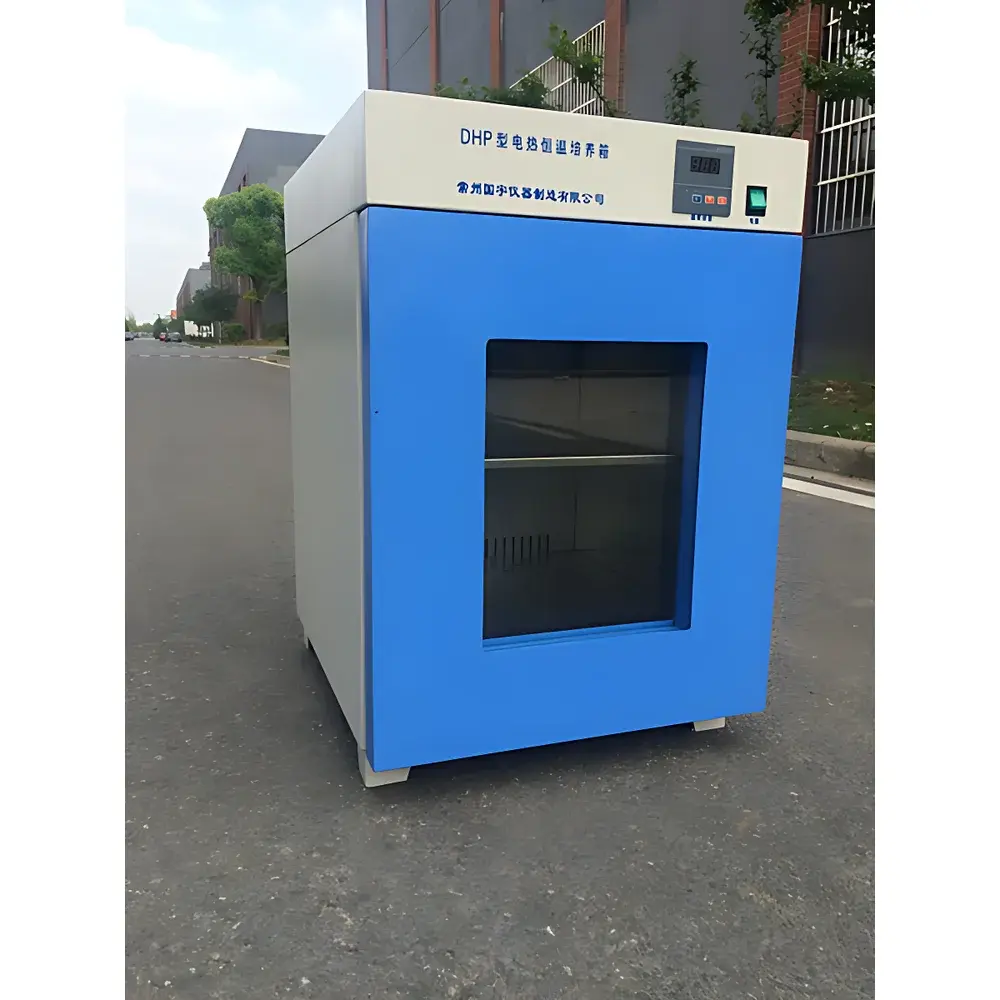
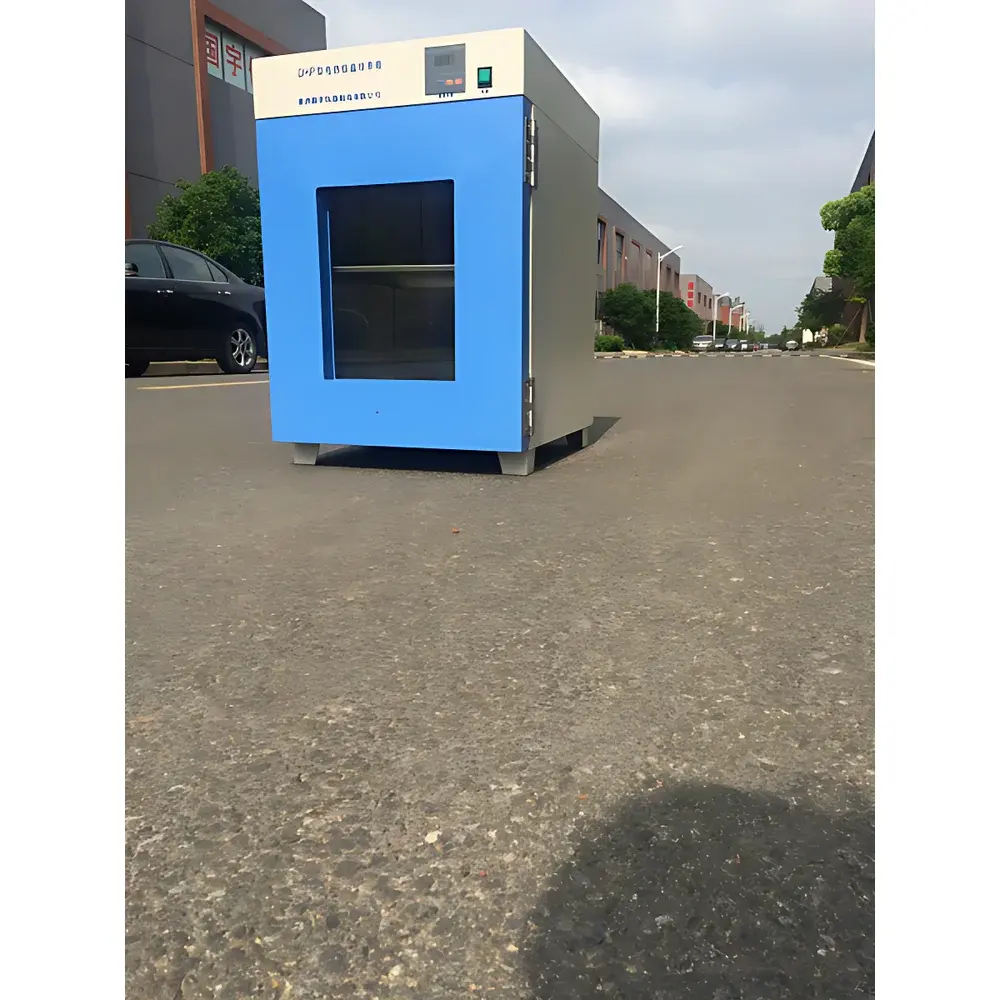
CZGY DHP-300 Digital Precision Dry Incubator
| Brand | CZGY |
|---|---|
| Origin | Jiangsu, China |
| Manufacturer Type | Direct Manufacturer |
| Model | DHP-300 |
| Price | USD 295 (FOB) |
| Temperature Range | Ambient +5°C to 65°C |
| Temperature Uniformity | ±1°C |
| Internal Chamber Dimensions | 300 × 300 × 360 mm (L×W×H) |
| Power Supply | 220 V / 50 Hz |
| Rated Power | 150 W |
| Shelf Load Capacity | 10 kg |
| Temperature Stability | ≤ ±0.5°C |
| Construction | Cold-rolled steel exterior with electrostatic powder coating |
| Insulation | High-density ultra-fine glass wool |
| Air Circulation | Optimized forced-air convection duct system |
Overview
The CZGY DHP-300 Digital Precision Dry Incubator is an entry-level yet rigorously engineered benchtop incubation system designed for routine microbiological culture maintenance, enzyme activity assays, cell line passaging, and general laboratory sample conditioning where precise, stable, and uniform dry-heat environments are required. Unlike CO₂ or humidity-controlled incubators, the DHP-300 operates as a convection-heated dry incubator—relying on calibrated resistive heating elements combined with a thermally optimized air circulation architecture to deliver consistent thermal performance across its 30-liter internal volume. Its microprocessor-based temperature controller features PID algorithm implementation with adjustable P, I, and D parameters, enabling users to fine-tune response dynamics for varying thermal loads and ambient conditions. The device complies with fundamental electrical safety standards for laboratory equipment (IEC 61010-1), and its mechanical design meets GLP-aligned operational expectations for traceability, repeatability, and ease of cleaning in regulated academic and industrial QC laboratories.
Key Features
- Stainless steel working chamber with seamless rounded corners—ensures full cleanability and resistance to corrosion from repeated ethanol or disinfectant exposure
- High-efficiency thermal insulation using ultra-fine glass wool (density ≥48 kg/m³), minimizing external heat dissipation and improving energy efficiency
- Forced-air convection system with rear-mounted fan and directional airflow channels—guarantees ≤±1°C temperature uniformity across all spatial zones within the chamber
- Dual-display digital controller with independent setpoint and real-time measurement readouts—supports rapid parameter navigation via SET/△/▽ keys
- User-configurable PID tuning parameters (P-band: 1–200°C, integral time: 0–999 s, derivative time: 0–999 s)—enables optimization for high-mass or low-thermal-inertia loads
- Comprehensive protection suite: over-temperature alarm (AL), output hysteresis (HY), sensor offset calibration (SC: ±50°C range), and parameter lock (LCK levels 0–2)
- Robust cold-rolled steel chassis with electrostatic epoxy-polyester powder coating—provides mechanical durability and long-term resistance to abrasion and environmental oxidation
Sample Compatibility & Compliance
The DHP-300 accommodates standard-sized Petri dishes (up to 150 mm), multi-well plates (6–96-well), test tubes (13–18 mm OD), flasks (Erlenmeyer up to 500 mL), and custom aluminum or stainless steel sample racks. It is not rated for volatile organic solvents, flammable gases, or biohazardous aerosols—consistent with Class II biosafety cabinet integration protocols. While the unit does not carry CE marking for EU medical device directives (MDR 2017/745) or FDA 510(k) clearance, its construction, labeling, and operational documentation align with ISO/IEC 17025:2017 clause 5.5.2 (equipment verification) requirements when deployed in accredited testing laboratories. Temperature validation reports may be generated per ASTM E2874–22 (Standard Practice for Calibration and Verification of Dry Heat Sterilizers and Incubators) using NIST-traceable Class A PT100 probes.
Software & Data Management
The DHP-300 operates as a standalone analog-digital hybrid instrument with no embedded data logging or USB/Ethernet connectivity. However, its analog voltage output (0–5 V DC proportional to chamber temperature) is compatible with third-party DAQ systems (e.g., National Instruments USB-6009, Keysight 34972A) for continuous monitoring and CSV export. Users performing IQ/OQ/PQ qualification under GxP environments can implement manual audit trails via paper-based logbooks or electronic lab notebooks (ELNs) such as LabArchives or Benchling—recording setpoints, observed deviations, calibration dates, and maintenance interventions. The controller supports 21 CFR Part 11–compliant workflows when paired with validated ELN platforms that enforce electronic signatures, audit logs, and role-based access control.
Applications
- Maintenance of bacterial cultures (e.g., E. coli, Bacillus subtilis) at optimal growth temperatures (30–37°C)
- Enzyme kinetics studies requiring stable thermal environments during substrate incubation
- Post-hybridization washing steps in Southern/Northern blotting protocols
- Pre-incubation of antibody-coated ELISA plates prior to assay execution
- Accelerated stability testing of pharmaceutical excipients under ICH Q1A(R2) guidelines (e.g., 40°C/75% RH simulated via external humidifier—not built-in)
- Quality control of raw materials in food and cosmetic manufacturing per AOAC and ISO 6887-1:2017 microbiological methods
- Teaching labs for undergraduate life science curricula requiring cost-effective, reliable thermal platforms
FAQ
Is the DHP-300 suitable for cell culture applications requiring CO₂ or humidity control?
No. This is a dry convection incubator without CO₂ regulation, humidification, or condensation management. It is intended for non-adherent microbial or biochemical applications only.
Can the temperature sensor be recalibrated in-house?
Yes—the SC parameter allows user-adjustable offset correction (±50°C range) using a NIST-traceable reference thermometer, though factory calibration remains the baseline for compliance reporting.
What is the maximum shelf loading capacity per level?
Each stainless steel shelf supports up to 10 kg distributed load; stacking multiple shelves requires verification of total weight against structural integrity limits.
Does the unit include validation documentation?
Factory-supplied documentation includes electrical safety test report, dimensional drawing, and controller firmware revision log. Full IQ/OQ documentation must be developed by the end-user per their internal SOPs.
Is it possible to integrate this incubator into a centralized building management system (BMS)?
Only via optional analog signal interface (0–5 V output); no native Modbus, BACnet, or Ethernet support is provided.



