
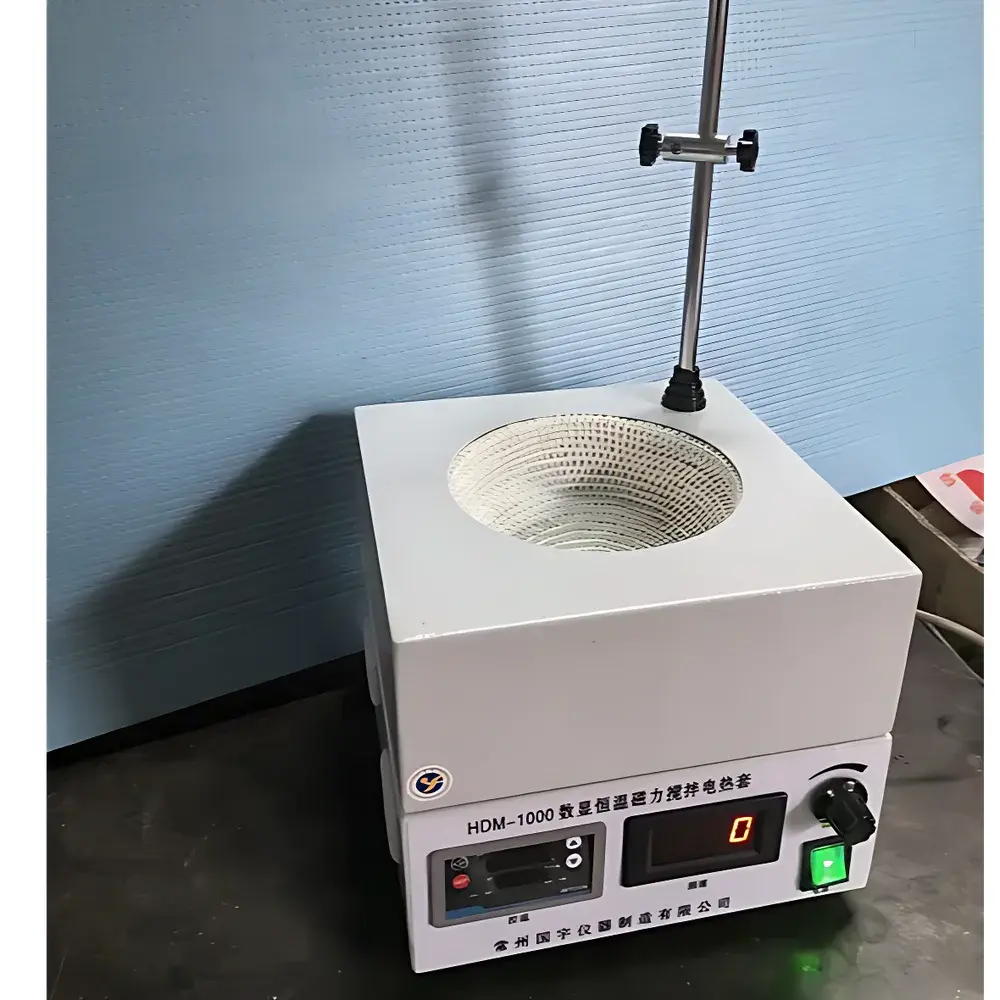
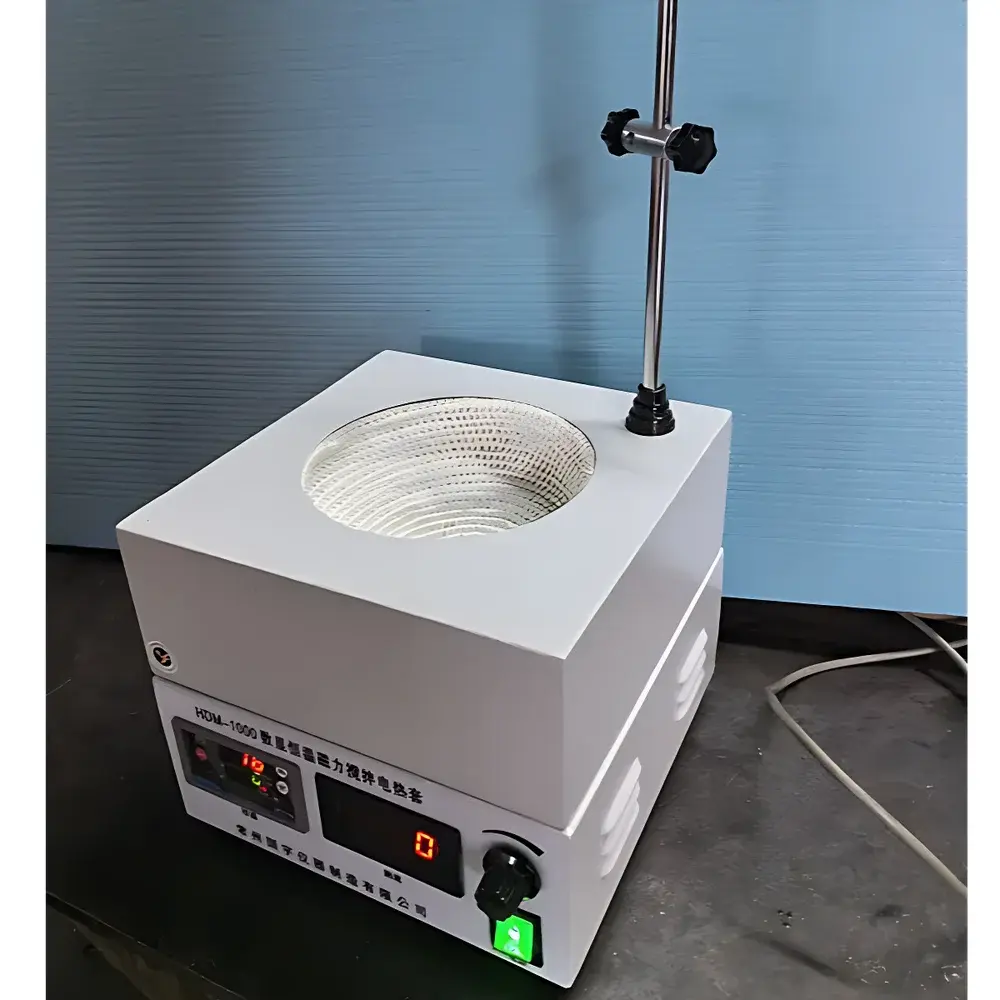
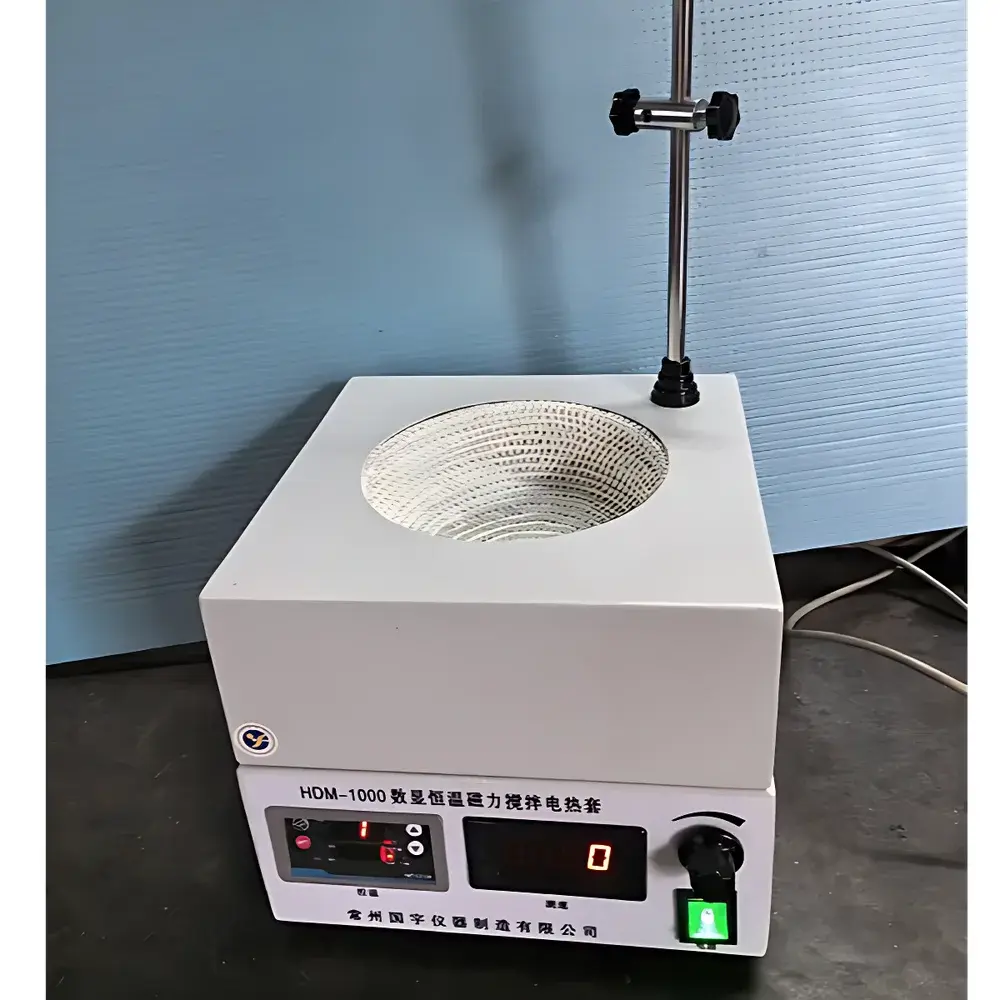
CZGY HDM-1000S Dual-Digital Display Constant-Temperature Magnetic Stirring Electric Heating Mantle
| Brand | CZGY |
|---|---|
| Origin | Jiangsu, China |
| Manufacturer Type | Direct Manufacturer |
| Region of Origin | Domestic (China) |
| Model | HDM-1000S |
| Rated Voltage | 220 V ±10% |
| Rated Frequency | 50 Hz ±2 Hz |
| Temperature Range | Ambient +30 °C to 300 °C (digital display) |
| Temperature Control Accuracy | ±1 °C |
| Capacity | 1000 mL |
| Heating Power | 450 W |
| Speed Range | 0–2000 rpm (digital speed display) |
Overview
The CZGY HDM-1000S Dual-Digital Display Constant-Temperature Magnetic Stirring Electric Heating Mantle is an integrated laboratory heating and mixing system engineered for precise thermal control and homogeneous agitation of liquid samples in glass vessels. It operates on resistive heating principles: a nickel-chromium resistance wire is hermetically embedded within high-purity, alkali-free glass fiber insulation, then woven into a hemispherical mantle geometry optimized for uniform radial heat transfer. This design eliminates open flames, minimizes thermal gradients across vessel walls, and reduces mechanical stress on fragile glassware—critical for reflux, synthesis, extraction, and dissolution protocols requiring both stable temperature maintenance and continuous mixing. The unit incorporates dual independent digital displays—one for real-time bath temperature and one for magnetic stirrer rotational speed—enabling simultaneous monitoring without manual interpolation or external instrumentation.
Key Features
- Integrated dual-display interface: separate LED readouts for temperature (°C) and stirring speed (rpm), eliminating reliance on analog dials or secondary meters
- Hemispherical heating mantle architecture with alkali-free glass fiber insulation ensures rapid thermal response (typical time-to-setpoint <8 min at 200 °C), low thermal inertia, and long-term dielectric stability
- Sealed Ni-Cr heating element prevents oxidation and moisture ingress, supporting reliable operation up to 300 °C under continuous load
- Magnetic stirring subsystem features adjustable speed control from 0 to 2000 rpm with consistent torque delivery across the full range, compatible with standard PTFE-coated stir bars (up to 60 mm length)
- 450 W rated power output provides sufficient energy density for efficient heating of 1000 mL aqueous or low-viscosity organic solutions in standard round-bottom flasks (e.g., 1000 mL RB flask, OD ≈ 120 mm)
- Grounded chassis and insulated housing comply with IEC 61010-1 safety requirements for laboratory electrical equipment; mandatory grounding terminal provided
Sample Compatibility & Compliance
The HDM-1000S is designed for use with borosilicate glass reaction vessels ranging from 500 mL to 1000 mL capacity, including round-bottom flasks, flat-bottom beakers, and jacketed reactors. Its curvature-matched mantle profile ensures maximal surface contact and minimizes localized overheating. The unit meets general-purpose laboratory safety standards per GB/T 29491–2013 (Chinese national standard for electric heating mantles) and conforms to electromagnetic compatibility (EMC) Class B limits for industrial scientific equipment. While not certified to UL/CSA or CE for export markets, its construction adheres to fundamental principles aligned with ISO/IEC 17025 environmental conditioning requirements when operated within validated thermal and mechanical parameters. Users performing GLP- or GMP-aligned work should implement instrument-specific operational qualification (OQ) protocols, including temperature uniformity mapping and speed calibration traceable to NIST-traceable references.
Software & Data Management
The HDM-1000S is a standalone analog-digital hybrid instrument with no embedded microprocessor, network interface, or data logging capability. All control and display functions are implemented via discrete electronic circuits—ensuring robustness, immunity to firmware corruption, and minimal maintenance overhead. Temperature setpoint and stirring speed are adjusted manually using calibrated potentiometers; displayed values reflect direct sensor outputs (NTC thermistor for temperature, Hall-effect tachometer for speed). For laboratories requiring audit trails or electronic records, integration with external data acquisition systems (e.g., LabVIEW, MATLAB, or PLC-based SCADA) is achievable via optional analog voltage outputs (0–5 V DC proportional to temperature/speed), subject to third-party signal conditioning. No software validation is required under FDA 21 CFR Part 11, as the device lacks electronic record generation or user-accessible configuration memory.
Applications
This heating mantle supports a broad spectrum of routine and research-grade applications across academic, pharmaceutical, petrochemical, and environmental laboratories. Typical use cases include: controlled-temperature solvent evaporation in analytical sample preparation; catalytic hydrogenation and Grignard reaction setups requiring inert-atmosphere compatibility; viscosity measurement pre-conditioning of polymer solutions; accelerated stability testing of formulations per ICH Q1A(R3); digestion of environmental water or soil extracts prior to ICP-MS analysis; and buffer equilibration for chromatography mobile phase preparation. Its absence of exposed heating elements makes it particularly suitable for use inside fume hoods and with volatile or flammable solvents when paired with explosion-proof stir bars and proper ventilation.
FAQ
What is the recommended break-in procedure before first use?
During initial operation, slow ramping (≤50 °C/min) is required to volatilize residual processing oils from the glass fiber insulation. Observe white smoke generation; power down upon onset, allow complete cooling and ventilation, then repeat until no visible emissions occur. This process typically requires 3–5 cycles.
Is the unit suitable for use with corrosive reagents such as concentrated acids or halogenated solvents?
The mantle’s external silicone rubber coating offers limited resistance to incidental splashes but is not chemically rated. Direct exposure to strong oxidizers (e.g., HNO₃, Cl₂) or halogenated organics (e.g., CHCl₃, CCl₄) may degrade insulation integrity over time. Use secondary containment and verify compatibility with manufacturer-supplied material safety data.
Can the HDM-1000S maintain temperature stability during extended overnight runs?
Yes—provided ambient conditions remain stable (±5 °C), airflow is unobstructed, and the vessel is appropriately sized. However, unattended operation is discouraged per standard laboratory safety policy; users must implement external timer cutoffs or supervisory monitoring per institutional risk assessment.
Does the magnetic stirrer support variable torque compensation at high viscosity?
No—the drive circuit delivers fixed current to the internal coil. Stirring efficiency decreases above ~1000 mPa·s; for viscous media, reduce speed incrementally and verify vortex formation visually. Optional high-torque stir bars (e.g., cross-shaped or anchor-type) may improve performance.
How often should calibration verification be performed?
Annual verification against traceable references is recommended. Temperature accuracy should be confirmed using a calibrated immersion thermometer (±0.5 °C tolerance) placed at the geometric center of a water-filled 1000 mL flask; speed verification requires a non-contact optical tachometer referenced to NIST SRM 2040.



