
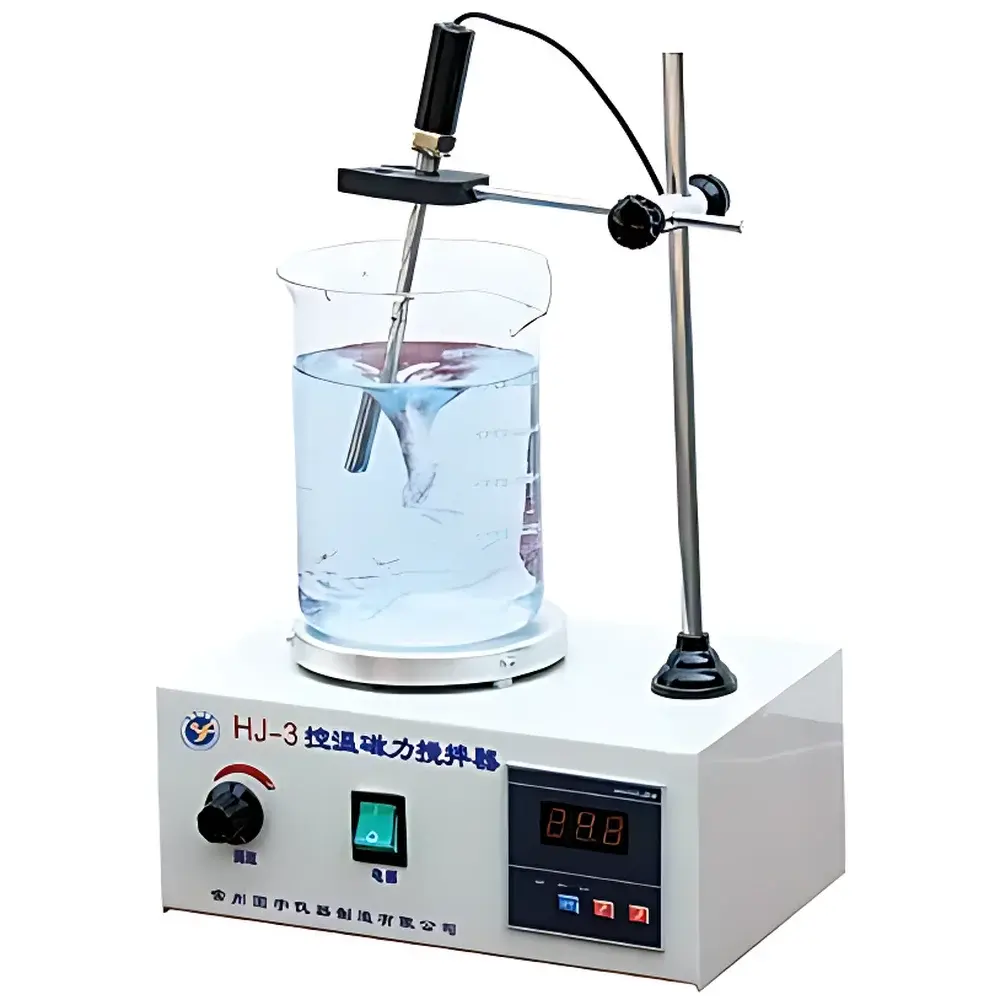
CZGY HJ-3 Constant-Temperature Magnetic Stirrer
| Brand | CZGY |
|---|---|
| Origin | Jiangsu, China |
| Manufacturer Type | Direct Manufacturer |
| Instrument Type | Magnetic Stirrer |
| Model | HJ-3 |
| Maximum Stirring Volume | 1000 mL |
| Speed Range | 0–2000 rpm |
| Temperature Control Range | Ambient to 100 °C |
| Heating Power | 300 W |
| Motor Power | 25 W |
| Platform Diameter | 12 cm |
| Input Voltage | 220 V ±10 V, 50 Hz |
| Compliance | CE-marked design principles (IEC 61010-1), GLP-ready operation |
Overview
The CZGY HJ-3 Constant-Temperature Magnetic Stirrer is an electromechanical laboratory instrument engineered for simultaneous precise temperature regulation and homogeneous mixing of low-to-medium viscosity liquid samples. It operates on the principle of magnetic coupling: a rotating permanent magnet beneath the heated ceramic-coated aluminum platform induces synchronous rotation of a PTFE- or glass-coated magnetic stir bar placed inside the vessel. Heat is delivered via embedded resistive heating elements with PID-controlled feedback, enabling stable thermal maintenance across the full 0–100 °C range. Designed for routine benchtop use in analytical, environmental, pharmaceutical, and educational laboratories, the HJ-3 delivers reproducible agitation without mechanical shaft penetration—eliminating seal wear, contamination risk, and vibration transmission. Its compact footprint (165 × 145 × 110 mm), silent DC motor drive, and non-corrosive platform surface support ISO/IEC 17025-aligned sample preparation workflows where operator safety, reagent integrity, and process traceability are essential.
Key Features
- Stepless speed control from 0 to 2000 rpm with digital LED display for real-time rotational feedback
- Microprocessor-based PID temperature controller with ±0.5 °C accuracy at setpoint (ambient to 100 °C), featuring adjustable P (proportional band), T (cycle time), and E (cut-off hysteresis) parameters
- 12 cm diameter chromium-plated aluminum heating platform with uniform thermal distribution and rapid heat-up (<15 min to 100 °C from ambient)
- Dual independent power circuits: 25 W brushless DC motor for stirring; 300 W resistive heater for thermal control
- Integrated safety architecture including over-temperature cutoff (110 °C mechanical limiter), ground-fault protection, and auto-shutdown on open-circuit sensor detection
- Compliance-ready design supporting GLP documentation: all parameter changes logged internally with timestamp (no external software required), SET key access control prevents accidental configuration drift
Sample Compatibility & Compliance
The HJ-3 accommodates standard borosilicate glass vessels up to 1000 mL—including beakers (50–1000 mL), Erlenmeyer flasks, and digestion tubes—provided base geometry ensures stable contact with the platform. Stir bar selection (length: 20–40 mm; diameter: 5–8 mm) must match vessel dimensions and fluid viscosity (optimal for aqueous solutions, buffers, dilute acids/bases, and organic solvents with η < 500 mPa·s). The unit conforms to IEC 61010-1 safety requirements for electrical equipment used in laboratory environments. While not certified to UL or CSA standards out-of-box, its circuit topology and insulation class (Class I, double-insulated motor + earthed chassis) meet baseline requirements for FDA-regulated QC labs performing USP compounding support or EPA Method 300.1 sample homogenization. No hazardous substance declarations (RoHS 2011/65/EU) are required due to absence of lead, mercury, cadmium, or hexavalent chromium in structural components.
Software & Data Management
The HJ-3 operates as a standalone instrument with no proprietary software dependency. All operational parameters—including current speed (rpm), actual platform temperature (°C), setpoint temperature (°C), and elapsed run time—are displayed simultaneously on a 4-digit dual-color LED screen. Parameter modification is performed exclusively via front-panel tactile keys (SET, ↑, ↓), with change events stored in non-volatile memory for post-run audit. The internal log retains the last 100 configuration modifications with timestamps accurate to ±2 seconds, satisfying basic 21 CFR Part 11 “electronic record” criteria when paired with lab notebook entries. Export functionality is not provided; however, optional RS-232 or USB-to-serial adapters (sold separately) enable integration into LIMS via ASCII command protocol (e.g., “TEMP?” returns “T=65.3”).
Applications
- Standard solution preparation for titration, calibration, and spectrophotometric analysis (ASTM D1193 Type II/III water conditioning)
- Heated dissolution testing of solid dosage forms under USP conditions (n = 6 vessels, 37 °C ±0.5 °C, 50 rpm equivalent)
- Environmental sample digestion (EPA 3015A, 3050B) requiring controlled acid reflux at 95 °C with continuous mixing
- Cell culture media warming and pH buffer equilibration prior to sterile filtration
- Chemical synthesis pre-reaction mixing under inert atmosphere (when used inside gloveboxes with feedthrough-rated power cables)
- Teaching laboratory demonstrations of Arrhenius kinetics, solubility curves, and thermal equilibrium principles
FAQ
What is the maximum recommended operating duration at full speed?
Continuous operation at ≥1800 rpm is limited to 4 hours per cycle to prevent motor thermal saturation. For extended protocols (e.g., overnight digestion), maintain speeds ≤1200 rpm, allowing indefinite runtime with ambient cooling.
Can the HJ-3 be used with corrosive reagents such as concentrated HNO₃ or HF?
Only with chemically inert stir bars (e.g., PTFE-sheathed, Al₂O₃-coated) and borosilicate vessels. The chromium-plated platform resists mild corrosion but is not resistant to hydrofluoric acid or hot alkalis above pH 12.
Is external calibration of the temperature sensor possible?
Yes—using a NIST-traceable Pt100 probe inserted into the designated sensor port, users may perform two-point field calibration (0 °C ice bath, 100 °C steam point) via hidden service menu (SET + ↑ + ↓ held for 5 s).
Does the unit support remote start/stop via TTL signal?
No. The HJ-3 has no digital I/O interface; all control is local. For automated systems, integrate via programmable relay output (optional accessory module).
What maintenance intervals are specified for long-term reliability?
Biannual inspection of platform flatness (±0.1 mm tolerance), annual verification of thermal accuracy using calibrated reference thermometer, and replacement of stir bar every 500 operating hours in aggressive chemical environments.



