
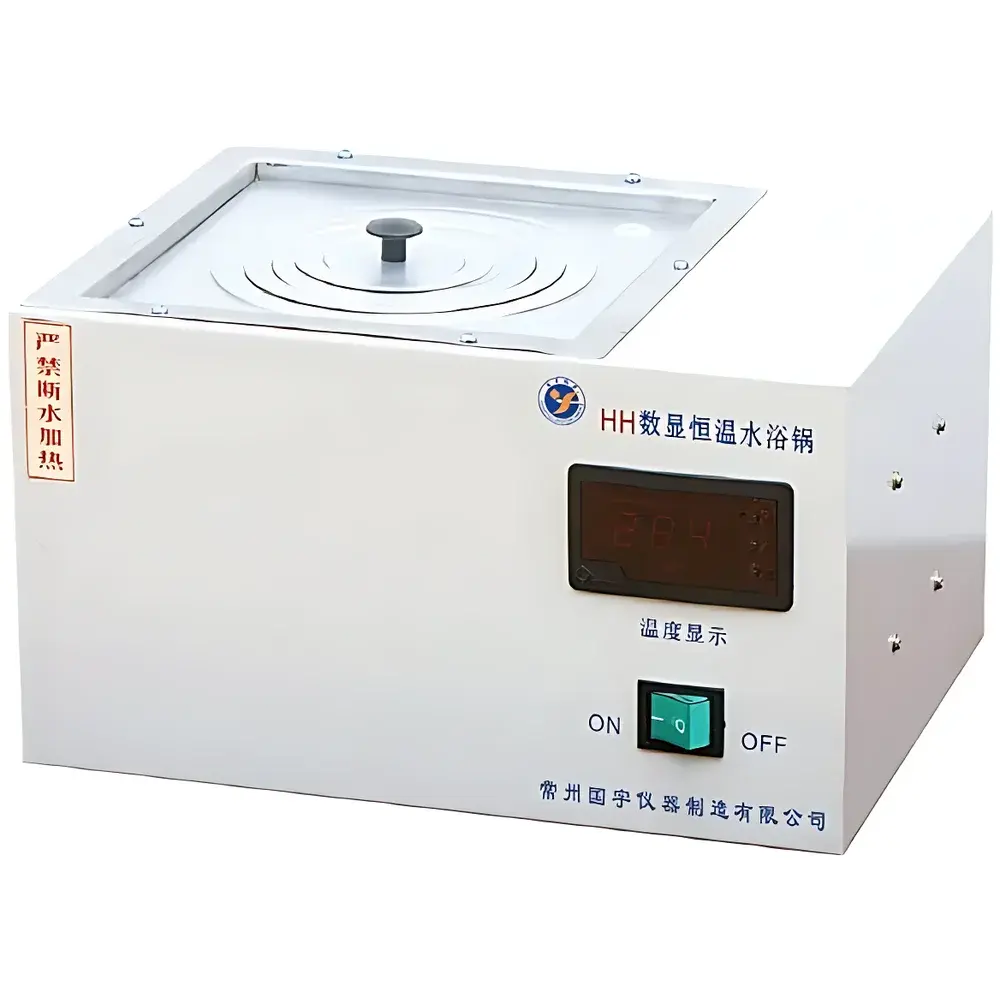
CZGY HH-S4 Digital Display Constant Temperature Water Bath
| Brand | CZGY |
|---|---|
| Model | HH-S4 |
| Type | Water Bath |
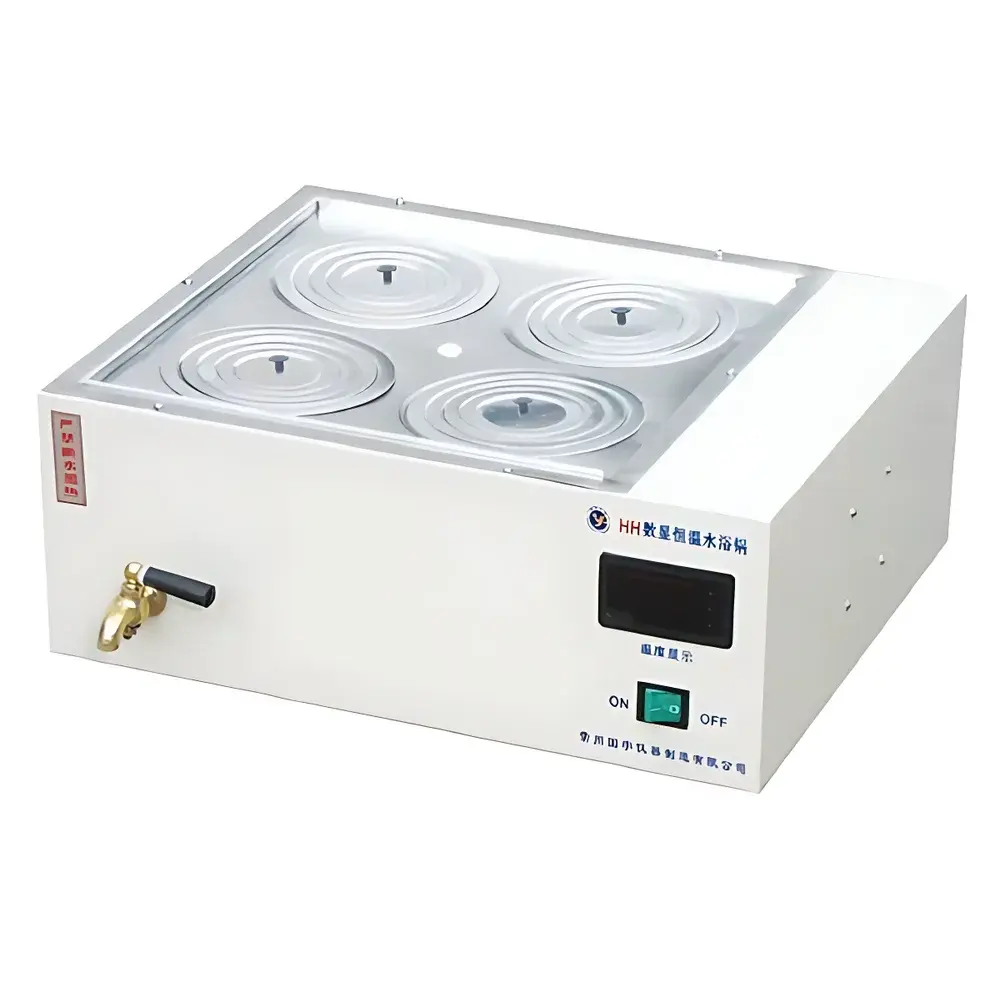
| Configuration | 4-Well, Dual-Row |
| Tank Dimensions | 305 × 305 × 120 mm |
| Capacity | Approx. 11.2 L |
| Heating Power | 1000 W |
| Temperature Range | Ambient to 100 °C |
| Temperature Control Accuracy | ±0.5 °C |
| Display | LED Digital |
| Control Method | PID with Adjustable P/E/T Parameters |
| Construction | Inner Chamber – 304 Stainless Steel Welded Tank |
| Lid Design | Removable Perforated Lid (12 cm Diameter Holes, Four Holes per Row) |
| Circulation | Non-Circulating (Static Bath) |
| Power Supply | 220 V AC, 50 Hz, Grounded Three-Pin Plug |
| Safety Features | Grounding Terminal, Over-Temperature Protection (Implied), Dry-Run Prevention Advisory |
Overview
The CZGY HH-S4 Digital Display Constant Temperature Water Bath is an entry-level, precision-engineered static water bath designed for routine thermal stabilization of samples in academic, industrial, and quality control laboratories. It operates on the principle of resistive heating combined with digital PID temperature regulation, delivering stable thermal environments across its full operating range (ambient to 100 °C). Unlike circulating baths, the HH-S4 relies on natural convection within the stainless steel tank—making it suitable for applications where gentle, uniform heating—not forced flow—is required. Its dual-row, four-well configuration provides efficient parallel sample processing without cross-contamination risk, while the rigid 304 stainless steel inner tank ensures long-term corrosion resistance against aqueous and mildly alkaline solutions. The unit complies with fundamental electrical safety requirements for Class I laboratory equipment under IEC 61010-1, and its grounded three-pin interface supports safe operation in GLP-compliant lab environments.
Key Features
- Dual-row, four-well design (305 × 305 × 120 mm tank) optimized for simultaneous handling of multiple flasks, test tubes, or beakers
- LED digital display with intuitive SET/↑/↓ key interface for real-time temperature monitoring and setpoint adjustment
- PID-based temperature controller with user-accessible tuning parameters (P-band, E-offset, T-cycle) enabling fine-grained thermal response optimization
- 304 stainless steel welded inner tank—electropolished finish optional—resistant to oxidation, pitting, and chemical etching from common buffer solutions
- Epoxy powder-coated cold-rolled steel exterior offering mechanical durability and protection against ambient moisture and incidental spills
- Removable perforated lid with standardized 12 cm diameter apertures; each hole surrounded by four concentric sealing ridges to minimize evaporation and improve thermal retention
- No built-in pump or circulation system—intentionally configured for static bath applications requiring minimal mechanical disturbance
Sample Compatibility & Compliance
The HH-S4 accommodates standard laboratory glassware including 50–500 mL Erlenmeyer flasks, volumetric cylinders, and immersion-type sensors. Its non-circulating architecture avoids shear stress on delicate biological suspensions (e.g., enzyme assays, cell viability studies) and eliminates risk of aerosol generation during volatile solvent handling. While not certified to ISO/IEC 17025 or ASTM E2251 for metrological traceability, the ±0.5 °C control accuracy meets typical requirements for preparatory steps in pharmacopeial methods (e.g., USP environmental conditioning support, EP 2.2.45 extraction protocols). Units are supplied with grounding terminals compliant with national electrical codes (NEC Article 517.160) and include clear operational warnings regarding minimum fill level (to prevent dry-heating damage) and maximum fill line (to avoid overflow during boiling).
Software & Data Management
The HH-S4 operates as a standalone analog-digital hybrid instrument with no embedded firmware logging, USB connectivity, or remote interface capability. All temperature data remain local to the LED display; no audit trail, timestamping, or electronic record storage is provided. As such, it aligns with basic GMP Annex 11 and FDA 21 CFR Part 11 “excluded systems” criteria—i.e., instruments whose outputs do not form part of formal batch records or analytical reports. Users requiring documentation must employ external calibrated thermometers (e.g., NIST-traceable Pt100 probes) and manual log sheets adhering to ALCOA+ principles (Attributable, Legible, Contemporaneous, Original, Accurate, Complete, Consistent, Enduring, Available). Factory default PID parameters (P = 10, E = 0.5, T = 30 s) are preconfigured for rapid thermal equilibration with minimal overshoot under standard load conditions.
Applications
- Enzyme activity assays requiring precise incubation at 37 °C, 45 °C, or 60 °C
- Standardization of viscosity reference oils prior to rotational rheometry
- Pre-heating reagents for titration, colorimetry, and spectrophotometric analysis
- Dissolution testing support (USP Apparatus I/II water jacket temperature maintenance)
- Controlled thawing of frozen serum aliquots or microbial cultures
- Accelerated stability studies (ICH Q1A) for pharmaceutical intermediates at elevated temperatures
- Calibration bath for liquid-in-glass thermometers and digital probe verifiers
FAQ
Does the HH-S4 support external temperature probe input for chamber monitoring?
No—the unit uses only its internal thermistor sensor; no auxiliary input port is provided.
Can this bath be used with oil media instead of water?
Yes—its 100 °C upper limit and stainless steel construction permit use with silicone or mineral oils up to 80 °C continuously; verify oil flash point exceeds operating temperature.
Is the lid removable for cleaning or custom fixture integration?
Yes—the perforated lid is fully detachable and compatible with third-party clamp-on adapters for reaction condensers or reflux setups.
What is the recommended minimum water level to prevent heater damage?
Water must fully submerge the heating element (located at tank base); never operate below 50 mm depth.
Does the unit include over-temperature cut-off protection?
While not explicitly stated in specifications, all CZGY units incorporate bimetallic thermal cutoffs rated at 110 °C as secondary safety—verified during factory burn-in testing.



