
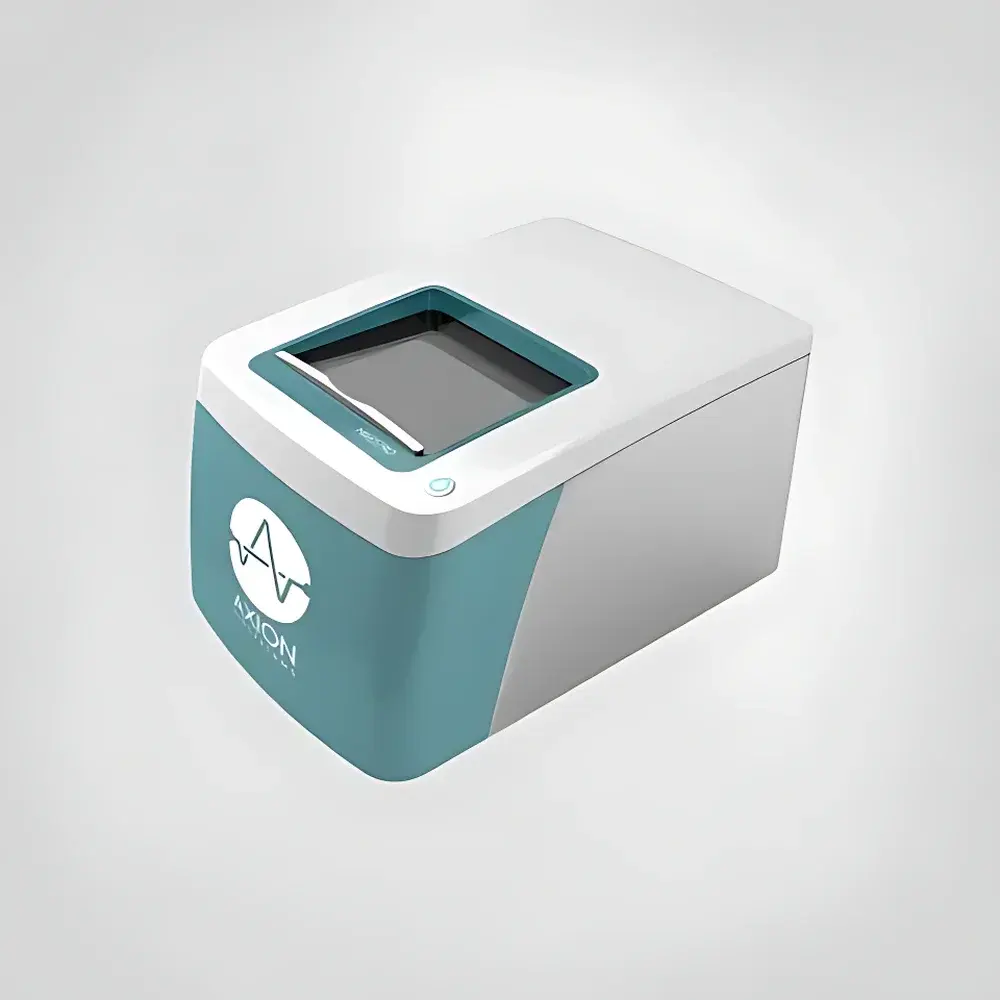
Axion BioSystems Maestro Z / ZHT Label-Free Impedance-Based Stem Cell Quality Control System
| Brand | Axion BioSystems |
|---|---|
| Origin | USA |
| Manufacturer | Axion BioSystems, Inc. |
| Product Type | Imported Life Science Instrument |
| Model | Maestro Z / ZHT |
| Pricing | Upon Request |
Overview
The Axion BioSystems Maestro Z / ZHT is a label-free, real-time impedance-based physiological monitoring platform engineered for quantitative, non-invasive assessment of stem cell viability, attachment kinetics, proliferation dynamics, and functional integrity—critical parameters in human pluripotent stem cell (hPSC) quality control. Unlike endpoint assays reliant on dyes or genetic reporters, the Maestro Z/ZHT employs multi-frequency alternating current (AC) impedance spectroscopy to measure changes in electrical resistance across microelectrode arrays integrated into standard 96-well CytoView plates. This principle—termed Electric Cell-substrate Impedance Sensing (ECIS)—detects subtle, time-resolved shifts in cell morphology, membrane integrity, intercellular junction formation, and monolayer confluence without perturbing cellular physiology. As demonstrated in the landmark 2021 Nature Methods study by Dr. Ning Chen (NIH), the system enabled high-throughput, longitudinal comparison of hPSC recovery post-cryopreservation and single-cell cloning under small-molecule interventions (e.g., CEPT cocktail), revealing statistically significant differences in attachment efficiency and proliferative capacity—quantified via impedance amplitude at plateau phase.
Key Features
- True Multi-Frequency Impedance Detection: Simultaneous application of multiple AC frequencies (10 Hz – 10 MHz) enables decoupling of barrier function (low-frequency resistance) from membrane capacitance and cytoplasmic conductivity (high-frequency components), delivering physiologically resolved metrics beyond simple confluence.
- Integrated Incubator-Compatible Design: Compact footprint with dedicated thermal and electromagnetic shielding ensures stable operation inside standard CO2 incubators—eliminating artifacts from door opening, vibration, or ambient temperature fluctuations during long-term kinetic assays (up to 7+ days).
- CytoView Z 96-Well Microelectrode Plates: Gold-film electrodes patterned on tissue-culture-treated polystyrene; compatible with all major stem cell culture matrices (Matrigel, Vitronectin, Laminin-521) and amenable to downstream immunostaining or RNA extraction post-assay.
- FDA 21 CFR Part 11–Compliant Software Suite: Includes electronic signatures, audit trails, role-based access control, and automated data archiving—validated for GLP/GMP environments supporting regulatory submissions.
- Onboard Data Storage & Redundancy: Internal solid-state memory buffers raw impedance time-series continuously, preventing data loss during host PC failure or network interruption.
Sample Compatibility & Compliance
The Maestro Z/ZHT supports diverse biological models relevant to regenerative medicine and cell therapy development: adherent hPSCs (including iPSCs and ESCs), suspension-derived progenitors, 3D organoid aggregates, co-cultures (e.g., endothelial–stromal–epithelial tri-cultures), and primary human cells. It meets ASTM E2554-18 standards for impedance-based cytotoxicity assay validation and aligns with ISO/IEC 17025 requirements for measurement uncertainty reporting. All hardware and firmware comply with IEC 61000-4 electromagnetic compatibility directives and UL 61010-1 safety certification for laboratory equipment.
Software & Data Management
The Maestro software provides synchronized real-time visualization, automated baseline subtraction, normalization to reference wells, and kinetic parameter extraction—including lag time, doubling time, maximum impedance slope, and plateau amplitude. Export formats include CSV, Excel, and HDF5 for integration with Python/R-based analysis pipelines. Raw impedance spectra (Z’ and Z”) are preserved for advanced modeling (e.g., Cole-Cole fitting, equivalent circuit analysis). Audit logs record user actions, instrument calibration events, plate mapping changes, and data export history—fully traceable per FDA 21 CFR Part 11 Annex 11 expectations.
Applications
- hPSC cryopreservation recovery profiling and lot-release QC
- Single-cell cloning efficiency optimization and clone selection
- Dynamic assessment of GPCR agonist/antagonist activity in stem cell-derived lineages
- TEER monitoring in iPSC-derived intestinal, blood-brain barrier, or renal epithelial models
- Immunomodulatory cell–target cell interaction kinetics (e.g., CAR-T killing, NK cell cytotoxicity)
- 3D spheroid/organoid growth, compaction, and drug-induced disintegration
- Toxicity screening of differentiation media components or biomanufacturing reagents
FAQ
Can the Maestro Z/ZHT distinguish between apoptosis and necrosis in real time?
Yes—through frequency-dependent impedance signatures: early apoptosis manifests as increased low-frequency resistance (tight junction reinforcement), followed by progressive loss of high-frequency capacitance (membrane blebbing); necrosis produces rapid, broadband impedance collapse.
Is it possible to perform impedance measurements while adding compounds or changing media?
Yes—the system supports programmable fluidic event markers synchronized with impedance acquisition, enabling precise temporal correlation of treatment addition with functional response onset.
Does the platform support custom electrode geometries or well formats beyond 96-well?
Currently validated only for CytoView Z 96-well plates; however, Axion offers custom assay development services for specialized applications requiring alternative configurations.
How is data integrity ensured during extended multi-day experiments?
All impedance data streams are timestamped, checksum-verified, and written redundantly to both internal flash memory and connected host storage—with automatic recovery upon reconnection.
What regulatory documentation is provided for GxP implementation?
A full validation package—including IQ/OQ/PQ protocols, risk assessments, software verification reports, and 21 CFR Part 11 configuration guides—is supplied with each instrument.
Related Products




