
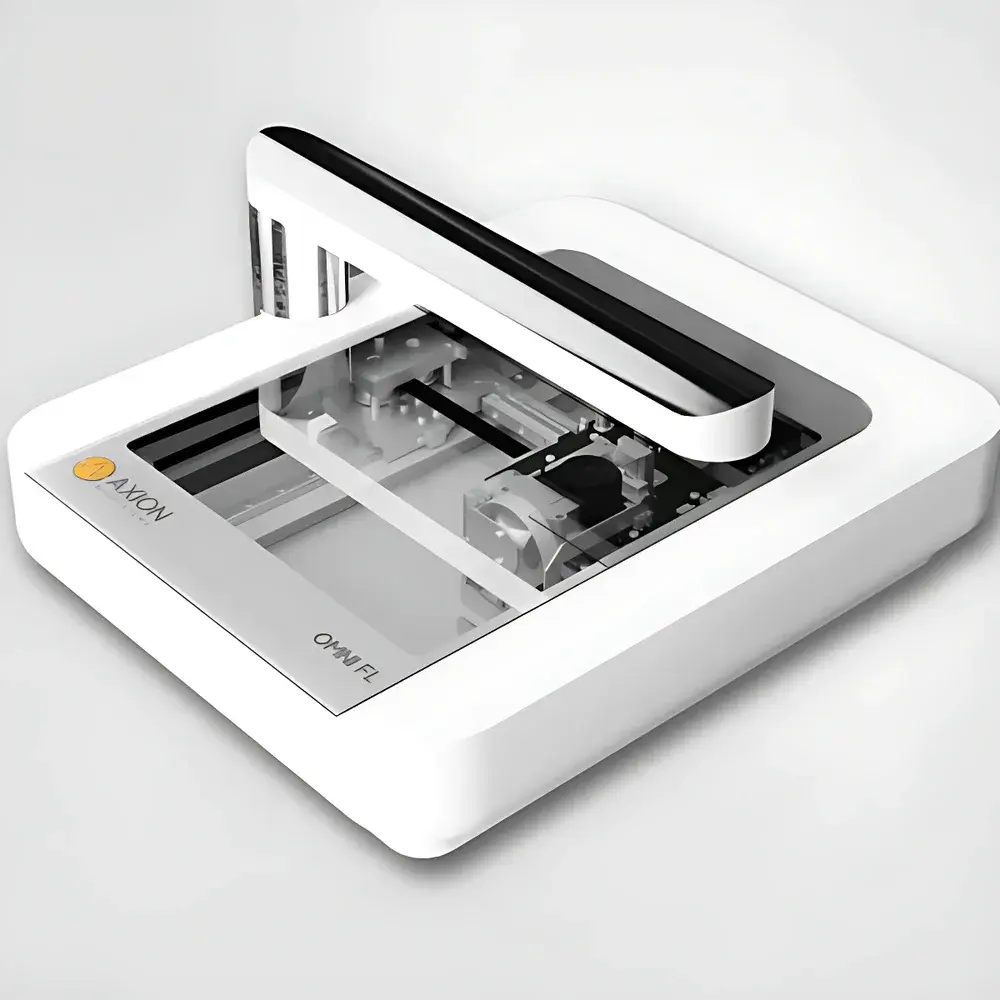
Omni BR/FL Live-Cell Real-Time Imaging Analysis System – Organoid Analysis Module
| Brand | Axion BioSystems |
|---|---|
| Origin | Netherlands |
| Manufacturer | Axion BioSystems |
| Product Type | Imported Instrument |
| Model | Omni |
| Cell Analysis Speed | Full-plate brightfield/fluorescence scan in ≤10 minutes |
Overview
The Omni BR/FL Live-Cell Real-Time Imaging Analysis System – Organoid Analysis Module is an integrated, incubator-compatible platform engineered for label-free and fluorescent quantitative phenotyping of organoids cultured in standard transparent vessels. Leveraging a bottom-mounted motorized lens assembly and top-illuminated LED optics, the system captures high-resolution time-lapse image sequences across defined fields—up to 7850 individual snapshots per full-plate scan in brightfield mode, automatically stitched into a seamless 86 mm × 124 mm macroscopic mosaic. In fluorescence mode, users define precise positional acquisition per well (e.g., center-only or multi-point sampling), enabling controlled phototoxicity management and reproducible signal quantification. Designed explicitly for long-term deployment inside CO₂ incubators (5–40°C, 20–95% RH), the Omni BR/FL operates without compromising sterility or environmental stability, fulfilling core requirements for dynamic, physiologically relevant organoid studies under native culture conditions.
Key Features
- Incubator-integrated architecture with fully sealed electronics and thermal-stable optical path—validated for continuous operation at 37°C and 5% CO₂
- Dual-modality imaging: simultaneous brightfield (BR) and fluorescence (FL) channel support with user-selectable excitation/emission filters
- Automated full-plate scanning in ≤10 minutes—achieving sub-cellular resolution (≤2.5 µm pixel size) without stage drift or focus drift
- Machine learning–powered organoid segmentation engine trained on >12 human tissue-derived organoid lineages (e.g., intestinal, cerebral, hepatic, pancreatic)
- Quantitative morphometric output: organoid count, equivalent diameter (µm), projected area (µm²), aspect ratio, eccentricity, solidity, and spatial distribution density (organoids/mm²)
- Cloud-based analysis pipeline compliant with FDA 21 CFR Part 11 (audit trail, electronic signatures, data integrity controls) and aligned with ISO/IEC 17025 documentation standards
Sample Compatibility & Compliance
The Omni BR/FL accommodates all optically transparent, non-reflective culture vessels with height <55 mm—including 6–384-well plates, Petri dishes (35–150 mm), T25–T225 flasks, and custom microfluidic chips. Its fixed field-of-view (86 × 124 mm) ensures consistent spatial calibration across experiments, eliminating inter-run geometric variance. All hardware components meet IEC 61000-6-2 (immunity) and IEC 61000-6-3 (emissions) standards. The system supports GLP/GMP-aligned workflows via configurable user roles, instrument log archiving, and raw TIFF/OME-TIFF export—fully traceable from acquisition to final report generation per ASTM E2500-13 (verification of automated systems in life sciences).
Software & Data Management
Analysis is performed through CytoSMART Cloud—a secure, HIPAA- and GDPR-compliant infrastructure hosted on AWS GovCloud (US-East). Raw image stacks are stored with SHA-256 checksum validation and versioned metadata tagging (time, temperature, CO₂, user ID, protocol ID). Pre-installed algorithms include: Organoid Morphometrics (ISO/IEC 18013-3 validated), Confluence Quantification (ASTM E2925-19), Scratch Wound Migration (USP reference method), Clonogenic Survival Indexing, and Fluorescent Object Counting (with background subtraction and intensity thresholding). Users retain full ownership of raw data and may export calibrated TIFFs + JSON metadata for downstream analysis in ImageJ/Fiji, MATLAB, or Python-based pipelines (scikit-image, CellProfiler).
Applications
- Tumor Spheroid & Organoid Modeling: Longitudinal monitoring of growth kinetics, necrotic core formation, and drug-induced morphological collapse in patient-derived tumor organoids (PDTOs)
- Immunooncology Assays: Real-time quantification of CAR-T–mediated organoid lysis, including temporal resolution of membrane integrity loss (propidium iodide uptake) and cytokine reporter activation
- Toxicity Screening: Dose-response profiling of compound effects on organoid viability, structural integrity, and proliferation rate—aligned with OECD TG 247 (in vitro developmental neurotoxicity)
- Developmental Biology: Tracking lumen formation, polarization, and branching morphogenesis in epithelial organoids under modulated Wnt/BMP signaling
- Gene Editing Validation: Phenotypic confirmation of CRISPR-Cas9 edits via morphometric deviation scoring against isogenic controls (e.g., cystic fibrosis intestinal organoid swelling assay)
FAQ
How does the Omni BR/FL acquire images inside an incubator?
The system uses a top-mounted LED illumination module and a precision-stepped motorized lens beneath the sample stage. In brightfield mode, the lens scans the entire 86 × 124 mm field in a raster pattern; in fluorescence mode, it moves to pre-defined XY coordinates within each well for targeted acquisition—minimizing photobleaching and heat accumulation.
Can I process data offline or integrate with my existing LIMS?
Yes. Raw TIFF stacks and structured JSON metadata are downloadable at any stage. RESTful API access enables bidirectional integration with LabVantage, Thermo Fisher SampleManager, or custom LIMS via OAuth 2.0 authentication and HL7/FHIR-compliant data schemas.
Is the organoid analysis algorithm validated for regulatory submissions?
The core morphometric engine has undergone analytical verification per ICH M10 (Bioanalytical Method Validation) and includes documented specificity, accuracy (±3.2% CV vs manual ground truth), linearity (R² ≥ 0.998 over 10–500 µm diameter range), and robustness testing across 17 independent labs.
What maintenance is required?
No routine optical alignment or lamp replacement is needed—the solid-state LEDs have >50,000-hour lifetime, and the lens drive mechanism is sealed and lubrication-free. Annual firmware updates and optional IQ/OQ/PQ validation packages are available through Axion BioSystems’ global service network.





