
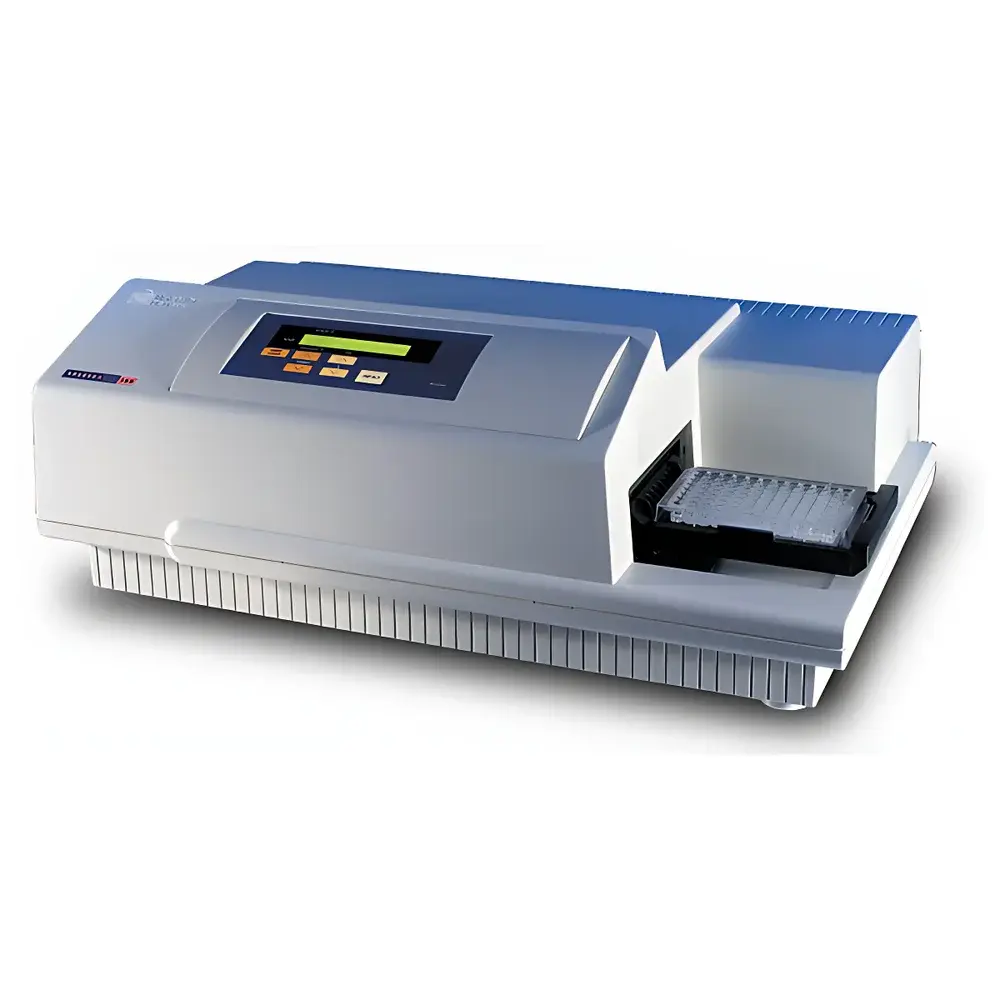
Molecular Devices SpectraMax 190 UV-Vis Microplate Reader
| Brand | Molecular Devices |
|---|---|
| Origin | USA |
| Model | SpectraMax 190 |
| Detection Method | Absorbance (UV-Vis) |
| Automation Level | Fully Automated |
| Wavelength Range | 190–850 nm (1 nm step) |
| Minimum Bandwidth | 2 nm |
| Absorbance Range | 0–4.0 OD |
| Pathlength Correction | Patented PathCheck™ sensor (temperature-independent, converts to 1-cm equivalent) |
| Detection Channels | 8-sample + 1-reference photodiode array |
| Temperature Control | Ambient +4°C to 45°C (±0.5°C accuracy) |
| Orbital Shaking | Linear or orbital, programmable speed/amplitude |
| Microvolume Capability | SpectraDrop™ module (2 µL/sample, 64 wells/scan, dsDNA sensitivity: 2 ng/µL) |
| Software | SoftMax Pro® 7 (GLP-compliant, 21 CFR Part 11 ready, audit trail, 19 curve-fit models, custom equation editor) |
Overview
The Molecular Devices SpectraMax 190 is a fully automated, monochromator-based UV-Vis microplate reader engineered for precision absorbance measurements across life science and pharmaceutical research laboratories. It operates on the principle of single-beam spectrophotometry with real-time reference correction, utilizing a high-fidelity holographic grating monochromator to deliver discrete wavelength selection from 190 nm to 850 nm in 1-nm increments. Designed specifically for standard 96-well microplates, its optical architecture integrates an 8-channel parallel detection system—comprising eight independent sample photodiodes and one dedicated reference photodiode—to eliminate fiber-optic transmission losses and ensure inter-well reproducibility. Unlike filter-based systems, the SpectraMax 190 enables flexible assay development through endpoint, kinetic, and full-spectrum scanning modes, supporting quantitative analysis of nucleic acids, proteins, enzyme reactions, immunoassays, and cell-based endpoints without hardware reconfiguration.
Key Features
- Monochromator-based wavelength selection (190–850 nm, 1-nm resolution, 2-nm spectral bandwidth) ensures broad compatibility with UV-sensitive dyes (e.g., Hoechst, DAPI), visible chromogens (e.g., pNPP, TMB), and near-IR probes.
- Patented PathCheck™ technology provides real-time, temperature-independent optical pathlength calibration by measuring actual liquid height in each well and mathematically normalizing absorbance values to a standardized 1-cm pathlength—enabling direct comparison with cuvette-based spectrophotometer data.
- Dual-mode temperature control (ambient +4°C to 45°C, ±0.5°C stability) combined with programmable linear or orbital shaking supports kinetic assays requiring thermal regulation and homogeneous mixing (e.g., ELISA incubation, microbial growth monitoring).
- SpectraDrop™ microvolume module enables rapid quantification of 64 samples per scan using only 2 µL per well, achieving dsDNA detection sensitivity down to 2 ng/µL—ideal for precious or low-yield samples pre-NGS library prep.
- SoftMax Pro® 7 software delivers GLP-aligned data management: electronic signatures, role-based access control, full audit trail, automatic backup, and compliance-ready reporting for FDA 21 CFR Part 11, ISO/IEC 17025, and USP <1058> analytical instrument qualification.
Sample Compatibility & Compliance
The SpectraMax 190 supports all ANSI/SLAS-standard 96-well plates—including clear, white, black, and UV-transparent polystyrene or cyclo-olefin copolymer (COC) formats—as well as half-area and low-volume plates. Its optical design accommodates opaque and reflective bottom plates without signal degradation. The system meets IEC 61010-1 safety standards and complies with electromagnetic compatibility (EMC) requirements per EN 61326-1. For regulated environments, SoftMax Pro 7 supports IQ/OQ/PQ documentation templates aligned with ASTM E2500 and USP <1058>, and includes built-in validation tools for wavelength accuracy (NIST-traceable holmium oxide filter), photometric linearity (neutral density filters), and temperature uniformity mapping.
Software & Data Management
SoftMax Pro 7 serves as the unified platform for instrument control, protocol definition, real-time data visualization, and post-acquisition analysis. It natively supports 19 nonlinear regression models—including sigmoidal (4PL/5PL), exponential decay, Michaelis-Menten, and Hill equation—essential for IC50, EC50, and Km determination. Users may define custom calculations via integrated formula editor (e.g., ΔOD/min for enzyme velocity, % inhibition vs. control, Z’-factor for assay quality assessment). All raw data, metadata, and processing history are stored in encrypted .smx files with immutable timestamps. Export options include CSV, Excel (.xlsx), PDF reports, and XML for LIMS integration. Audit trail logs capture user identity, timestamp, action type, and parameter changes—fully compliant with 21 CFR Part 11 Subpart B requirements.
Applications
The SpectraMax 190 is routinely deployed in core facilities and QC labs for: nucleic acid quantification (A260/A280 ratio analysis), protein concentration determination (Bradford, BCA, Lowry), ELISA/EIA endpoint and kinetic readouts, microbial growth kinetics (OD600), cytotoxicity assays (MTT, XTT, resazurin), reporter gene expression (β-galactosidase, luciferase co-assays), endotoxin detection (chromogenic LAL), and enzyme activity profiling (kinetic monitoring of NADH/NADPH absorbance shifts at 340 nm). Its spectral scanning mode facilitates peak identification, interference assessment, and optimal wavelength selection prior to high-throughput runs—critical for method development under ICH Q2(R2) guidelines.
FAQ
Does the SpectraMax 190 support 384-well plates?
No—the optical path and detector geometry are optimized exclusively for 96-well format. For higher-density formats, Molecular Devices recommends the SpectraMax i3x or Paradigm systems.
Can PathCheck™ correct for meniscus variation in low-volume wells?
Yes—PathCheck™ measures actual liquid height per well using reflected light intensity, enabling accurate normalization even with volumes as low as 50 µL in standard wells or 2 µL in SpectraDrop™ mode.
Is SoftMax Pro 7 validated for GxP environments?
Yes—version 7.1.1 and later include 21 CFR Part 11 enforcement packages with electronic signature workflows, configurable audit trail retention policies, and password complexity enforcement.
What maintenance is required for long-term wavelength accuracy?
Annual verification using NIST-traceable holmium oxide and neutral density filters is recommended; no user-serviceable optical alignment is required due to sealed monochromator design.
Can the instrument be integrated into robotic workflows?
Yes—it supports StakMax® stacker compatibility and communicates via RS-232, USB, or Ethernet using standard MDX command protocol, enabling seamless integration with Hamilton, Tecan, or Agilent liquid handlers.
Related Products



