
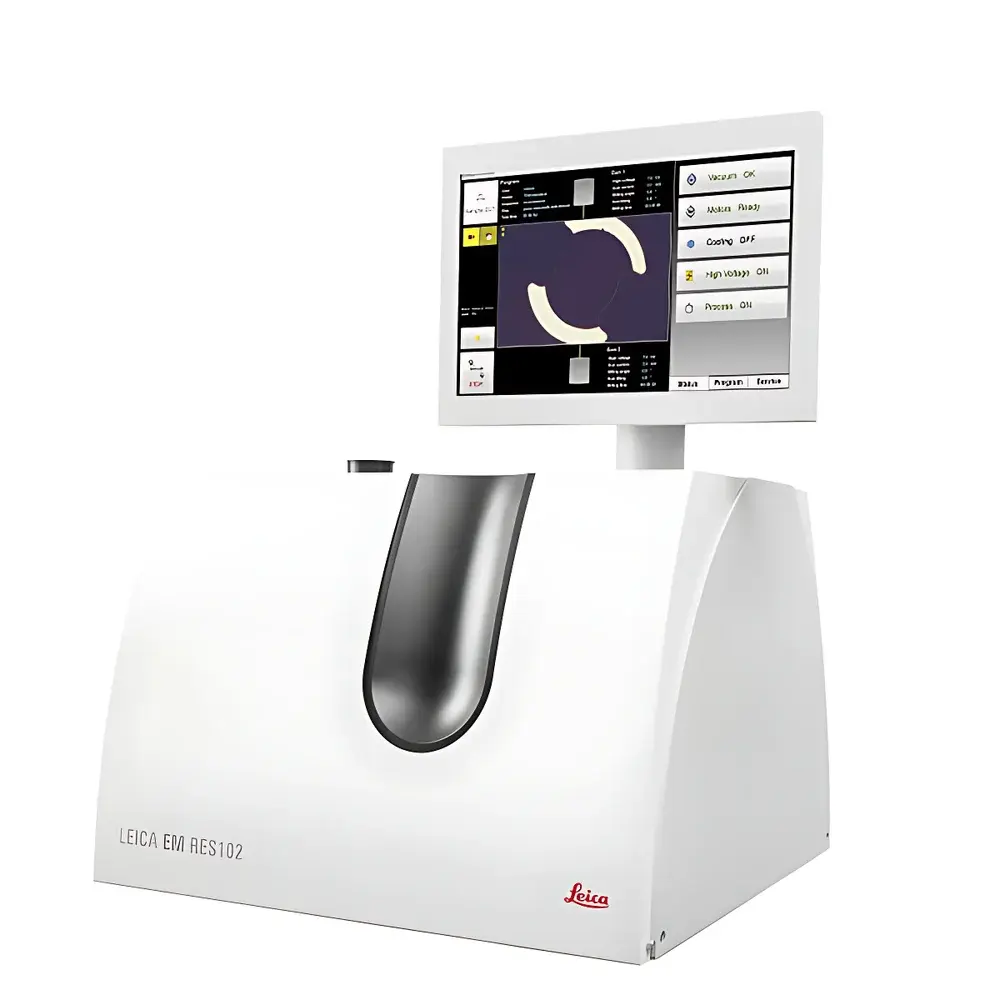
Leica EM RES102 Multi-Functional Ion Milling System
| Brand | Leica |
|---|---|
| Origin | Germany |
| Model | EM RES102 |
| Maximum Sample Size | Ø 25 mm × 12 mm |
| Tilting Angle Range | –90° to +90° (dependent on sample holder) |
| Ion Beam Energy | 0.8 keV to 10 keV (adjustable in 0.1 keV increments) |
Overview
The Leica EM RES102 Multi-Functional Ion Milling System is a high-precision, benchtop ion beam milling instrument engineered for the preparation of electron-transparent thin sections and artifact-free surfaces for transmission electron microscopy (TEM), scanning electron microscopy (SEM), and light microscopy (LM). It operates on the principle of physical sputtering: accelerated inert gas ions (typically argon) impinge upon a solid sample surface at controlled energy and incidence angles, progressively removing material through momentum transfer. Unlike chemical etching or mechanical polishing, ion milling preserves crystallographic integrity and avoids subsurface deformation—critical for high-resolution structural and compositional analysis. The system integrates dual-beam capability (optional upgrade path), precise angular control, and cryogenic compatibility to support both hard ceramics/metals and beam-sensitive organic, polymeric, or biological specimens.
Key Features
- Programmable dual-ion-beam configuration with independent energy and angle control for asymmetric milling and cross-sectioning.
- Cryogenic LN2-cooled sample stage (–140 °C to +60 °C) enables stable milling of temperature-sensitive materials including polymers, pharmaceuticals, and frozen-hydrated tissues.
- High-resolution angular positioning system with ±0.1° repeatability across the full –90° to +90° tilt range—essential for precise cross-sectional geometry and crystallographic orientation control.
- Ion beam energy adjustable from 0.8 keV to 10 keV in 0.1 keV increments, supporting low-kV gentle milling (<2 keV) for soft materials and high-kV rapid thinning (>6 keV) for dense alloys or ceramics.
- Modular sample holder architecture accommodating TEM half-grid holders (3 mm), SEM stubs (Ø25 mm), planchette-based LM slides, and custom fixtures—enabling single-platform workflow integration across microscopy modalities.
- Integrated vacuum interlock, real-time pressure monitoring, and automatic beam shuttering ensure operator safety and process reproducibility per ISO 14644-1 Class 5 cleanroom-compatible operation.
Sample Compatibility & Compliance
The EM RES102 supports a broad spectrum of materials without requiring conductive coating or embedding: metallic alloys (Al, Ti, Ni-based superalloys), geological specimens (silicates, oxides), semiconductor wafers (Si, GaN, SiC), polymer blends, battery electrode composites, and cryo-preserved biological tissues. All milling protocols adhere to ASTM E1558–22 (Standard Guide for Ion Beam Milling of Metals and Alloys for Microstructural Analysis) and are compatible with GLP/GMP documentation requirements. The system’s software logs all operational parameters—including beam energy, incidence angle, dwell time, chamber pressure, and stage temperature—with timestamped audit trails compliant with FDA 21 CFR Part 11 for regulated environments.
Software & Data Management
Leica’s proprietary EM UC7/RES software provides intuitive graphical workflow management with pre-validated application methods (e.g., “TEM Thin-Edge”, “SEM Cross-Section”, “Polymer Gentle Polish”). Each method stores complete parameter sets—including beam raster pattern, scan speed, dwell time, and cooling profile—for one-click recall and inter-laboratory protocol standardization. Raw log files export in CSV and XML formats; metadata conforms to MIAME/MINSEQ standards for integration into LIMS or ELN platforms. Remote access via LAN-enabled Ethernet port supports secure SSH/TLS connections for off-site monitoring and routine maintenance diagnostics.
Applications
- Preparation of electron-transparent lamellae from bulk materials for high-angle annular dark-field (HAADF) STEM imaging and EDS/EELS mapping.
- Generation of damage-free cross-sections in multilayer thin-film devices (e.g., OLED stacks, PV cells, MRAM structures) for interface analysis.
- Routine SEM sample polishing to eliminate mechanical deformation artifacts prior to FIB-SEM serial sectioning or EBSD indexing.
- Cryo-ion milling of vitrified biological samples for correlative light and electron microscopy (CLEM) workflows.
- Surface cleaning and topography enhancement of fracture surfaces for quantitative fractography and phase identification.
FAQ
What vacuum level is required for stable ion beam operation?
The system achieves base pressure ≤5 × 10⁻⁶ mbar via turbomolecular pumping; typical operating pressure during milling is 1.5–3.0 × 10⁻⁴ mbar.
Can the EM RES102 be integrated with a focused ion beam (FIB) workstation?
Yes—its standardized flange interface (CF63) and digital I/O ports allow synchronization with commercial FIB-SEM platforms for hybrid site-specific milling workflows.
Is routine maintenance user-performable?
Daily checks (ion source alignment verification, cryogen level monitoring) and quarterly filament replacement are supported by guided procedures in the onboard help system and Leica’s remote-assisted service portal.
Does the system support automated endpoint detection?
While not equipped with in-situ optical or electron detection, the system enables endpoint estimation via time-controlled milling combined with post-milling TEM grid inspection or SEM edge-thickness correlation curves.



