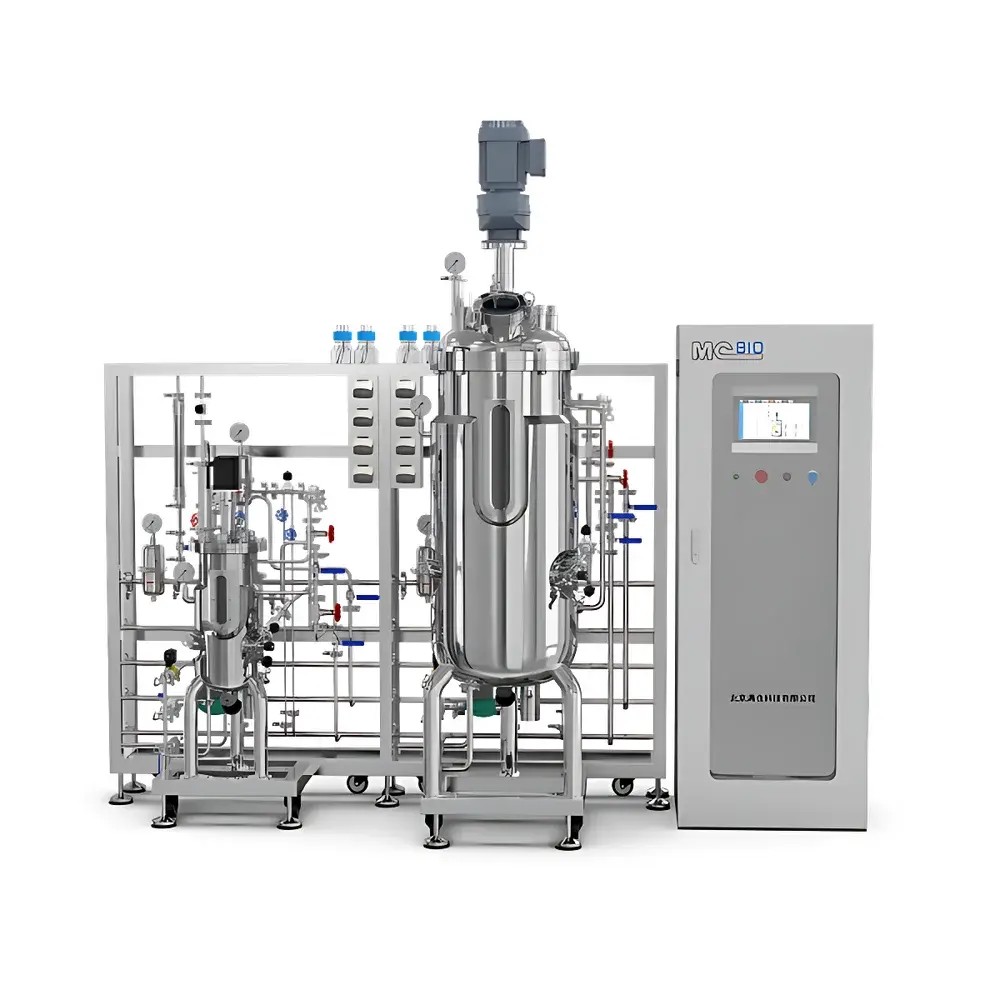
Mancang MC-JSF-1T/3 Triple 10L Stainless Steel Fermenter
| Brand | Mancang |
|---|---|
| Origin | Beijing, China |
| Manufacturer Type | Direct Manufacturer |
| Country of Origin | China |
| Model | MC-JSF-1T/3 |
| Vessel Volume | 10 L (per vessel) × 3 |
| Aeration System | Quadruple sterile air supply lines |
| pH Control Range | 2.0–12.0 |
| Dissolved Oxygen (DO) Control Range | 0–200% saturation |
| Temperature Control Range | 5–65 °C (via chilled water + electric heating) |
Overview
The Mancang MC-JSF-1T/3 is a triple-vessel, fully automated stainless steel fermenter system engineered for rigorous laboratory-scale bioprocess development in academic research institutions, contract development organizations (CDOs), and early-stage biomanufacturing facilities. Each of the three independently controlled 10 L vessels operates on the principle of aerobic or microaerobic submerged fermentation under precisely regulated environmental conditions—enabling parallel experimental design for strain screening, media optimization, and process parameter mapping. Constructed entirely from electropolished AISI 316L stainless steel, the system supports in-situ steam sterilization (SIP) at 121 °C for 30 minutes per cycle, complying with ASME BPE-2021 surface finish standards (Ra ≤ 0.6 µm internal). Its modular architecture integrates mechanical agitation, multi-point gas blending, real-time physicochemical monitoring, and closed-loop feedback control—making it suitable for cultivating bacteria, yeasts, filamentous fungi, and mammalian suspension cells under GLP-compliant workflows.
Key Features
- Triple 10 L working-volume vessels housed in a single integrated frame—enabling statistically robust parallel fermentation runs without cross-contamination risk
- Independent PID-controlled temperature regulation per vessel (5–65 °C) using Pt-100 sensors, electric heating elements, and external chiller interface
- Dual-channel pH control (2.0–12.0) via autoclavable Mettler Toledo (Hamilton) pH electrodes and precision peristaltic dosing pumps for acid/base addition
- Dissolved oxygen control (0–200% saturation) using Hamilton DO probes with thermal compensation; optional cascade control with agitation speed and airflow rate
- Quadruple sterile air supply per vessel: includes 0.01 µm hydrophobic membrane filters, pressure-regulated stainless steel manifolds, and calibrated glass rotameters with manual flow valves
- Top-entry mechanical agitation system featuring dual flat-blade impellers and an integrated high-efficiency foam-breaking propeller; speed range 0–1000 rpm (DC motor, digitally adjustable)
- Comprehensive sterilizable sensor suite: pH, DO, temperature, pressure, foam detection, and optional redox (ORP) and exhaust gas (O₂/CO₂) modules
- Industrial-grade MC-Bio control platform based on Siemens S7-1200 PLC; 32-bit color touchscreen HMI with audit-trail-enabled data logging compliant with FDA 21 CFR Part 11 requirements
Sample Compatibility & Compliance
The MC-JSF-1T/3 accommodates a broad spectrum of microbial and eukaryotic cultures—including Escherichia coli, Saccharomyces cerevisiae, Pichia pastoris, Aspergillus niger, and CHO cell lines—in complex, high-viscosity, or particulate-containing media (e.g., corn steep liquor-based broths). All wetted parts meet USP Class VI and ISO 10993 biocompatibility criteria. The system adheres to ASME BPE-2021 hygienic design guidelines for biopharmaceutical equipment and supports validation protocols aligned with ISO 13485, ISO 9001, and EU Annex 1 principles. In-situ SIP capability satisfies sterilization validation requirements per ASTM E2895-13 and supports routine process qualification under GMP-relevant environments.
Software & Data Management
The embedded MC-Bio software provides synchronized acquisition of up to 64 analog and digital process variables per vessel at configurable sampling intervals (1–60 sec). Data are stored locally on encrypted SD cards and exported in CSV or Excel-compatible formats. The system supports OPC UA connectivity for integration into enterprise MES or SCADA platforms. Audit trails record all operator actions, parameter changes, alarm events, and calibration logs—with time-stamped digital signatures. Optional add-ons include automated SIP sequence scripting, trend-based deviation alerts, and export-ready batch reports formatted for regulatory submission (e.g., IND/IMPD dossiers).
Applications
- Strain performance comparison across identical environmental setpoints
- Design-of-experiments (DoE) studies for carbon/nitrogen source optimization
- Scale-down model development for upstream process transfer to pilot-scale bioreactors
- Process characterization of fed-batch and perfusion modes under dynamic DO/pH setpoint profiles
- Validation of sterilization cycles and filter integrity testing (DOP challenge, bubble point)
- Teaching bioprocess engineering principles in university biotechnology curricula
- Pre-clinical production of recombinant proteins, enzymes, and organic acids
FAQ
Is the system compatible with cGMP documentation requirements?
Yes—the MC-Bio control system supports electronic signatures, change control logs, and 21 CFR Part 11-compliant audit trails when configured with user authentication and role-based access.
Can the fermenters be operated individually or only in parallel?
Each vessel features independent control loops and can be operated autonomously or synchronized with shared parameters (e.g., common air supply or cooling water manifold).
What sterilization methods are supported?
Standard configuration supports manual in-situ steam sterilization (SIP) using external saturated steam (≥3 bar(g)). Optional AUTO-SIP module enables fully automated SIP sequence execution with temperature/pressure ramp profiling and hold validation.
Are third-party sensors (e.g., FTIR, Raman) supported for integration?
Yes—the system provides open analog/digital I/O ports and Modbus RTU/TCP interfaces for integrating external analyzers, subject to signal conditioning and protocol alignment.
What maintenance intervals are recommended for critical components?
Peristaltic pump tubing should be replaced every 500 operational hours; sterile air filters require replacement after 10 SIP cycles or quarterly—whichever occurs first. Agitator mechanical seals are rated for ≥5000 hours of continuous operation under nominal load.
Related Products