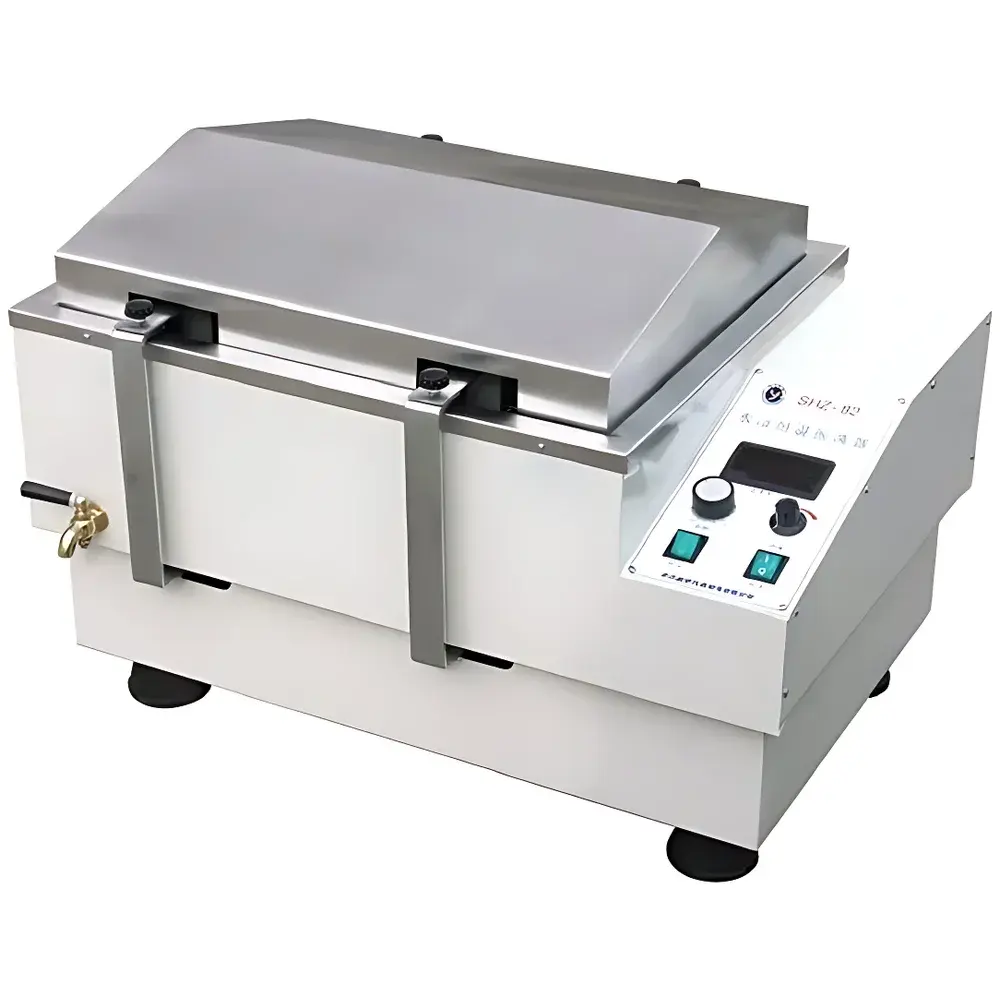
CZGY SHA-C Water Bath Incubator Shaker
| Brand | CZGY |
|---|---|
| Origin | Jiangsu, China |
| Manufacturer Type | Direct Manufacturer |
| Instrument Type | Water Bath Incubator Shaker (Reciprocating) |
| Timer Range | 0–120 min |
| Oscillation Frequency | 0–300 rpm |
| Amplitude | 20 mm |
| Temperature Range | Ambient to 100 °C |
| Platform Quantity | 1 |
| Temperature Uniformity | ±0.5 °C |
| Temperature Stability | ±0.5 °C |
| Heating Power | 1500 W |
| Tray Dimensions | 40 × 31 cm |
| Power Supply | 220 V ±10%, 50 Hz ±1 Hz |
| External Dimensions | 69 × 46 × 48 cm |
| Construction | Stainless Steel Interior |
| Drive Mechanism | Eccentric Reciprocating Motion |
| Clamping System | Universal Spring Clamp Assembly |
Overview
The CZGY SHA-C Water Bath Incubator Shaker is an integrated laboratory instrument engineered for precise temperature-controlled agitation of biological and biochemical samples in aqueous environments. It combines a thermostatically regulated water bath with a mechanically driven reciprocating shaker platform, enabling simultaneous thermal equilibration and uniform orbital or linear motion—critical for cell culture propagation, microbial growth studies, enzyme kinetics assays, and solubility testing. Unlike air-jacketed incubator shakers, the water bath design ensures superior thermal homogeneity and minimal temperature gradient across sample vessels, particularly during extended incubation periods (e.g., 12–72 h). The unit operates on a robust eccentric drive mechanism delivering consistent 20 mm amplitude motion across the full 0–300 rpm range, with digital PID temperature control maintaining setpoints within ±0.5 °C over time and space—meeting foundational performance expectations for GLP-compliant routine microbiology and molecular biology workflows.
Key Features
- Digital LED display for real-time monitoring of both temperature (°C) and elapsed timer duration (min), supporting intuitive parameter verification without external calibration tools.
- Stepless speed regulation via front-panel rotary encoder, enabling fine-tuned optimization of shear stress for sensitive cell lines or viscous media without mechanical gear shifts.
- Stainless steel water bath chamber (AISI 304 grade) resistant to corrosion from saline buffers, acidic/basic reagents, and repeated sterilization cycles—ensuring long-term structural integrity and ease of decontamination.
- Universal spring clamp system accommodates diverse vessel geometries: round-bottom flasks (50–1000 mL), test tubes (12–25 mm OD), microcentrifuge tube racks, and custom multi-well plates—without requiring accessory kits.
- Programmable mechanical timer (0–120 min) with auto-shutoff; alternatively, continuous operation mode is available for unattended overnight protocols.
- Low-splash oscillation profile minimizes evaporation loss and cross-contamination risk while maintaining sufficient mixing energy for aerobic suspension cultures.
Sample Compatibility & Compliance
The SHA-C supports standard laboratory consumables including borosilicate glass Erlenmeyer flasks, polypropylene centrifuge tubes, and silicone-sealed serum bottles. Its ambient-to-100 °C operating envelope covers common applications such as bacterial enrichment (37 °C), thermophilic enzyme assays (60–80 °C), and DNA denaturation/annealing simulations. While not certified to ISO/IEC 17025 or ASTM E171 for metrological traceability, its thermal and mechanical repeatability aligns with internal QC benchmarks used in academic core facilities and contract research organizations performing non-regulated exploratory work. For GMP environments, users should validate temperature uniformity per USP and mechanical consistency per ISO 20387 Annex B prior to deployment in production-related activities.
Software & Data Management
The SHA-C operates as a standalone analog-digital hybrid device with no embedded firmware, network interface, or data logging capability. All operational parameters are set manually and retained only during active power supply—no audit trail, user access control, or electronic record generation is provided. Consequently, it complies with FDA 21 CFR Part 11 only in “non-electronic record” mode; laboratories requiring ALCOA+ data integrity must implement external validation protocols, including manual logbook entries, periodic temperature mapping, and independent rpm verification using calibrated tachometers. Integration with LIMS or ELN systems requires third-party hardware interfaces (e.g., USB relay modules + custom Python scripts).
Applications
- Microbial cultivation under controlled aeration and thermal conditions for antibiotic susceptibility testing (AST) and bioburden analysis.
- Suspension-based mammalian cell expansion in serum-containing or chemically defined media prior to transfection or cryopreservation.
- Extraction efficiency optimization for plant metabolites, nucleic acids, or protein antigens using aqueous-phase agitation at elevated temperatures.
- Standardization of dissolution testing for pharmaceutical excipients per USP , where water bath shakers serve as reference platforms for comparative release profiling.
- Pre-analytical sample homogenization in environmental water testing (e.g., EPA Method 1603) to ensure representative colony-forming unit (CFU) distribution prior to membrane filtration.
FAQ
Is the SHA-C suitable for use with volatile organic solvents?
No. The open water bath design and lack of vapor containment make it incompatible with acetone, ethanol, chloroform, or other low-boiling-point solvents due to fire hazard and accelerated evaporation.
Can multiple flask sizes be run simultaneously on the single platform?
Yes—provided total load does not exceed 5 kg and center-of-mass remains within the platform’s geometric centroid; imbalance-induced vibration may compromise temperature stability above ±10% mass asymmetry.
Does the unit include a water level sensor or dry-run protection?
No. Manual water level maintenance is required; operation without adequate fluid volume risks heater element failure and irreversible damage.
What is the recommended maintenance interval for the drive mechanism?
Lubrication of the eccentric shaft bearing is advised every 12 months or after 2000 operational hours using ISO VG 68 mineral oil—per manufacturer service bulletin SB-SHA-C-2023-04.
Is CE or UL certification available for this model?
The SHA-C meets GB/T 14710–2009 (Chinese national standard for environmental adaptability of medical electrical equipment) but carries no CE, UL, or IEC 61010–1 certification; export installations require local conformity assessment.
Related Products