
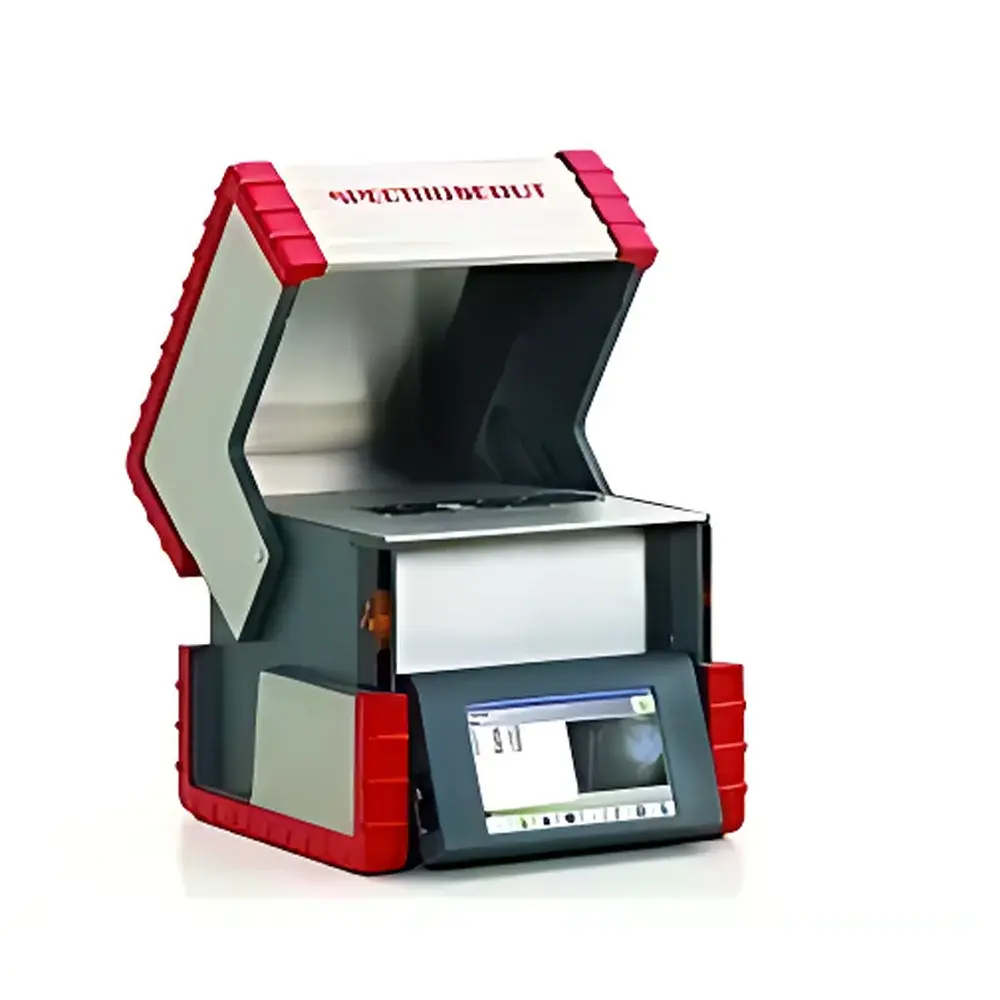
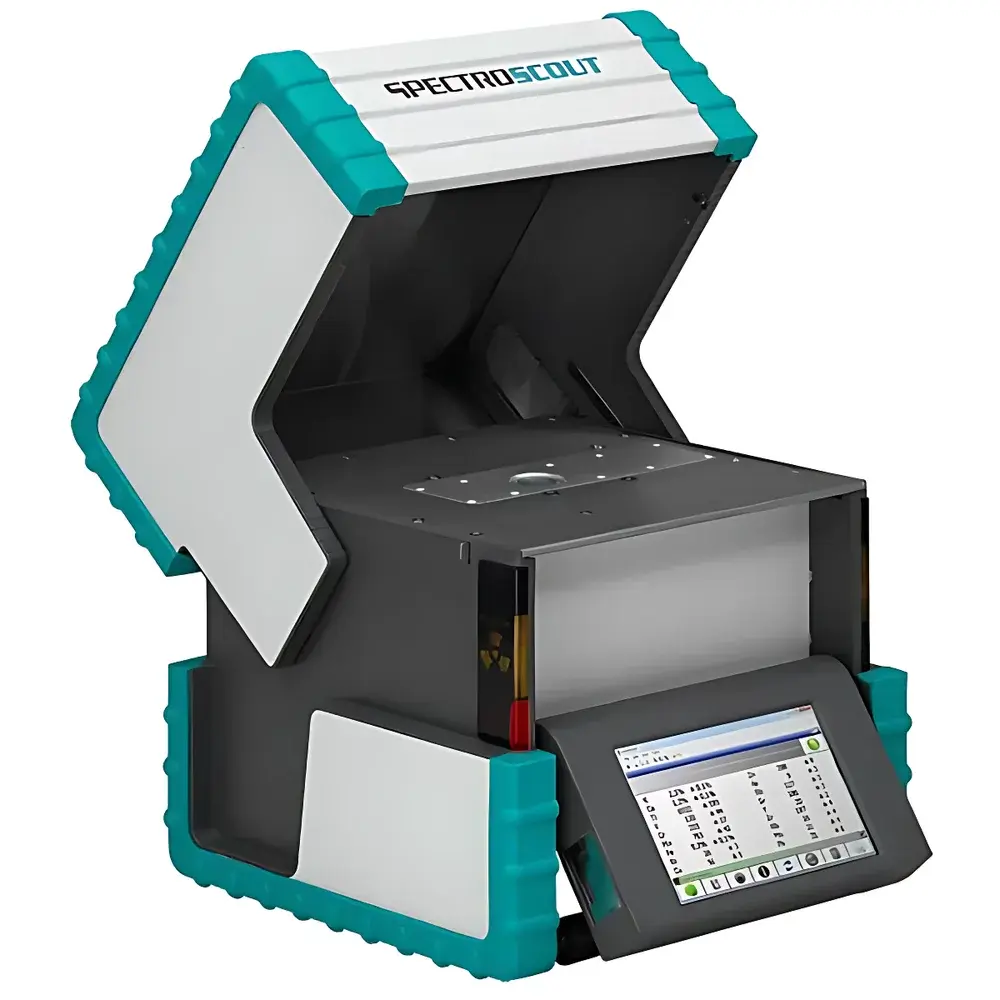
SPECTRO SCOUT Portable Energy Dispersive X-Ray Fluorescence Spectrometer
| Brand | SPECTRO |
|---|---|
| Origin | Germany |
| Model | SPECTRO SCOUT |
| Instrument Type | Polarized ED-XRF |
| Configuration | Benchtop/Field-Deployable |
| Detector | Silicon Drift Detector (SDD) |
| X-ray Tube | Rhodium (Rh) anode, up to 50 kV |
| Elemental Range | Na (11) to U (92) |
| Detection Limits | As low as <1 ppm for selected elements |
| Analysis Time | 3–10 min per sample |
| Dimensions | 270 × 306 × 306 mm |
| Weight | 12.75 kg |
| Battery Life | Up to 5 hours continuous operation |
| Sample Chamber | Large-volume, accommodates irregular and bulk samples |
| Calibration | iCAL single-sample standardization in ≤5 minutes |
| Software Interface | Integrated touchscreen with preloaded application packages |
| Optional | Integrated high-resolution camera for sample positioning and image-result correlation |
| Connectivity | USB, Wi-Fi, Ethernet |
Overview
The SPECTRO SCOUT Portable Energy Dispersive X-Ray Fluorescence (ED-XRF) Spectrometer is an engineered field-deployable analytical platform designed to deliver laboratory-grade elemental quantification outside controlled environments. Based on polarized excitation geometry—where a secondary target polarizes the primary X-ray beam to suppress background and enhance peak-to-background ratios—the instrument achieves high spectral resolution and low detection limits without requiring cryogenic cooling or vacuum purging. Its core architecture integrates a high-power Rh-target microfocus X-ray tube (up to 50 kV), a large-area silicon drift detector (SDD) with Peltier cooling, and an embedded real-time signal processor optimized for matrix-independent quantification. Unlike conventional handheld XRF devices, the SPECTRO SCOUT features a spacious sample chamber enabling analysis of heterogeneous solids, soils, ores, alloys, and irregularly shaped specimens—making it suitable for both regulatory screening and quantitative geochemical or industrial QA/QC workflows.
Key Features
- Polarized ED-XRF optical path design minimizes scattering artifacts and improves sensitivity for light elements (Na–Al) and trace heavy metals (Pb, As, Cd, Hg) simultaneously.
- iCAL (intelligent Calibration) technology enables full instrument standardization using a single reference material in under five minutes—eliminating multi-point calibration routines and reducing operator dependency.
- Integrated high-resolution camera system allows precise spatial registration of measurement spots; captured images are time-stamped and stored alongside spectral data for audit-ready documentation.
- Self-contained computing platform with capacitive touchscreen interface runs proprietary SPECTRO XRF software v5.x, supporting method-driven analysis, automated report generation (PDF/CSV), and GLP-compliant data logging.
- Ruggedized aluminum chassis with IP54-rated enclosure ensures operational reliability in harsh field conditions—including offshore platforms, mining sites, and manufacturing floors.
- Hot-swappable lithium-ion battery pack supports uninterrupted 5-hour operation; optional AC adapter enables benchtop mode with continuous power and enhanced thermal stability.
Sample Compatibility & Compliance
The SPECTRO SCOUT accepts solid, powdered, and pressed pellet samples up to 100 mm in diameter and 40 mm in height. Its open-chamber design facilitates rapid loading of geological cores, scrap metal fragments, catalyst residues, and environmental soil cores without grinding or pelletizing—reducing preparation-induced bias. The instrument complies with IEC 61000-6-3 (EMC), IEC 61010-1 (safety), and meets EU RoHS Directive Annex II requirements for restricted substance screening. Analytical protocols align with ASTM D7348 (total sulfur in fuels), ASTM D5623 (wear metals in lubricants), ISO 12847 (soil heavy metal determination), and EPA Method 6200 (field portable XRF for metals in soils). Full audit trails—including user logins, parameter changes, calibration history, and raw spectrum archives—are retained in accordance with FDA 21 CFR Part 11 and GLP/GMP data integrity guidelines.
Software & Data Management
The embedded operating system hosts SPECTRO’s XRF Analyzer Suite, featuring intuitive workflow navigation, customizable method templates (e.g., “Soil Screening”, “Alloy Grade ID”, “Lubricant Additives”), and dynamic limit checking against regulatory thresholds (e.g., EU ELV, China GB/T 30587, US CPSC). All spectra are stored in vendor-neutral .spc format with embedded metadata (date/time, GPS coordinates if enabled, operator ID, instrument serial number). Data export supports direct transfer via USB mass storage, network share, or cloud-synced repositories. Remote diagnostics and firmware updates are supported over secure TLS-encrypted connections. For enterprise integration, the instrument provides ODBC-compliant database access and RESTful API endpoints for LIMS interoperability.
Applications
- On-site geological prospecting and mine grade control—real-time quantification of Fe, Cu, Zn, Ni, Co, REEs in drill core and trench samples.
- Environmental compliance monitoring—screening of Pb, As, Cr, Cd, and Hg in contaminated soils, sediments, and landfill leachates per EPA Region 10 protocols.
- Industrial materials verification—positive material identification (PMI) of stainless steels, superalloys, and weld deposits in power generation and petrochemical infrastructure.
- Recycling stream characterization—rapid sorting of electronic waste (WEEE), catalytic converters, and scrap aluminum based on elemental composition.
- Fuel quality assurance—determination of total sulfur, chlorine, and wear-related Si/Al in diesel, marine fuel, and aviation turbine oils.
- Cultural heritage and jewelry authentication—non-destructive analysis of Au, Pt, Ag, and alloying elements in historical artifacts and precious metal goods.
FAQ
Does the SPECTRO SCOUT require external cooling or vacuum pumping for operation?
No. The integrated Peltier-cooled SDD operates at –20 °C without liquid nitrogen or mechanical pumps, ensuring silent, maintenance-free field deployment.
Can the instrument be used for regulatory reporting under ISO/IEC 17025-accredited laboratories?
Yes—when operated within validated methods and documented calibration procedures, its measurement uncertainty profiles support use in accredited testing environments.
Is GPS geotagging of measurements available?
Optional external Bluetooth GPS module enables automatic embedding of WGS84 coordinates into each analysis record.
What sample preparation is required for soil analysis?
Air-dried, homogenized soil can be analyzed directly in the chamber; no pressing or binder addition is necessary for semi-quantitative screening. For certified-level accuracy, ASTM D7348-compliant drying and sieving are recommended.
How is data security ensured during remote data transfer?
All network communications use TLS 1.2+ encryption; local storage employs AES-256 full-disk encryption, and user access is governed by role-based permissions (admin/operator/auditor).
Related Products





