
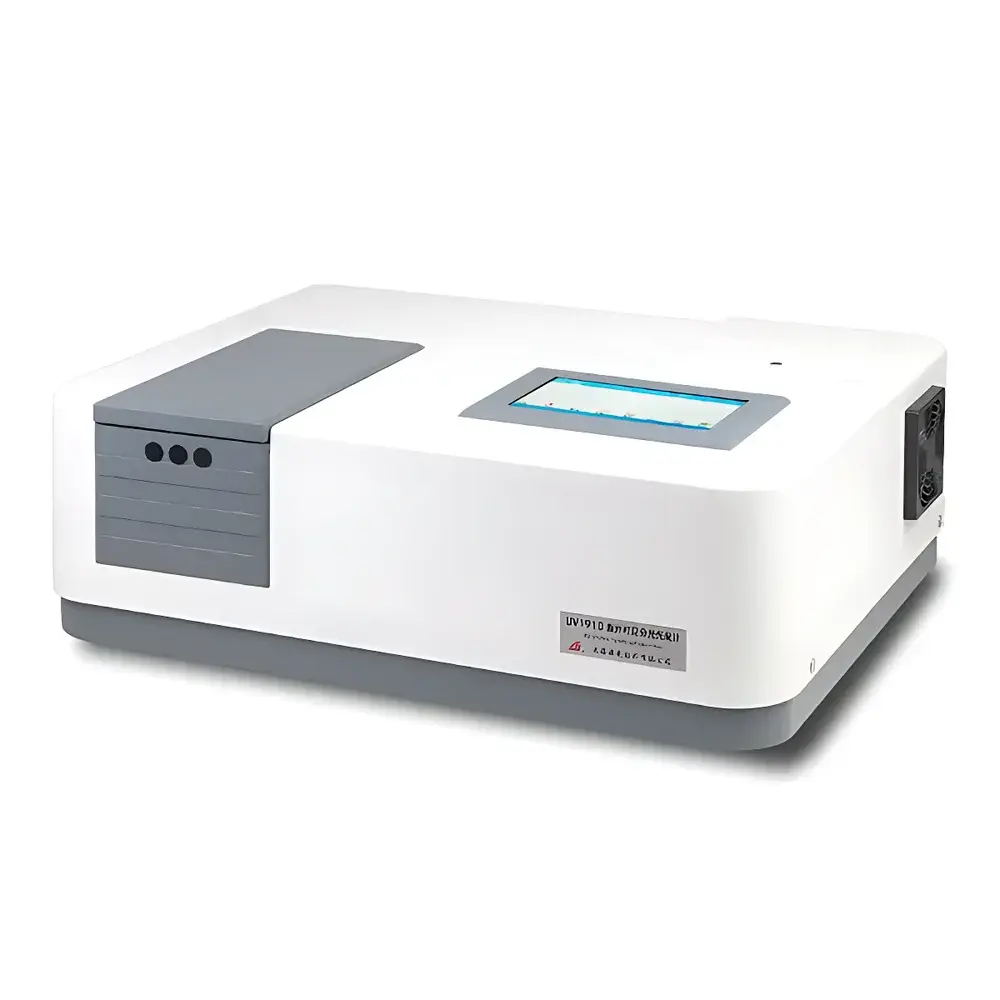
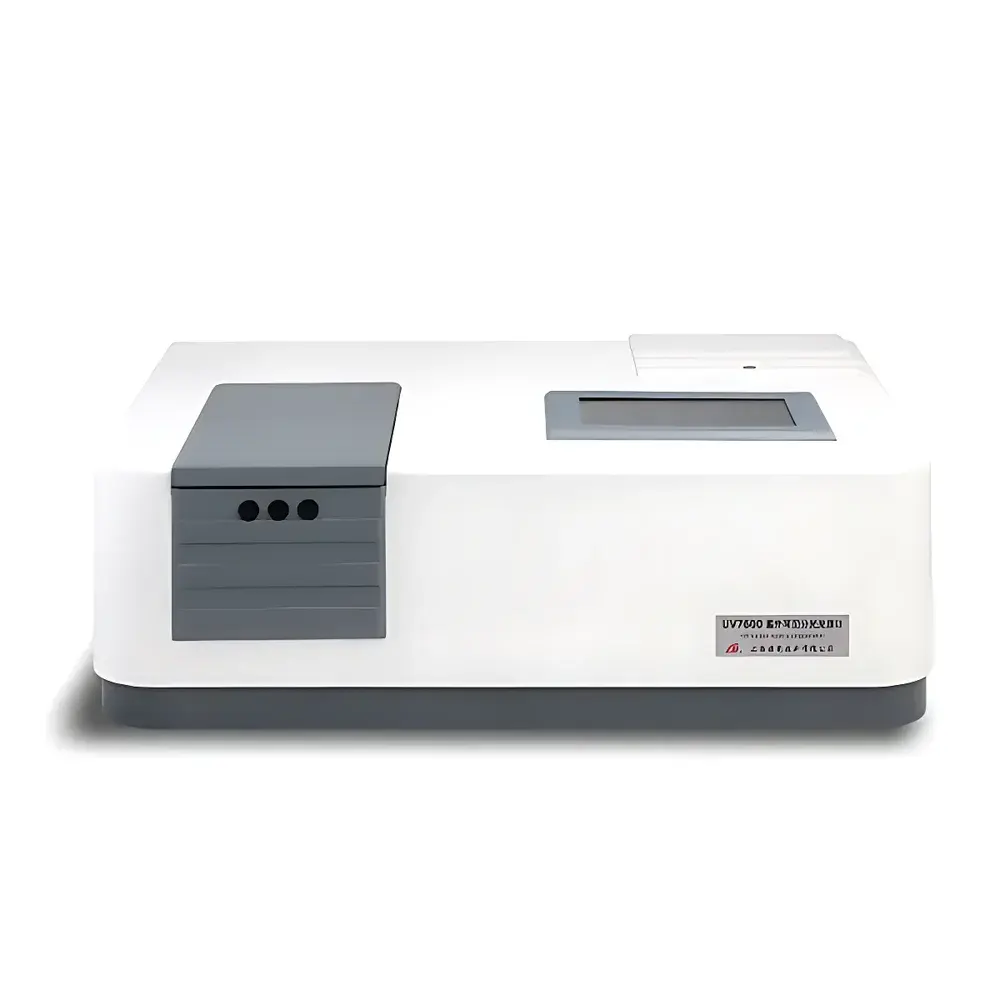
Lengguang Tech. UV1910 Dual-Beam Ultraviolet-Visible Spectrophotometer
| Brand | Lengguang Tech. |
|---|---|
| Origin | Shanghai, China |
| Manufacturer | Yes |
| Type | Domestic |
| Model | UV1910 |
| Optical System | Dual-beam |
| Detector | Silicon Photocell |
| Wavelength Range | 191–1100 nm |
| Wavelength Accuracy | ±0.3 nm |
| Wavelength Repeatability | ≤0.1 nm |
| Spectral Bandwidth | 1 nm |
| Stray Light | ≤0.03% |
Overview
The Lengguang Tech. UV1910 Dual-Beam Ultraviolet-Visible Spectrophotometer is a precision optical instrument engineered for quantitative and qualitative analysis across the ultraviolet and visible spectral regions (191–1100 nm). It operates on the principle of dual-beam absorption spectroscopy: light from a deuterium lamp (UV) and tungsten-halogen lamp (VIS/NIR) is split into sample and reference beams via a high-stability optical chopper, enabling real-time compensation for source intensity drift and detector response variation. This architecture ensures exceptional baseline stability (<±0.0008 A), low photometric noise (≤0.05% T at 0% T), and long-term measurement reproducibility—critical for regulatory-compliant laboratories performing routine QC, method validation, or research-grade spectral characterization. The instrument integrates a Czerny-Turner monochromator with a 1200-line/mm holographic grating, delivering a fixed 1 nm spectral bandwidth optimized for resolution-sensitive applications such as pharmaceutical assay, nucleic acid quantification, and thin-film transmittance profiling.
Key Features
- Dual-beam optical design with digital ratio feedback processing, minimizing baseline drift to ≤0.0005 Abs/h and ensuring stable photometric performance over extended operation cycles.
- High-fidelity optical train incorporating Hamamatsu long-life deuterium lamps (≥2000 h lifetime) and imported tungsten-halogen sources, coupled with an auto-aligning beam switch mirror for seamless UV/VIS source transition without manual recalibration.
- 7-inch full-color capacitive touchscreen interface supporting standalone operation: wavelength scanning, time-based kinetics, multi-wavelength absorbance acquisition, and single-point concentration calculation using preloaded calibration curves.
- Fixed 1 nm spectral bandwidth—optimized for resolving adjacent absorption peaks in complex matrices while maintaining signal-to-noise integrity per ASTM E275 and ISO 6425 standards.
- Stray light level ≤0.03% at 220 nm and 340 nm—validated per USP and Ph. Eur. 2.2.25 requirements—enabling accurate measurement of highly absorbing samples (A > 3.0) without significant deviation from Beer-Lambert linearity.
- Modular hardware architecture supporting optional 6-cell or 8-cell automated sample changers, variable-pathlength cuvettes (1–100 mm), and solid-sample holders for film, filter, or powder transmission analysis.
Sample Compatibility & Compliance
The UV1910 accommodates liquid, solution, suspension, and solid-state samples via standardized 10-mm quartz or glass cuvettes, micro-volume adapters, and accessory holders for membranes or coated substrates. Its photometric accuracy (±0.3% T, ±0.3 nm wavelength) and repeatability (≤0.1% T, ≤0.1 nm) align with international performance criteria defined in ISO 17025-accredited testing environments. The system supports GLP/GMP workflows through audit-trail-enabled software logging, role-based user authentication, and electronic signature-capable method storage—fully compliant with FDA 21 CFR Part 11 requirements when used with validated Lengguang UV-Link Pro software. All optical components meet RoHS directives; mechanical housing conforms to IEC 61010-1 safety standards for laboratory electrical equipment.
Software & Data Management
The UV1910 communicates with host PCs via USB 2.0 and is fully supported by Lengguang UV-Link Pro—a Windows-based application certified for analytical data integrity under ALCOA+ principles. The software provides comprehensive functionality including wavelength scanning (0.05–2 nm step intervals), kinetic monitoring (up to 9999 data points), DNA/RNA purity assessment (A260/A280, A260/A230), and quantitative analysis using linear/nonlinear regression models. Raw absorbance spectra, time-course datasets, and calibration reports are stored in vendor-neutral CSV and XML formats. Built-in instrument qualification tools support IQ/OQ protocols, including wavelength accuracy verification using holmium oxide and didymium filters per NIST SRM 2034 and 2035 traceability guidelines.
Applications
- Pharmaceutical quality control: Assay of active pharmaceutical ingredients (APIs), excipient identification, and dissolution profile monitoring per USP .
- Biochemical analysis: Quantification of proteins (Bradford/Lowry), nucleic acids (A260 normalization), and enzyme kinetics (NADH/NADPH monitoring at 340 nm).
- Environmental testing: Nitrate/nitrite determination in water samples (EPA Method 353.2), heavy metal complexation studies via ligand-absorbance shifts.
- Materials science: Thin-film thickness estimation from interference fringes, optical bandgap calculation for semiconductors (Tauc plot analysis).
- Academic research: Reaction progress tracking, equilibrium constant determination, and spectral deconvolution of overlapping chromophores.
FAQ
What is the maximum absorbance range supported by the UV1910?
The instrument measures absorbance from –4.0 to +4.0 A, corresponding to transmittance from 0.01% to 200.0%, enabling both high-sensitivity low-absorbance and high-dynamic-range measurements.
Does the UV1910 support compliance with pharmacopeial methods?
Yes—its wavelength accuracy (±0.3 nm), stray light performance (≤0.03%), and photometric linearity meet the instrumental requirements specified in USP , EP 2.2.25, and JP 2.05.
Can the instrument be integrated into a LIMS environment?
Via UV-Link Pro’s ODBC-compliant database export and ASCII/CSV report generation, raw and processed data can be ingested into third-party LIMS platforms supporting structured data import protocols.
Is external calibration required after installation?
No—built-in self-calibration routines use internal spectral references; however, periodic verification with NIST-traceable standards (e.g., holmium oxide filter) is recommended per ISO/IEC 17025 clause 7.7.
What maintenance is required for long-term reliability?
Routine cleaning of cuvette compartments and optical windows every 3 months; lamp replacement every 2000 hours (deuterium) or 5000 hours (tungsten-halogen); no optical alignment tools or service technician intervention needed due to plug-and-play lamp modules and auto-positioning optics.





