
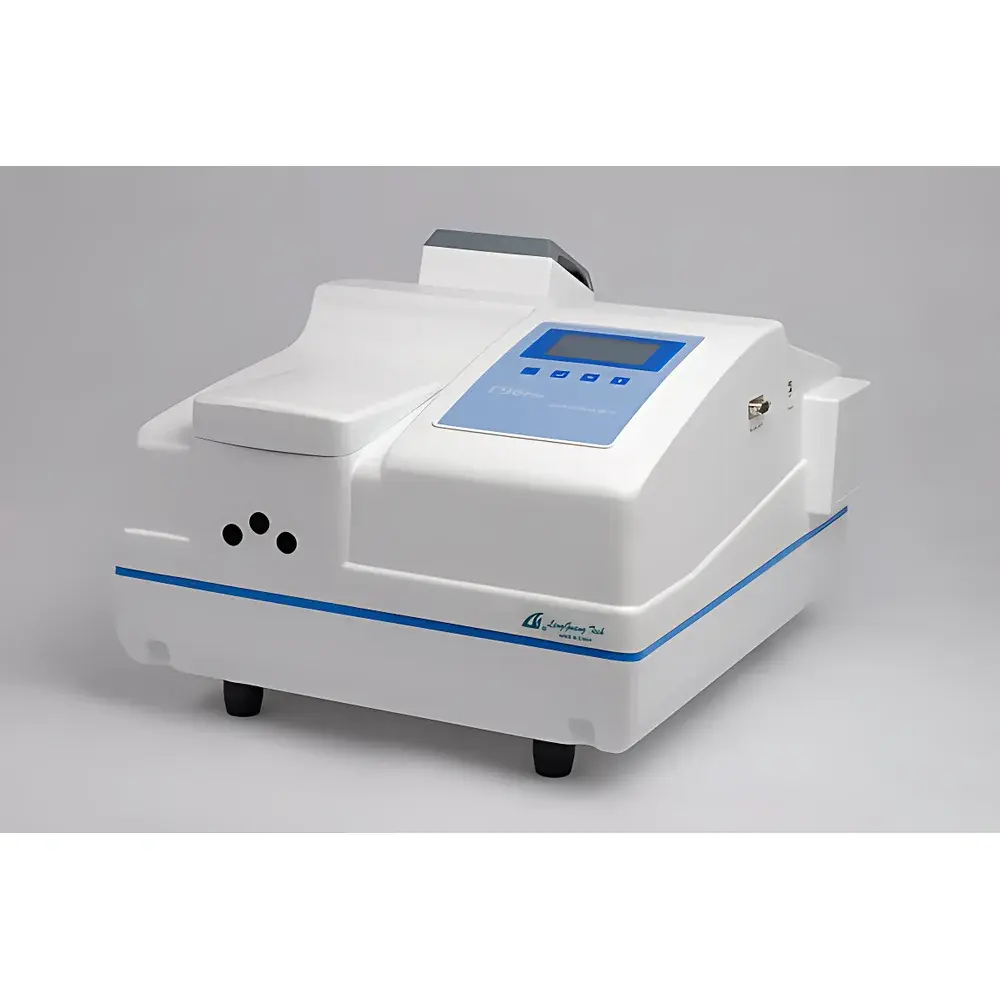
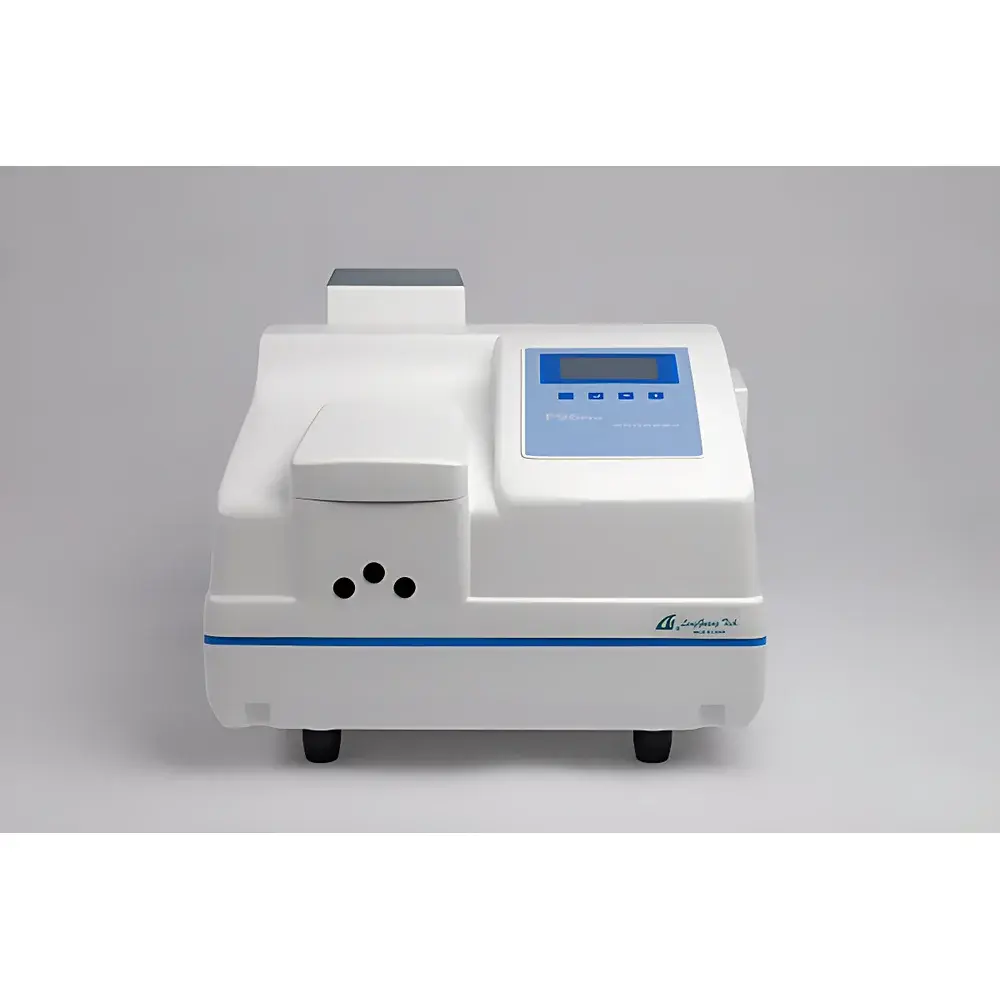
Lengguang Tech F96S Steady-State Molecular Fluorescence Spectrometer
| Brand | Lengguang Tech |
|---|---|
| Origin | Shanghai, China |
| Manufacturer Type | Direct Manufacturer |
| Instrument Type | Steady-State Fluorescence Spectrometer |
| Model | F96S |
| Dispersion Element | Holographic Grating |
| Slit Width (Spectral Bandwidth) | 10 nm |
| Spectral Resolution | 10 nm |
| Sensitivity | >90:1 (Water Raman SNR) |
| Wavelength Accuracy | ±1.0 nm |
| Excitation Wavelength Range | 250–600 nm (LED-based) |
| Emission Wavelength Range | 200–650 nm |
| Emission Wavelength Repeatability | ≤0.5 nm |
| Standard Excitation Sources | 365 nm, 376 nm, 392 nm, 405 nm LEDs |
| Scan Speed | Up to 48,000 nm/min |
| Normalization Function | Fluorescence Intensity Normalization |
| Software Modes | Fluorescence Intensity & Luminescence Intensity |
| Data Processing | 1st–4th Derivative Spectra, Peak Detection, Area Integration, Multi-Curve Overlay, Ratio Analysis |
| Quantitative Methods | Calibration Curve (1st–3rd order), Coefficient Method |
| Sample Forms | Liquid, Powder, Thin Film |
| Compliance | Designed for ISO/IEC 17025-aligned laboratory workflows, supports GLP documentation practices |
Overview
The Lengguang Tech F96S Steady-State Molecular Fluorescence Spectrometer is an entry-level yet rigorously engineered benchtop instrument designed for quantitative and qualitative fluorescence analysis in academic, industrial, and regulatory environments. It operates on the principle of steady-state photoluminescence detection—where a sample is excited by discrete-wavelength LED sources, and the resulting emission is dispersed via a Czerny–Turner monochromator equipped with a holographic grating and measured using a low-noise photomultiplier tube (PMT) or silicon photodiode detector. Unlike traditional xenon-arc or mercury-lamp systems, the F96S employs solid-state LED excitation sources (365, 376, 392, and 405 nm standard), delivering stable output, minimal thermal drift, and negligible UV ozone generation—critical for long-duration kinetic experiments and routine teaching labs requiring reproducibility across user groups.
Key Features
- Four integrated, temperature-stabilized LED excitation sources (365 nm, 376 nm, 392 nm, 405 nm) enable rapid switching between excitation conditions without mechanical filter wheels or lamp alignment.
- High-speed spectral scanning up to 48,000 nm/min ensures full-emission spectra acquisition in under one second—ideal for time-resolved screening and high-throughput assay development.
- 10 nm spectral bandwidth (slit-controlled) provides optimal balance between signal-to-noise ratio and spectral discrimination for small-molecule fluorophores and protein-bound probes.
- Fluorescence intensity normalization algorithm compensates for inter-instrument variability, enabling cross-laboratory data comparability—particularly valuable in multi-site educational programs and collaborative research consortia.
- Dual operational modes: Fluorescence Intensity mode (for spectral scanning, kinetics, and quantitation) and Luminescence Intensity mode (for phosphorescence or delayed emission studies where longer integration times are required).
- Robust optical architecture with minimized stray light path and optimized PMT voltage regulation ensures consistent detection down to sub-nanomolar concentrations in aqueous standards (e.g., quinine sulfate in 0.1 M H2SO4).
Sample Compatibility & Compliance
The F96S accommodates standard 10 mm quartz or disposable polystyrene cuvettes (1 cm pathlength), as well as powder holders and film stages for solid-phase analysis. Its open-sample compartment design permits integration with optional accessories—including thermostatted cell holders (±0.1 °C), magnetic stirrers, and fiber-optic probes—for in situ or flow-through measurements. While not certified to IEC 61000-4 EMC standards out-of-box, its electromagnetic emissions profile meets Class B limits per CISPR 11 when operated in typical lab environments. The system supports audit-ready operation: all spectral acquisitions, parameter settings, and calibration logs are timestamped and exportable in CSV and ASCII formats, facilitating compliance with ISO/IEC 17025 clause 7.7 (result reporting) and foundational elements of FDA 21 CFR Part 11 when paired with institutional electronic record policies.
Software & Data Management
The proprietary F96S Control & Analysis Suite (v3.2+) runs natively on Windows 10/11 and provides full local control over excitation selection, scan parameters, detector gain, and integration time. Spectral processing includes baseline correction (Rubberband, Asymmetric Least Squares), smoothing (Savitzky–Golay, 3–15 point), peak deconvolution (Gaussian/Lorentzian fitting), and derivative spectroscopy (1st–4th order). Quantitative modules support multi-point calibration with polynomial regression (linear to cubic), error propagation reporting, and limit-of-detection (LOD) calculation per IUPAC guidelines. All raw data files (.f96) embed metadata (instrument ID, operator name, date/time, environmental temp/humidity if logged externally), ensuring traceability in GLP/GMP-aligned workflows.
Applications
The F96S serves as a primary analytical tool in undergraduate chemistry and biochemistry laboratories for teaching Beer–Lambert law validation, quantum yield estimation, and Förster resonance energy transfer (FRET) principles. In applied settings, it supports QC testing of pharmaceutical excipients (e.g., residual fluorescein in PEG formulations), enzymatic activity assays (e.g., β-galactosidase using MUG substrate), heavy metal detection via chelation-induced fluorescence enhancement (e.g., Al3+/morin complexes), and polymer degradation monitoring through carbonyl-related emission shifts. Environmental applications include PAH profiling in water extracts and chlorophyll-a quantification in algal blooms—leveraging its 200–650 nm emission range and high sensitivity at low excitation power.
FAQ
What excitation wavelengths are fixed, and can additional LEDs be added?
The F96S ships with four factory-aligned LEDs (365, 376, 392, 405 nm); no field-upgrade path exists for additional excitation sources due to optical path constraints and firmware calibration dependencies.
Is the instrument compatible with third-party cuvette heaters or chillers?
Yes—standard 10 mm cuvette holders accept commercially available Peltier-based temperature control units (e.g., Quantum Northwest TC125), provided mechanical clearance and electrical isolation are maintained.
Does the software support automated batch processing of multiple samples?
Batch acquisition is supported via sequence programming; however, fully unattended operation (e.g., auto-cuvette exchange) requires external robotic integration not provided by default.
Can emission spectra be corrected for instrument response function?
Yes—the software includes built-in spectral correction using a calibrated reference detector; users may import custom correction files generated from NIST-traceable standards.
What is the recommended maintenance interval for optical alignment verification?
Optical alignment should be verified annually using the included holmium oxide or didymium glass reference filters; no user-serviceable collimation adjustments are accessible without factory calibration tools.




