
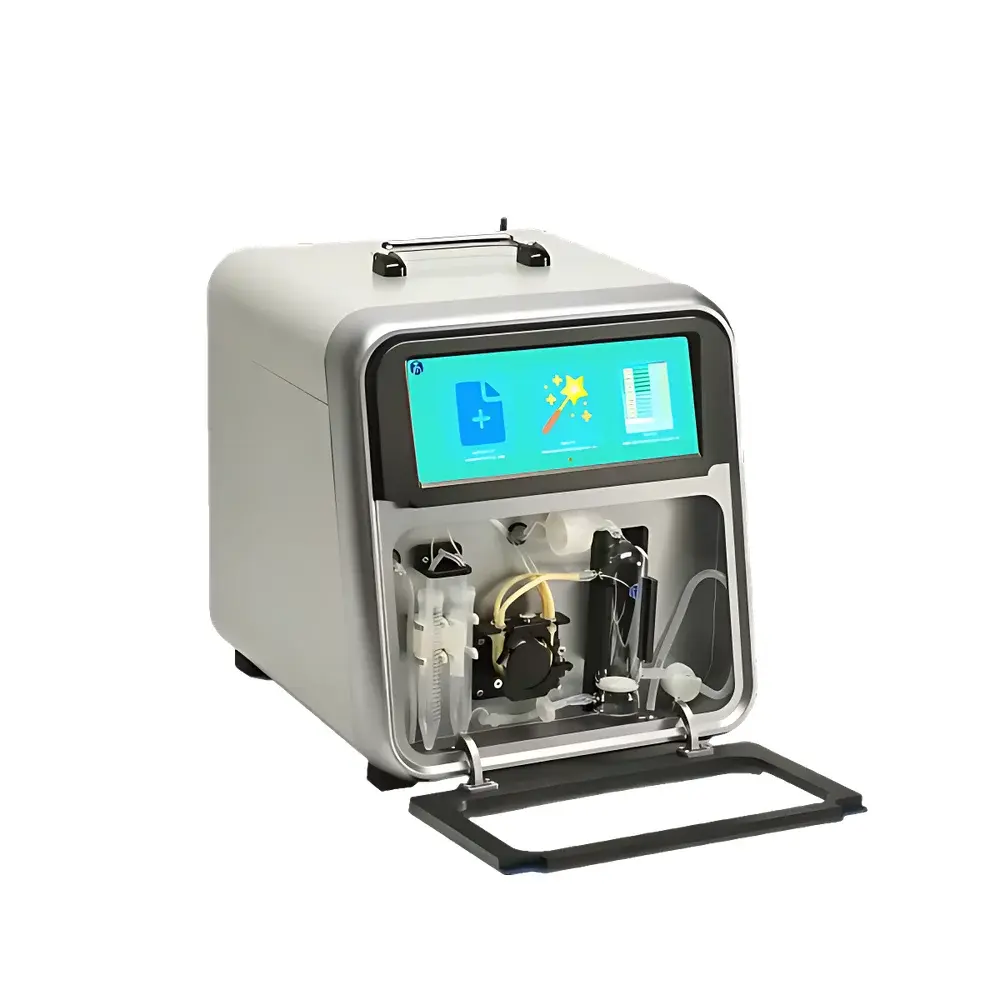
Ability Technology PPA-1200 Portable Dielectric Barrier Discharge Optical Emission Spectrometer
| Brand | Ability Technology |
|---|---|
| Origin | Beijing, China |
| Manufacturer Type | Direct Manufacturer |
| Country of Origin | China |
| Model | PPA-1200 |
| Detection Elements | As, Sb, Pb, Sn, Hg, Se, Bi, Te, Ge in aqueous environmental matrices |
| Detection Limits | Sb ≤ 0.3 ppb, Hg ≤ 0.03 ppb |
Overview
The Ability Technology PPA-1200 is a field-deployable dielectric barrier discharge optical emission spectrometer (DBD-OES) engineered for rapid, on-site trace metal analysis in environmental water samples. Unlike conventional laboratory-based atomic spectroscopy systems—such as ICP-OES or GF-AAS—the PPA-1200 employs a low-power, atmospheric-pressure microplasma source generated via dielectric barrier discharge to atomize and excite analyte elements directly in liquid microsamples (typically 10–100 µL). Emitted spectral lines in the UV–visible range (190–800 nm) are resolved by a high-resolution Czerny–Turner monochromator and detected using a thermoelectrically cooled CCD array. This architecture eliminates the need for argon gas supply, high-voltage RF generators, or complex nebulization systems—enabling true portability without compromising analytical rigor. The instrument is specifically optimized for emergency response scenarios where immediate identification and quantification of toxic heavy metals—including arsenic (As), antimony (Sb), lead (Pb), mercury (Hg), selenium (Se), and bismuth (Bi)—are critical to risk assessment and regulatory decision-making.
Key Features
- Compact, battery-operated design (≤12 kg) with integrated sample introduction module, plasma source, optical path, and detector—fully self-contained for vehicle-mounted or handheld deployment.
- Sub-ppb detection capability: validated limits of detection (LODs) of ≤0.3 ppb for Sb and ≤0.03 ppb for Hg in deionized water matrix, meeting EPA Method 200.8 sensitivity benchmarks for field screening.
- Automated calibration and drift correction using internal reference lines (e.g., Hg 253.65 nm, As 193.696 nm) and dual-standard bracketing to ensure measurement stability over extended field shifts.
- Ruggedized aluminum chassis with IP54-rated enclosure, shock-absorbing mounts, and thermal management system enabling operation across –10 °C to +45 °C ambient conditions.
- Pre-configured method libraries for EPA-regulated metals, including speciation-aware protocols for inorganic Hg(II) and methylmercury surrogates under controlled reduction conditions.
Sample Compatibility & Compliance
The PPA-1200 accepts raw or filtered environmental water samples—including surface water, groundwater, wastewater effluent, and drinking water—with minimal pretreatment (acidification to pH <2 with ultrapure HNO₃ recommended). It accommodates variable salinity (up to 35 g/L TDS) and organic load (≤20 mg/L DOC) without signal suppression beyond ±8% relative standard deviation. All hardware and firmware comply with IEC 61326-1 (EMC for laboratory equipment), ISO/IEC 17025:2017 clause 5.9 (method validation requirements), and support audit-ready documentation per GLP and EPA Region 10 Field Sampling Guidance. Data integrity conforms to FDA 21 CFR Part 11 principles through electronic signature-enabled user access control, immutable result logs, and time-stamped audit trails.
Software & Data Management
The proprietary AcqSpectra™ v3.2 software provides real-time spectral acquisition, multivariate background correction (using iterative polynomial fitting), and element-specific peak integration with automatic interference flagging (e.g., Fe 238.204 nm overlap on As 238.204 nm). Quantitative results are reported in µg/L or ppb with uncertainty estimation per GUM (JCGM 100:2018). Export formats include CSV, PDF analytical reports (with embedded metadata: GPS coordinates, operator ID, sampling timestamp), and direct upload to cloud-based environmental data platforms (EPA STORET, WQX, or custom LIMS via REST API). Software validation documentation—including IQ/OQ/PQ test scripts—is supplied with each unit.
Applications
- Rapid assessment during chemical spill incidents involving heavy metal contamination (e.g., mining tailings breach, industrial runoff).
- Field verification of treatment plant effluent compliance prior to discharge authorization.
- Mobile monitoring campaigns in remote watersheds lacking fixed laboratory infrastructure.
- Supporting ISO 14001 environmental management system audits with traceable, defensible field data.
- Academic and regulatory method development for DBD-based elemental analysis under ASTM D8255-22 (Standard Guide for Plasma-Based Elemental Analysis).
FAQ
What sample volume is required for a single analysis?
Typical analysis consumes 20–50 µL of acidified aqueous sample; no preconcentration is needed for sub-ppb detection.
Does the instrument require external gas supply or vacuum pump?
No—DBD plasma operates at ambient pressure using only electrical power (12 V DC or AC 100–240 V); no compressed gas or vacuum system is integrated or required.
How is spectral interference managed for multi-element analysis?
AcqSpectra™ applies matrix-matched interference correction algorithms and supports user-defined spectral windows to isolate analyte peaks from overlapping lines of major ions (e.g., Ca, Na, Cl).
Can the PPA-1200 be used for solid or soil leachate analysis?
Yes—validated for EPA Method 6010D leachates (TCLP, SPLP); direct analysis of digested soils requires dilution to maintain plasma stability and avoid carbon deposition.
Is remote diagnostics and firmware update supported?
Yes—via secure TLS-encrypted Wi-Fi or cellular modem; updates are digitally signed and require dual-user approval to maintain regulatory compliance integrity.







