
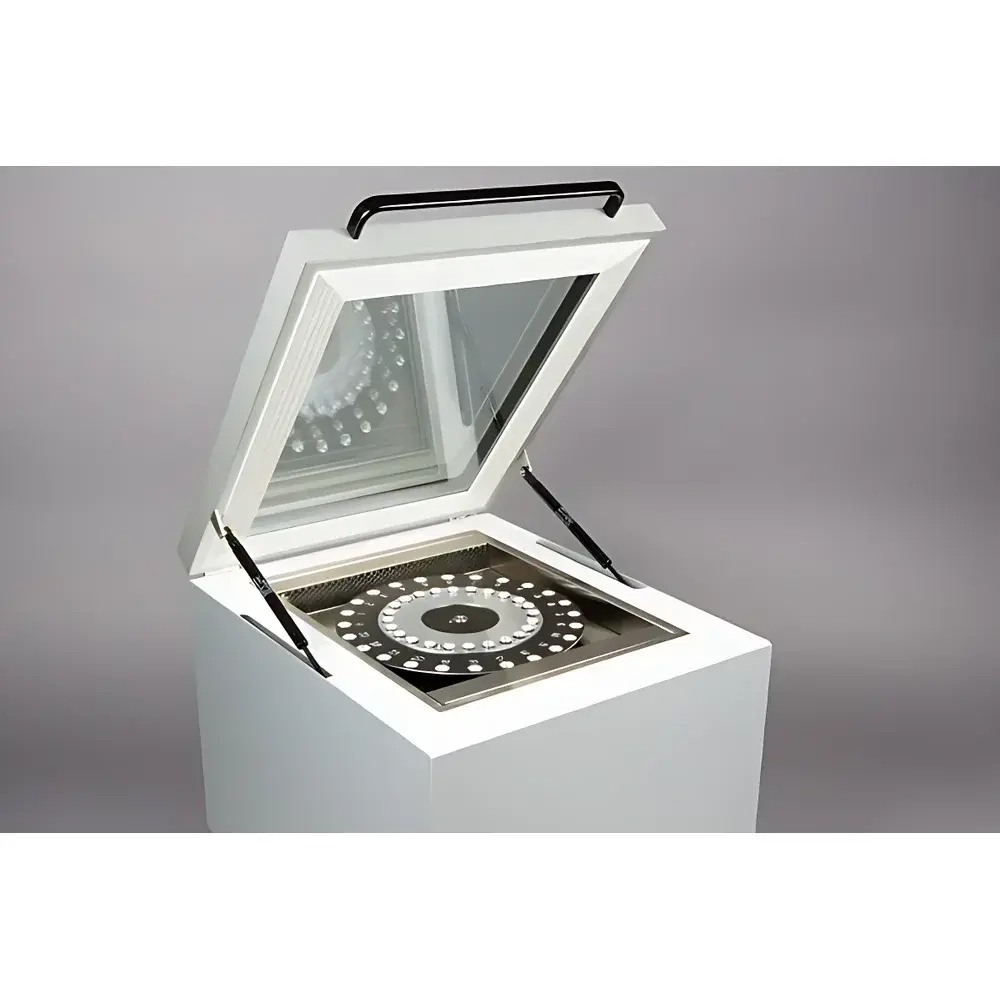
SPS Series High-Throughput Dynamic Vapor Sorption Analyzer
| Origin | Germany |
|---|---|
| Supplier Type | Authorized Distributor |
| Origin Category | Imported Instrument |
| Model | SPS Series |
| Pricing | Available Upon Request |
Overview
The SPS Series High-Throughput Dynamic Vapor Sorption (DVS) Analyzer is a gravimetric instrument engineered for precise, automated measurement of moisture sorption and desorption behavior under controlled relative humidity (RH) and temperature conditions. Based on the fundamental principle of microbalance-based mass change detection in a regulated vapor environment, the system quantifies water vapor uptake or loss as a function of RH (0–98% RH, ±0.1% RH control) and temperature (5–60 °C, ±0.1 °C stability). This enables generation of full isotherms, kinetic sorption/desorption profiles, hysteresis analysis, and thermodynamic parameter derivation (e.g., isosteric heat of sorption via van’t Hoff analysis). Designed for materials science, pharmaceuticals, food science, and packaging R&D, the SPS platform supports regulatory-compliant characterization required for formulation stability, excipient compatibility, lyophilization cycle development, and barrier performance evaluation.
Key Features
- High-throughput parallel analysis: Simultaneous monitoring of up to 23 samples using a precision rotary sample carousel — significantly reducing per-sample test time and enhancing statistical robustness for batch qualification or comparative studies.
- Modular sample handling architecture: Interchangeable rotating sample stages accommodate discs of 18 mm, 30 mm, 50 mm, and 80 mm diameter. Geometry-agnostic design ensures uniform vapor exposure for powders, granules, tablets, films, foams, botanical matrices, and even sealed-packaged specimens without unpacking.
- Dual-range electromagnetic force compensation balance: High-resolution weighing system with two selectable capacities (0.1 µg–1 g and 1 µg–220 g), enabling accurate mass tracking across trace-level hygroscopic transitions and macro-scale permeation tests.
- Fully autonomous operation: Predefined humidity/temperature ramps, dwell steps, and equilibration criteria execute unattended — delivering complete adsorption-desorption isotherms, dynamic kinetics curves, and cyclic aging profiles in a single run.
- Integrated variable-temperature capability: On-the-fly temperature modulation during RH stepping allows direct acquisition of temperature-dependent sorption isotherms — critical for modeling real-world storage conditions and predicting shelf-life under thermal stress.
- Gravimetric water vapor transmission rate (WVTR) testing: Compliant with ASTM E96 and ISO 15106 standards; supports quantitative permeability assessment of flexible packaging films, laminates, coated papers, metallized foils, and barrier coatings.
Sample Compatibility & Compliance
The SPS analyzer accommodates heterogeneous solid-state materials without preprocessing: amorphous and crystalline APIs, excipients, polymers, ceramics, catalysts, MOFs, dried herbs, roasted coffee, and composite packaging structures. Its non-destructive, chamber-integrated HD camera (1080p, real-time imaging) captures morphological evolution (cracking, deliquescence, swelling) during hydration/dehydration cycles. Optional Raman spectroscopy integration enables concurrent molecular fingerprinting — correlating structural changes (e.g., hydrate formation, polymorphic transition, amorphization) with mass uptake events. The system meets GLP/GMP documentation requirements, supporting audit-ready electronic records with full 21 CFR Part 11–compliant user access control, electronic signatures, and immutable audit trails.
Software & Data Management
Controlled via DVS Studio software (Windows-based), the platform provides intuitive method builder, live data visualization, multi-parameter curve fitting (GAB, BET, Peleg models), and export to CSV, Excel, or PDF. All raw mass/time/RH/temperature datasets are timestamped and stored with metadata (operator ID, calibration logs, environmental chamber logs). Batch reporting tools generate comparative summaries across sample sets, including Δm%, RH₅₀, monolayer capacity, and diffusion coefficient estimation. Data integrity is preserved through automatic backup, version-controlled method templates, and configurable retention policies aligned with ISO/IEC 17025 laboratory management systems.
Applications
- Pharmaceuticals: Excipient moisture sensitivity screening, API hydration state mapping, tablet coating integrity verification, and stability protocol development per ICH Q1/Q5.
- Packaging Science: WVTR benchmarking of mono- and multilayer films, shelf-life prediction modeling, and barrier layer optimization.
- Food & Agriculture: Water activity (aw) profiling of powders, grains, and dehydrated products; texture degradation kinetics linked to moisture ingress.
- Advanced Materials: Hydration-driven mechanical property shifts in hydrogels, cementitious systems, and porous carbons; MOF water capture efficiency validation.
- Natural Products: Quantification of hygroscopic equilibrium in botanical extracts, essential oils, and traditional herbal formulations — preserving authenticity during storage.
FAQ
What humidity range and control accuracy does the SPS system achieve?
The system delivers 0–98% RH with ±0.1% RH precision using dual-channel N₂/H₂O vapor mixing and feedback-controlled saturation modules.
Can the instrument perform cyclic sorption-desorption experiments?
Yes — programmable multi-step RH cycling with adjustable dwell times and equilibration thresholds enables hysteresis loop analysis and aging simulation.
Is calibration traceable to national standards?
All balances are factory-calibrated against certified weights (NIST-traceable); RH sensors are validated using saturated salt solutions per ISO 15106-3.
Does the system support IQ/OQ/PQ documentation packages?
Comprehensive validation protocols — including installation qualification (IQ), operational qualification (OQ), and performance qualification (PQ) templates — are provided for GxP-regulated environments.
How is data security maintained during long-duration runs?
Real-time local database logging with automatic failover, encrypted backups, and power-loss recovery ensure zero data loss across multi-day experiments.





