
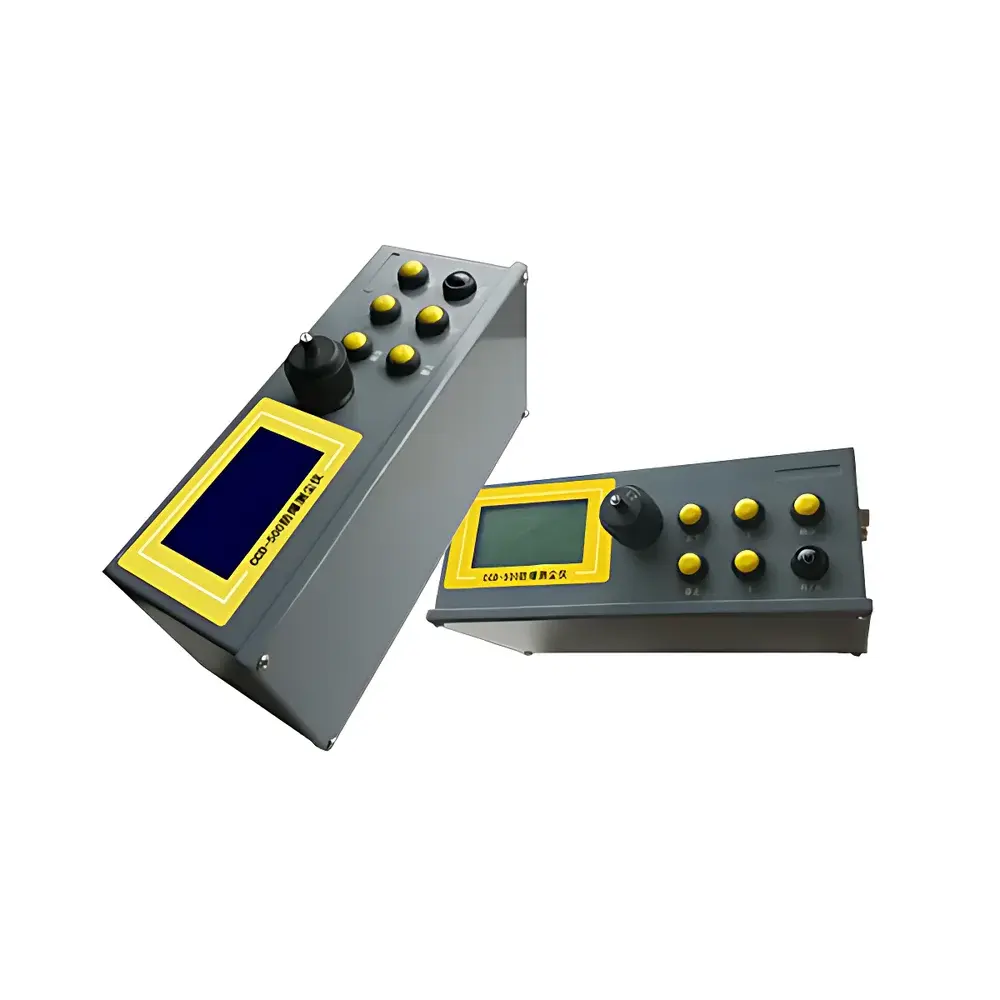
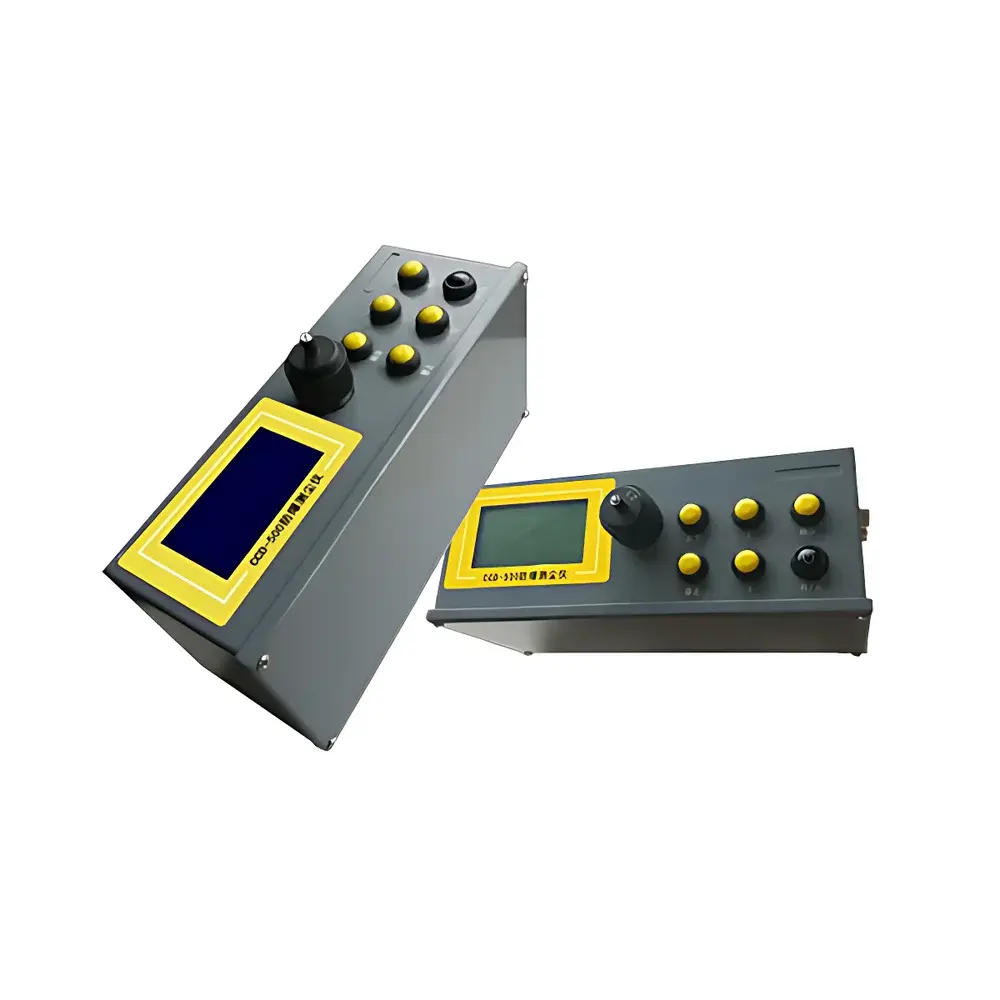
Ju Chuang CCD-500 Intrinsically Safe Explosive-Proof Dust Monitor
| Brand | Ju Chuang Environmental |
|---|---|
| Origin | Shandong, China |
| Model | CCD-500 |
| Explosion Protection Mark | Exib II BT4 Gb |
| Measurement Principle | Laser Light Scattering |
| Measurement Range | 0.01–100 mg/m³ (standard), with optional ranges up to 0.001–1000 mg/m³ |
| Resolution | 0.001 mg/m³ or 0.01 mg/m³ (user-selectable) |
| Accuracy | ±15% repeatability error |
| Particle Size Selectivity | PM1, PM2.5, PM5, PM10, TSP via interchangeable impactors |
| Sampling Mode | Real-time optical + integrated filter-based gravimetric sampling |
| Compliance | JJG 846–1993, TB/T 2323–1992, WS/T 206–2001 |
| Operating Environment | Zone 1 & 2, Group IIB, Temperature Class T4 |
Overview
The Ju Chuang CCD-500 Intrinsically Safe Explosive-Proof Dust Monitor is a portable, real-time particulate matter (PM) concentration analyzer engineered for hazardous environments where flammable gases, vapors, or combustible dusts may be present. It employs the well-established principle of laser light scattering—where airborne particles pass through a collimated laser beam and generate scattered light proportional to their size and concentration—to deliver rapid, quantitative mass concentration readings in mg/m³. Unlike passive gravimetric samplers, the CCD-500 provides immediate feedback within one minute while simultaneously supporting offline validation via integrated filter-based sampling. Its intrinsically safe design (Exib II BT4 Gb, certified under CE15.2063) ensures operational safety in Zone 1 and Zone 2 classified areas per IEC 60079-0 and IEC 60079-11, making it suitable for coal mines, chemical processing facilities, grain silos, pharmaceutical manufacturing suites, and other high-risk industrial settings governed by ATEX/IECEx frameworks.
Key Features
- Real-time optical measurement with selectable integration time (1 min default, configurable per user requirement)
- Dual-mode operation: simultaneous laser scattering quantification and gravimetric filter collection on PTFE or PVC membrane filters
- Interchangeable particle-cutting impactors for PM1, PM2.5, PM5, PM10, and total suspended particulates (TSP) compliance
- Optical chamber protected by laminar air curtain and self-cleaning purge gas system to prevent lens fouling and maintain signal integrity
- Onboard zero calibration routine with automatic baseline correction and drift compensation
- Internal data logging with timestamped records (up to 10,000 samples), exportable via RS232/USB interface
- Programmable alarm thresholds with visual and audible alerts for exceedance events
- Robust aluminum alloy housing rated IP54 for dust and splash resistance
Sample Compatibility & Compliance
The CCD-500 is validated for use with respirable dust fractions as defined in occupational health standards. Its optical response is calibrated against ISO 12103-1 A2 test dust and traceable reference aerosols, enabling direct correlation to gravimetric results when used alongside standardized filter weighing protocols. The instrument complies with Chinese national metrological verification regulation JJG 846–1993 for digital light-scattering dust meters, railway industry standard TB/T 2323–1992 for mass concentration conversion factors, and public health guideline WS/T 206–2001 for PM10 monitoring in indoor and outdoor ambient air. While not certified to ISO 29463 or EN 15267 for continuous emissions monitoring systems (CEMS), its performance characteristics align with field-deployable reference-grade instrumentation for occupational exposure assessment under OSHA 29 CFR 1910.1200 and EU Directive 2004/37/EC (CARC).
Software & Data Management
Data acquisition and configuration are managed via dedicated PC software compatible with Windows 7–11 (64-bit). The application supports bidirectional communication for firmware updates, parameter configuration, and batch download of stored measurements. Export formats include CSV and XLSX; time-series plots, concentration histograms, and compliance summary reports can be generated automatically. All data transfers occur outside explosive atmospheres, in accordance with IEC 60079-27 requirements for associated apparatus. Audit trails, user access logs, and electronic signatures are not embedded in the device firmware but may be implemented at the host PC level for GLP-aligned workflows. No cloud connectivity or remote telemetry capabilities are included—consistent with intrinsic safety architecture constraints.
Applications
- Occupational hygiene monitoring in underground mining, tunneling, and foundry operations
- Process dust control verification during powder handling, mixing, and pneumatic conveying
- Emergency response screening following dust release incidents (e.g., silo overflow, baghouse failure)
- Validation of local exhaust ventilation (LEV) system performance per HSE HSG258 guidelines
- Baseline ambient PM mapping in peri-industrial communities under national environmental monitoring programs
- Supporting method development for K-factor derivation between optical and gravimetric mass concentrations
FAQ
What does “intrinsically safe” mean for the CCD-500, and how is it verified?
The CCD-500 meets the Exib II BT4 Gb classification per IEC 60079-11, indicating that all internal circuits are designed to limit energy below ignition thresholds for Group IIB gases (e.g., acetone, ethyl alcohol) at surface temperatures ≤135°C. Certification CE15.2063 confirms third-party testing by a CNAS-accredited body.
Can the CCD-500 be used for regulatory compliance reporting?
Yes—for workplace exposure monitoring under Chinese GBZ 2.1–2019 and analogous national frameworks. However, final compliance determination requires concurrent gravimetric validation per JJG 846–1993 Annex B to establish site-specific calibration coefficients.
Is filter-based sampling mandatory for every measurement cycle?
No. Optical measurement operates independently; filter collection is optional and programmable. When enabled, it runs concurrently without affecting real-time readout latency.
Does the instrument support external pump flow control or pressure compensation?
It includes a built-in constant-flow sampling pump (±5% stability over 1–3 L/min) but lacks dynamic barometric or temperature compensation. Field corrections must be applied post-acquisition using ambient sensor data.
How often does the optical system require maintenance?
Under normal operating conditions, the air curtain and self-purge function minimize contamination. Lens inspection and cleaning are recommended every 200 hours of cumulative runtime or after exposure to high-humidity or oil-laden aerosols.







