
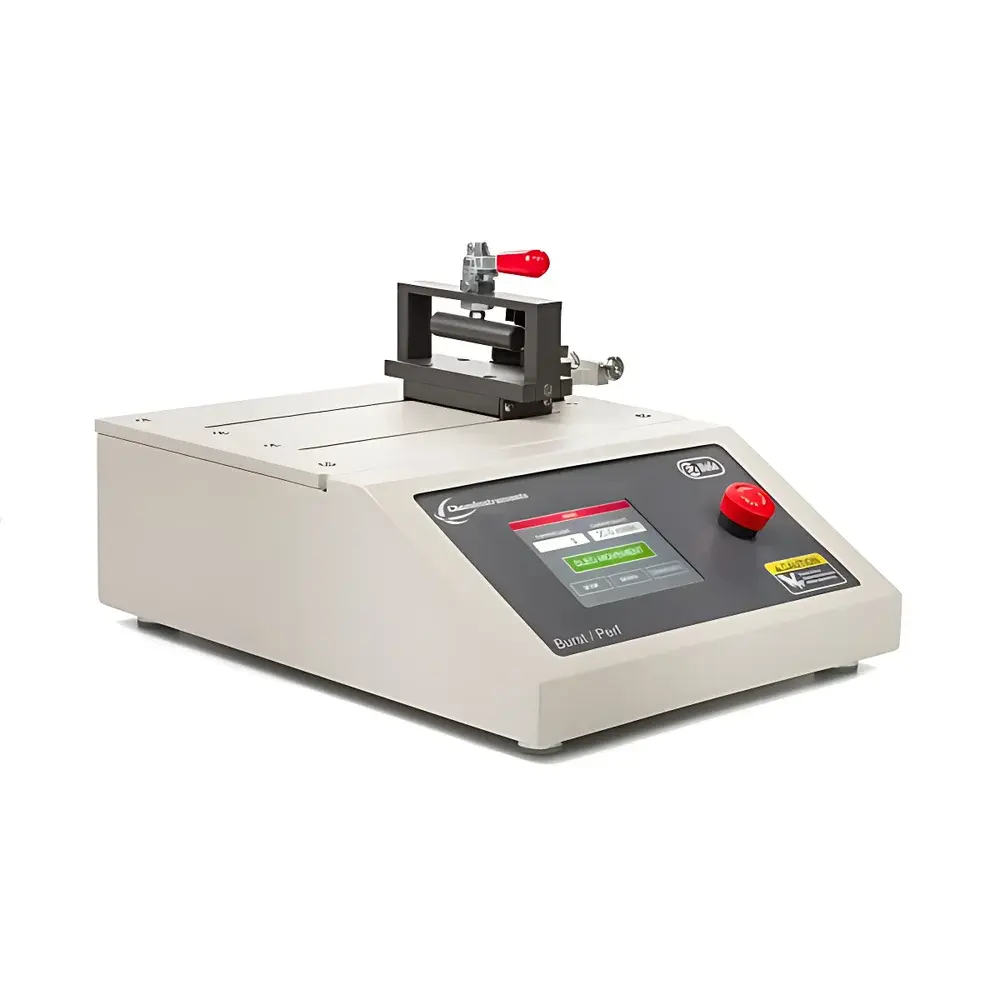
ChemInstruments BP-2000 Burst and Pinch Testing Machine
| Brand | ChemInstruments |
|---|---|
| Origin | USA |
| Model | BP-2000 |
| Load Cell Capacity | 25 lbf (standard), optional 2, 5, 10, and 50 lbf |
| Force Resolution | 0.1% of full scale |
| Maximum Test Force | 50 lbf (222.4 N) |
| Test Speed Range | 0.5–25 IPM (1–64 CPM), adjustable in 0.5 IPM increments |
| Data Acquisition Rate | 1,000–5,000 points/second |
| Test Length Range | 0.25–1.5 in (0.5–3.5 cm), adjustable in 0.25 in (0.5 cm) increments |
| Operating Temperature | 0–70 °C (32–150 °F) |
| Power Input | 85–265 VAC, 50/60 Hz |
| Dimensions (H×W×D) | 63 × 46 × 25 cm |
| Weight | 20 kg |
| Display | 5.7-inch integrated touchscreen interface |
| Data Export | USB to EZ Data software |
| Compliance | Designed for TLMI-1G and PSTC test methods |
| Load Cell Options | 2, 5, 10, 25, and 50 lbf capacities available |
Overview
The ChemInstruments BP-2000 Burst and Pinch Testing Machine is an electromechanical force-testing system engineered for precise, repeatable measurement of burst strength, pinch resistance, and delamination onset in flexible packaging, pressure-sensitive tapes, labels, laminates, and coated films. It operates on a controlled-rate-of-traverse (CRT) principle, applying uniaxial tensile force at programmable speeds while continuously monitoring load displacement response. The instrument complies with standardized test methodologies including TLMI-1G (Tape and Label Manufacturers Institute) for burst ratio evaluation and PSTC-107 (Pressure Sensitive Tape Council) for peel and shear-related mechanical integrity assessment. Its rigid cast-aluminum frame and precision-ground linear motion assembly ensure minimal deflection under load, supporting high reproducibility across laboratory, QC, and contract testing environments.
Key Features
- Integrated 5.7-inch capacitive touchscreen interface enabling standalone operation—no external PC required for test setup, execution, or real-time result review.
- Encoder-based digital speed control delivering stable, low-drift traverse rates from 0.5 to 25 inches per minute (IPM), with resolution down to 0.5 IPM increments.
- High-fidelity load measurement using a factory-calibrated 25 lbf (111.2 N) load cell (standard), traceable to NIST standards; optional load cells (2, 5, 10, and 50 lbf) support broad dynamic range requirements.
- Programmable test length selection (0.25–1.5 in / 0.5–3.5 cm in 0.25-in steps) enables method-specific specimen engagement geometry per TLMI-1G or internal SOPs.
- Real-time data acquisition at up to 5,000 Hz ensures accurate capture of peak force, inflection points, and post-yield behavior—even during rapid failure events.
- Onboard memory stores complete test records including max/min/average force values, time-stamped event markers, and raw waveform traces.
- Universal AC input (85–265 VAC, 50/60 Hz) eliminates need for voltage converters in global deployment.
Sample Compatibility & Compliance
The BP-2000 accommodates flat, sheet-like specimens up to 100 mm wide and 2 mm thick, including single- and multi-layer polymer films, foil-laminates, paperboard composites, and adhesive-coated substrates. Fixture adaptability supports standard TLMI-1G burst dies and custom-designed pinch anvils. All test protocols align with ASTM D882 (tensile properties of thin plastic sheeting), ISO 1184 (bursting strength of paper and board), and relevant sections of FDA 21 CFR Part 11 when used with validated EZ Data software configurations. Instrument design facilitates GLP/GMP audit readiness through timestamped electronic records, user-access controls, and non-modifiable data export logs.
Software & Data Management
Test data are exported via USB to the EZ Data analysis suite—a Windows-based application supporting statistical process control (SPC), trend charting, comparative cohort analysis, and PDF report generation. The software enforces ALCOA+ principles (Attributable, Legible, Contemporaneous, Original, Accurate, Complete, Consistent, Enduring, Available) and may be configured for 21 CFR Part 11 compliance—including electronic signatures, audit trails, and role-based permissions—when deployed in regulated quality systems. Raw binary files retain full-resolution waveform metadata for forensic reanalysis.
Applications
- Quantifying burst resistance of pouch seals and blister cavity lids in pharmaceutical and medical device packaging.
- Evaluating cohesive strength and interlayer adhesion in extrusion-laminated snack food wrappers.
- Validating seal integrity of heat-sealed polyethylene films per ASTM F88.
- Measuring pinch resistance of label facestocks during high-speed applicator trials.
- Supporting root-cause analysis of premature delamination in automotive interior trim laminates.
- Generating comparative datasets for supplier qualification against internal material specifications.
FAQ
Is the BP-2000 compliant with TLMI-1G test method requirements?
Yes—the mechanical architecture, speed control fidelity, and fixture geometry are specifically validated for TLMI-1G burst ratio testing.
Can the instrument operate without a connected computer?
Yes—full test initiation, parameter configuration, and result visualization occur locally via the integrated touchscreen.
What load cell options are available beyond the standard 25 lbf unit?
Optional capacities include 2 lbf, 5 lbf, 10 lbf, and 50 lbf, each supplied with individual calibration certificates.
Does the system support automated pass/fail criteria based on user-defined limits?
EZ Data software enables configurable acceptance thresholds and automatic flagging of out-of-spec results.
Is thermal environmental control integrated into the BP-2000?
No—the unit operates within ambient temperature ranges of 0–70 °C; external environmental chambers must be used for temperature-conditioned testing.



