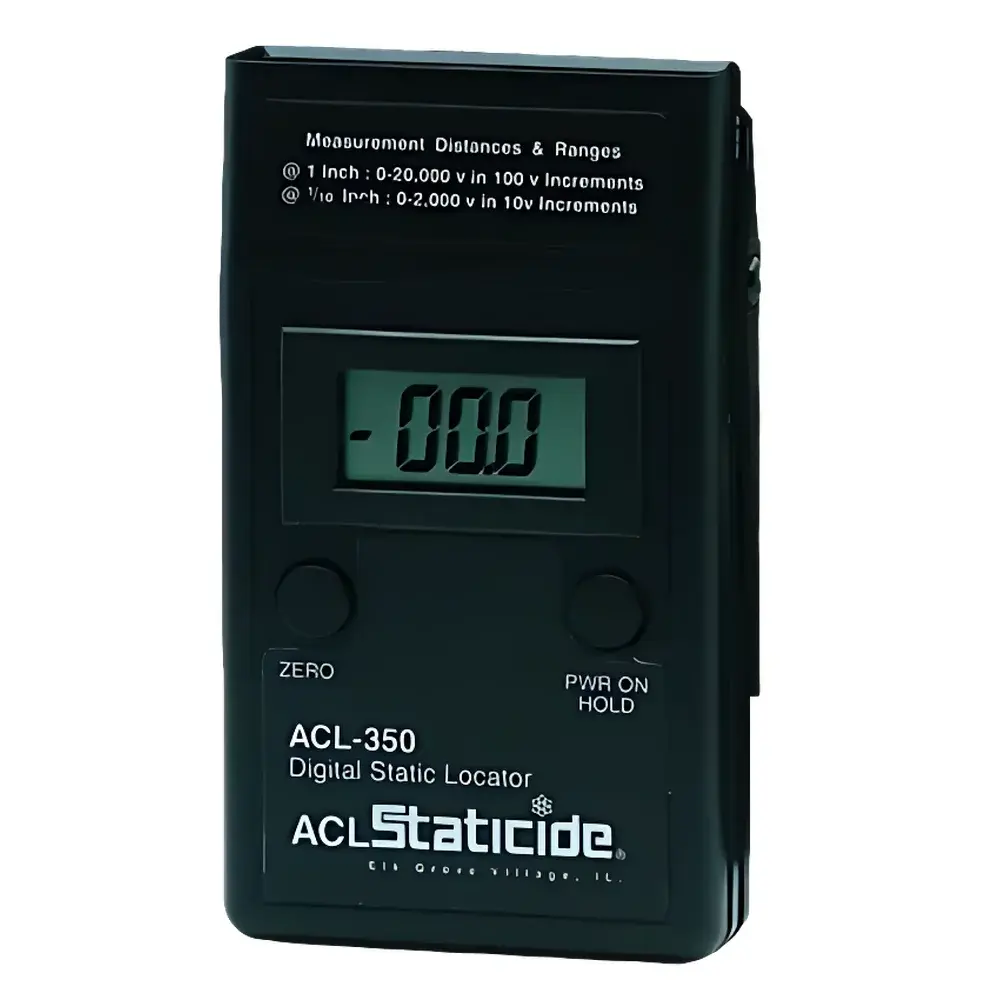
ACL Staticide ACL-350 Electrostatic Voltage Meter
| Brand | ACL Staticide |
|---|---|
| Origin | USA |
| Model | 350 |
| Display | 3.5-digit LCD with polarity indication |
| Battery | 9 V alkaline (included) |
| Measurement Ranges | 1″ (0–20 kV, 100 V resolution) |
| Accuracy | ±10% of reading |
| Operating Temperature | 10–40 °C |
| Humidity Range | ≤80% RH non-condensing |
| Dimensions | 107 mm × 61 mm × 23 mm |
| Weight | 5 oz (142 g) |
| Calibration | NIST-traceable certificate included |
| Warranty | 1 year (voided if case opened) |
| Housing | Conductive antistatic polymer with built-in grounding path |
| Sample Distance Dependency | Explicitly defined per probe-to-surface spacing |
| Compliance | Meets ANSI/ESD S20.20 and IEC 61340-5-1 recommended practices for electrostatic field measurement |
Overview
The ACL Staticide ACL-350 Electrostatic Voltage Meter is a handheld, non-contact field meter engineered for quantitative measurement of surface electrostatic potentials in cleanroom, electronics manufacturing, packaging, and medical device assembly environments. It operates on the principle of capacitive coupling to detect electric field strength generated by static charge accumulation on insulating or isolated conductive surfaces. Unlike contact-based voltmeters, the ACL-350 measures voltage without physical contact—eliminating charge disturbance and enabling repeatable, non-invasive assessment across diverse materials including plastics, foams, films, laminates, and ESD-sensitive components. Its design adheres to the fundamental physics of electrostatic field decay with distance, requiring operator-defined measurement standoff distances to ensure traceable, reproducible readings aligned with industry-standard test protocols.
Key Features
- 3.5-digit LCD display with automatic polarity detection—clearly indicates positive (+) or negative (–) surface charge
- Dual-function sample hold button: freezes displayed value for stable recording or documentation
- Integrated battery status indicator (“BAT”) for real-time power monitoring
- Multirange operation calibrated for five standardized probe-to-surface distances (0.1″, 1″, 4″, 6.5″, and 8.5″), each with defined voltage scaling factors and resolution
- Conductive antistatic housing provides inherent grounding continuity when held properly—no external ground strap required during standard use
- Compact ergonomic form factor (107 × 61 × 23 mm) and lightweight construction (142 g) support extended handheld operation in production line audits
- Supplied with NIST-traceable calibration certificate—validating metrological traceability to national standards per ISO/IEC 17025 principles
Sample Compatibility & Compliance
The ACL-350 is validated for use on low-conductivity substrates where charge retention is critical: polyethylene and polypropylene packaging films, expanded polystyrene (EPS) foam carriers, PETG trays, silicon wafer carriers, optical lens housings, and ESD garment fabrics. It supports compliance verification against ANSI/ESD S20.20 Section 8.3 (field measurements), IEC 61340-5-1 Annex B (electrostatic field mapping), and ISO 14644-1 Class 5–8 cleanroom monitoring requirements. While not a Class I measuring instrument per IEC 61010-1, its performance characteristics meet functional safety expectations for routine qualification of static control zones, workstation grounding integrity, and personnel grounding efficacy—particularly when used in conjunction with wrist strap testers and continuous monitors per ESD Association TR20.20 guidelines.
Software & Data Management
The ACL-350 is a standalone analog-digital hybrid instrument with no embedded Bluetooth, USB, or software interface. All data capture is manual: operators record values alongside distance settings, environmental conditions (temperature/humidity), and material identifiers in paper logs or LIMS-integrated spreadsheets. For audit readiness, users are advised to retain original NIST calibration certificates, maintain logbooks with date/time/station/operator fields, and perform periodic in-house verification using reference charged plates per ESD TR53. Though lacking electronic data export, its deterministic scaling logic (e.g., ×2 at 4″) ensures full transparency and facilitates automated post-processing in Excel or statistical process control (SPC) platforms.
Applications
- Verification of static dissipation performance in packaging lines handling PCBs, microfluidic cartridges, or sterile medical kits
- Baseline characterization of tribocharging behavior during film slitting, bag sealing, or roll-to-roll coating processes
- Validation of ionizer balance and decay time in ESD-protected areas (EPAs) per ANSI/ESD STM3.1
- Periodic screening of tote bins, fixtures, and tooling surfaces prior to high-precision assembly operations
- Training and troubleshooting support for ESD coordinators conducting root-cause analysis of latent device failures
- Supporting GLP-compliant documentation in regulated pharmaceutical packaging facilities where static-induced particulate adhesion poses contamination risk
FAQ
What is the minimum measurable voltage at 1-inch distance?
At 1-inch probe-to-surface spacing, the lower limit of detection is 100 V with 100 V resolution; values below this threshold register as “0” on the display.
Can the ACL-350 measure voltage on moving webs or conveyors?
Yes—provided the target surface remains within the specified standoff tolerance and relative motion does not exceed 0.5 m/s to avoid field distortion from air turbulence.
Is recalibration required after battery replacement?
No—battery replacement does not affect calibration; however, annual recalibration is recommended to maintain traceability per ISO/IEC 17025 and internal quality system requirements.
Does the instrument comply with FDA 21 CFR Part 11 for electronic records?
No—the ACL-350 produces no electronic records; manual entry into validated systems must follow site-specific Part 11 procedures for audit trail and signature controls.
Why does the reading change when distance varies?
Electrostatic field strength decays inversely with distance squared; the ACL-350’s range multipliers compensate for this physical relationship, ensuring voltage magnitude—not field intensity—is reported consistently across configurations.