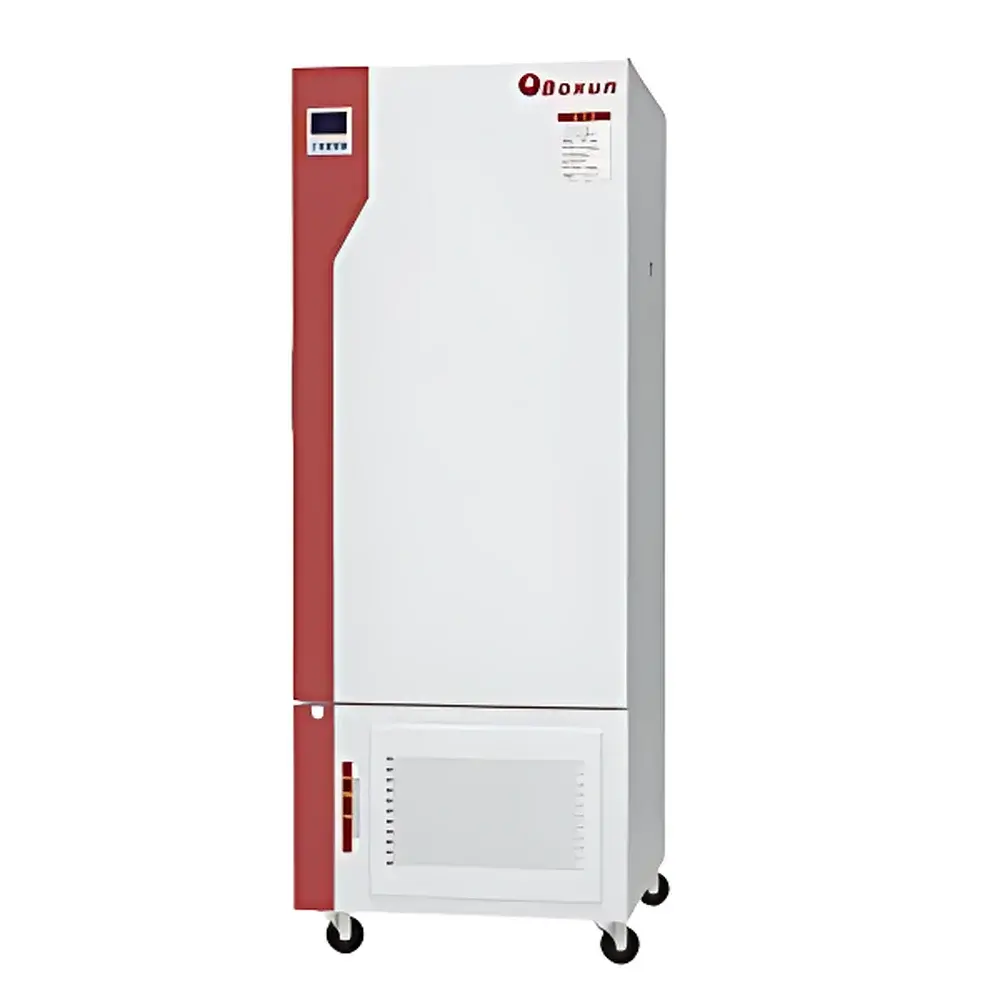
BOXUN BSP-250 Biochemical Incubator
| Brand | BOXUN |
|---|---|
| Origin | Shanghai, China |
| Manufacturer Type | Direct Manufacturer |
| Product Category | Domestic |
| Model | BSP-250 |
| Temperature Range | 0–60 °C |
| Temperature Resolution | 0.1 °C |
| Temperature Uniformity | ±1 °C (at 37 °C) |
| Temperature Fluctuation | ±0.5 °C |
| Input Power | 1100 W |
| Timer Range | 0–9999 min |
| Interior Dimensions (W×D×H) | 510 × 450 × 1090 mm |
| Exterior Dimensions (W×D×H) | 650 × 740 × 1726 mm |
| Shelving | 4 adjustable stainless-steel shelves |
| Refrigerant | Eco-friendly non-CFC refrigerant |
| Compressor | Internationally certified hermetic compressor |
| Control Interface | LCD display with microprocessor-based PID control |
| Communication | RS-485 port for data logging and remote monitoring |
| Programmability | 10-segment, 99-cycle programmable temperature profile |
| Safety Features | Over-temperature alarm, auto-recovery after power interruption, parameter memory retention, mechanical door lock, integrated defrost system (energy-free, non-disruptive) |
| Air Management | Independent fresh-air inlet with on-demand adjustment |
| Optional Accessories | Thermal printer (curve output), GPRS-based SMS alert module, PC-based supervision software |
Overview
The BOXUN BSP-250 Biochemical Incubator is a precision-engineered, microprocessor-controlled environmental chamber designed for stable, reproducible temperature maintenance in life science laboratories. It operates on the principle of forced-air convection with intelligent thermal management—utilizing a high-efficiency hermetic compressor, non-ozone-depleting refrigerant, and an optimized dual-path air circulation system. Unlike passive or natural-convection incubators, the BSP-250 employs a centrifugal blower and proprietary duct architecture to ensure uniform thermal distribution across the entire working volume, minimizing axial and radial gradients. Its operational range spans 0 °C to 60 °C—encompassing mesophilic microbial growth, enzymatic assays, BOD incubation per ISO 5815-1, plant tissue culture, and low-temperature preservation protocols. The unit meets structural and functional requirements aligned with ISO 13485 design controls and supports GLP-compliant workflows through audit-ready parameter logging and power-failure recovery.
Key Features
- Microprocessor-based PID temperature control with 0.1 °C resolution and real-time LCD interface displaying setpoint, actual temperature, elapsed time, and alarm status
- Forced-air convection system featuring a high-torque centrifugal fan and patented internal airflow channeling—achieving ±1 °C uniformity at 37 °C per IEC 61000-4-2 validation guidelines
- Integrated eco-refrigeration architecture using R134a or equivalent non-CFC refrigerant and a globally certified hermetic compressor for sustained stability and energy efficiency
- Independent fresh-air modulation valve enabling continuous or intermittent ventilation without compromising chamber integrity or temperature fidelity
- Four-tier adjustable stainless-steel shelving (mirror-polished 304 grade), compatible with standard Petri dishes, flasks, multiwell plates, and culture bags
- Non-intrusive, energy-free automatic defrost cycle activated by intelligent frost-sensing logic—eliminating thermal transients during long-term operation
- Comprehensive safety suite: over-temperature cut-off, mechanical door lock, EEPROM-based parameter retention, and auto-resume functionality following grid failure or controller reset
Sample Compatibility & Compliance
The BSP-250 accommodates diverse biological sample formats—including aerobic/anaerobic cultures in glass or polycarbonate vessels, suspension-based cell lines, solid-phase microbial colonies on agar media, and hydrated plant explants. Its interior chamber (510 × 450 × 1090 mm) provides unobstructed access via double-glazed observation door and two 30/60 mm diameter utility ports for sensor insertion or gas line integration. The unit complies with electrical safety standards IEC 61010-1 and EMC directive 2014/30/EU. While not classified as medical device under FDA 21 CFR Part 820, it fulfills ancillary equipment criteria for ISO/IEC 17025-accredited testing labs performing water quality analysis (APHA 5210B), pharmaceutical stability studies (ICH Q1A), and microbiological enumeration (ISO 4833-1). Optional RS-485 connectivity enables traceable data export compliant with ALCOA+ principles.
Software & Data Management
Equipped with standard RS-485 serial interface (Modbus RTU protocol), the BSP-250 supports bidirectional communication with laboratory information management systems (LIMS), SCADA platforms, or dedicated data loggers. Firmware stores up to 10 user-defined temperature programs—each comprising 99 sequential steps with ramp/soak profiles—and retains all active parameters in non-volatile memory. Optional PC software (Windows/Linux compatible) provides real-time graphing, CSV export, event tagging, and configurable alarm notifications. When paired with the thermal printer accessory, it generates time-stamped hardcopy records suitable for regulatory submissions. All logged entries include timestamp, setpoint, measured value, and operational state—satisfying documentation requirements for FDA 21 CFR Part 11 if deployed with appropriate electronic signature controls.
Applications
- Biochemical oxygen demand (BOD) incubation per ASTM D5210 and ISO 5815-1 protocols
- Microbial cultivation for food safety testing (ISO 6579, ISO 11290), clinical diagnostics, and environmental monitoring
- Enzyme kinetics and protein stability studies requiring precise sub-ambient or elevated thermal conditions
- Plant physiology research including seed germination, callus induction, and photoperiod-independent growth trials
- QC/QA incubation of reference standards, calibration cultures, and proficiency testing panels
- Long-duration shelf-life assessment of biologics, vaccines, and diagnostic reagents under controlled thermal stress
FAQ
What is the minimum operating temperature of the BSP-250?
The unit achieves stable operation down to 0 °C, verified under load conditions with internal humidity below 70% RH.
Can the incubator maintain temperature uniformity during door opening events?
Yes—the forced-air recovery algorithm restores setpoint within ≤3 minutes after a 10-second door opening, validated per ISO 15197 Annex C methodology.
Is the RS-485 interface compatible with LabVIEW and Python-based automation frameworks?
Yes—Modbus RTU implementation allows native integration via NI-VISA or PyModbus libraries without proprietary drivers.
Does the unit support external CO₂ or humidity control modules?
No—this is a temperature-only incubator; CO₂ and humidity regulation require separate add-on systems or higher-tier models such as the BOXUN BIC series.
How is calibration traceability ensured?
The unit accepts third-party NIST-traceable PT100 probes via its 30 mm utility port; factory calibration certificate includes uncertainty budget per ISO/IEC 17025 clause 6.4.
Related Products