
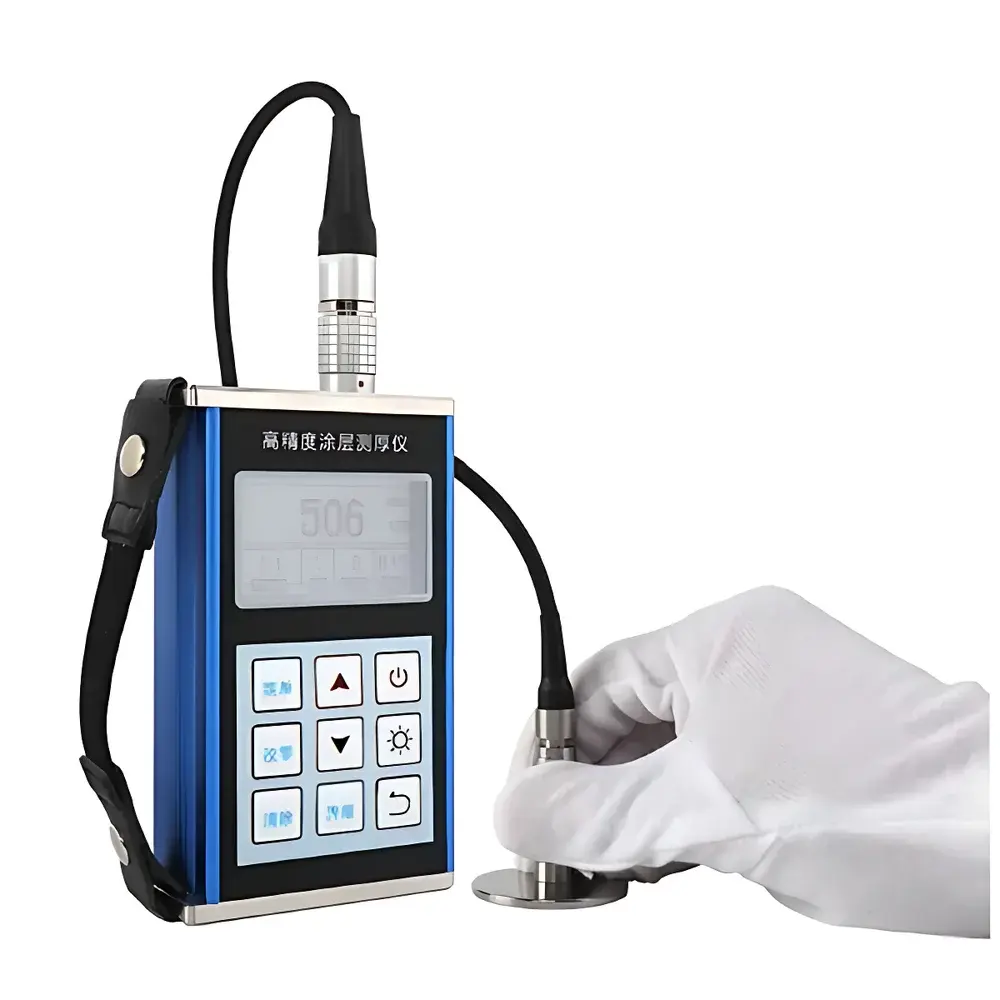
QINGTAO QT-N1 Electromagnetic Eddy Current & Magnetic Induction Coating Thickness Gauge
| Brand | QINGTAO |
|---|---|
| Model | QT-N1 |
| Measurement Principle | Dual-mode (Eddy Current for Non-Magnetic Substrates, Magnetic Induction for Ferrous Substrates) |
| Measurement Range | 0–1250 µm |
| Resolution | 0.1 µm |
| Accuracy | ±(3% H + 1.5 µm) with Single-Point Calibration |
| Substrate Compatibility | Ferrous metals (Fe, steel) and non-ferrous non-magnetic metals (Al, Cu, Zn, Sn) |
| Coating Types | Non-conductive (paint, enamel, plastic, rubber) and non-magnetic metallic (e.g., Cr, Zn on steel) |
| Probe Options | F1, F1/90°, F10, N1, N1/90°, N10 |
| Data Storage | 500 readings |
| Statistical Functions | MEAN, MAX, MIN, NO, S.DEV |
| Calibration Modes | Single-point & two-point |
| Operating Temperature | −10 °C to 50 °C |
| Power | 2 × AA (1.5 V) |
| Dimensions | 125 × 67 × 31 mm |
| Weight | ~340 g |
| Compliance | GB/T 4956–1985, GB/T 4957–1985 & –2003, JB/T 8393–1996, JJG 889–1995, JJG 818–1993 |
Overview
The QINGTAO QT-N1 is a dual-principle portable coating thickness gauge engineered for precision, repeatability, and field-deployable robustness in industrial quality control and R&D environments. It integrates electromagnetic induction (for ferromagnetic substrates such as carbon steel and iron) and high-frequency eddy current measurement (for non-ferrous, non-magnetic conductive substrates including aluminum, copper, zinc, and titanium) within a single compact platform. This dual-mode architecture enables traceable, non-destructive quantification of non-conductive and non-magnetic metallic coatings—including paints, epoxies, enamels, anodized layers, plastics, rubber, and electroplated chromium or zinc—without surface contact or sample preparation. The instrument operates on the fundamental physical principles defined in ISO 2178 (magnetic induction) and ISO 2360 (eddy current), ensuring metrological consistency across global manufacturing and regulatory workflows.
Key Features
- Dual-sensor architecture supporting both magnetic induction (F-series probes) and eddy current (N-series probes) measurement modes—eliminating the need for separate instruments when servicing mixed-material production lines.
- High-brightness monochrome LCD with wide viewing angle and ambient-light adaptive contrast—ensuring legibility under low-illumination conditions common in factory floors and aerospace hangars.
- Industrial-grade aluminum alloy housing with drop-resistant structural reinforcement and oversized probe socket—designed for sustained use in vibration-prone environments and frequent handling during shift-based QA inspections.
- Two operational modes: DIRECT (real-time single-value output) and A-B (differential mode for localized thickness variation analysis across weld seams or edge zones).
- Five built-in statistical functions—MEAN, MAX, MIN, NO (count), and S.DEV (standard deviation)—enabling on-device assessment of coating uniformity per ASTM D7091 Annex A1 guidelines.
- Configurable acoustic feedback (beep on measurement, error alert, low-battery warning) and visual error prompts—supporting hands-free operation in PPE-restricted settings.
- Intelligent power management with auto-shutdown (configurable delay) and low-voltage detection—preserving battery life across multi-shift deployments without compromising data integrity.
Sample Compatibility & Compliance
The QT-N1 meets stringent requirements for coating thickness verification in regulated sectors including automotive OEM supply chains, aerospace MRO facilities, and electronics manufacturing. Its measurement methodology aligns with multiple national and international standards: GB/T 4956–1985 (magnetic method on ferrous substrates), GB/T 4957–1985 and –2003 (eddy current method on non-ferrous substrates), JB/T 8393–1996 (instrument performance specification), and metrological verification protocols JJG 818–1993 and JJG 889–1995. While not inherently 21 CFR Part 11 compliant, raw measurement data exported via optional USB interface can be integrated into validated LIMS or ELN systems supporting GLP/GMP audit trails. Minimum substrate requirements—3 mm curvature radius, Φ5 mm minimum test area, and ≥0.3 mm base metal thickness—are clearly documented in the user manual to prevent systematic measurement bias.
Software & Data Management
Data acquisition and post-processing are optimized for efficiency: up to 500 measurements are stored internally with timestamp-independent indexing. Users may perform in-field deletion of outliers (single-entry or full memory wipe) prior to export. Though no proprietary PC software is bundled, ASCII-formatted CSV exports are supported via optional serial-to-USB adapter, enabling direct import into Excel, MATLAB, or statistical process control (SPC) platforms such as Minitab or InfinityQS. Calibration records—including probe ID, reference standard values, date, and operator ID—can be manually logged to satisfy internal QA documentation requirements. Two-point calibration routines allow compensation for probe drift over extended usage cycles, while basic probe correction adjusts for known systematic offsets using certified foil standards traceable to NIM (National Institute of Metrology, China).
Applications
- Automotive: Verification of e-coat, primer, and topcoat thickness on stamped steel body panels and aluminum chassis components.
- Aerospace: Monitoring anodized layer uniformity on 7075-T6 aluminum airframe parts per AMS-A-8625.
- Electronics: Measuring conformal coating (e.g., acrylic, silicone, urethane) thickness on PCB assemblies to IPC-A-610 Class 2/3 acceptance criteria.
- Energy: Assessing thermal spray ceramic coatings on turbine blades and corrosion-resistant polymer linings in offshore piping systems.
- Consumer Goods: Ensuring consistent paint film build on white goods housings and powder-coated furniture frames per ISO 19840.
FAQ
Can the QT-N1 measure conductive coatings on non-conductive substrates (e.g., copper on PCB)?
No—the instrument is designed exclusively for non-conductive or non-magnetic metallic coatings on electrically conductive metallic substrates. Conductive coatings on insulating substrates require coulometric or cross-section microscopy methods.
What is the minimum substrate thickness required for accurate eddy current measurement?
The base metal must be ≥0.3 mm thick to avoid backside interference effects; thinner substrates yield non-linear response and require empirical correction or alternative techniques.
Is probe interchangeability supported across different QT-N1 units?
Yes—N1, N1/90°, F1, and other compatible probes adhere to standardized mechanical and electrical interfaces per JB/T 8393–1996, enabling seamless replacement without recalibration if used within the same probe family.
Does the device support temperature compensation?
No real-time thermal compensation is implemented; users must perform measurements within the specified operating range (−10 °C to 50 °C) and allow instrument stabilization for ≥15 minutes after environmental transition.
How is measurement uncertainty determined for reporting in ISO/IEC 17025 accredited labs?
Uncertainty budgets should incorporate manufacturer-specified accuracy (±[3%H + 1.5 µm]), reference standard uncertainty (typically ±0.5 µm for NIST-traceable foils), repeatability (determined per ISO 14644-1 Annex B), and environmental influence factors—calculated per GUM (JCGM 100:2008).
Related Products



