
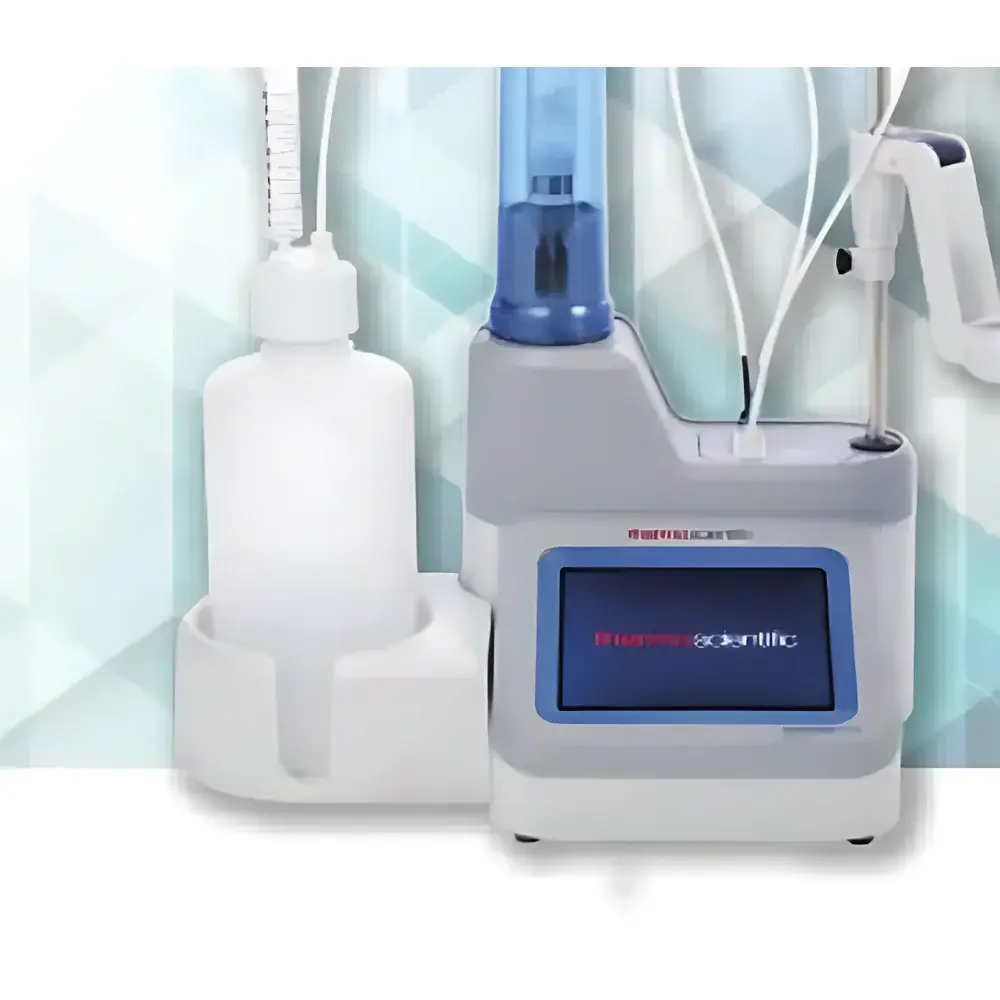
Thermo Scientific Orion Star T910 Automatic Potentiometric Titrator
| Brand | Thermo Scientific Orion |
|---|---|
| Origin | USA |
| Model | T910 |
| Instrument Type | General-Purpose Automatic Potentiometric Titrator |
| Application Scope | Universal |
| pH Range | 2.000 to 20.000 |
| mV Range | −2000.0 to +2000.0 mV |
| Meter Accuracy | ±0.2% of reading |
| Meter Resolution | 0.001 / 0.01 / 0.1 pH (user-selectable) |
| Titration Accuracy | ±0.5% RSD |
| Titration Resolution | 0.001 / 0.01 / 0.1 mL (user-selectable) |
| Burette Capacity Options | 10 mL, 20 mL (standard), 50 mL (ISO 8655-3 compliant) |
| Microstep Precision | 25,600 microsteps per motor revolution (≥2 million total steps over full stroke) |
| Stirrer Speed | 5 selectable speeds (250–3700 RPM) |
| Data Storage | 100 titration records with timestamp, calibration logs, and direct measurement history |
| Display | 5.7″ color capacitive touchscreen (640 × 480), glove-compatible |
| Operating Languages | English, Chinese, French, German, Italian, Japanese, Korean, Portuguese, Spanish |
| Certifications | CE, TÜV 3-in-1, FCC, EN/IEC 61326-1, IEC 61010, IP51 |
| Dimensions & Weight | 25.4 × 40.6 × 35.6 cm (10 × 16 × 14 in), 5.67 kg (12.5 lb) |
| Power Supply | 100–240 V AC, 50/60 Hz |
Overview
The Thermo Scientific Orion Star T910 Automatic Potentiometric Titrator is an engineered solution for high-reproducibility acid-base titrations based on potentiometric endpoint detection. It operates on the fundamental principle of monitoring potential change (mV) across a pH-sensitive electrode system as titrant is incrementally delivered—enabling precise identification of equivalence points via first-derivative analysis or user-defined mV/pH thresholds. Designed for compliance-critical environments, the T910 supports both single- and dual-equivalence point detection, fixed- or variable-blank compensation, and up to five replicate titrations per sample with automated outlier rejection based on RSD criteria. Its architecture integrates electrochemical measurement, fluidic control, and thermal compensation into a single platform validated for routine use in QC laboratories, environmental testing facilities, food & beverage R&D, and pharmaceutical process development.
Key Features
- Automated titration workflows with zero operator intervention after method initiation—reducing human error and enabling unattended overnight operation.
- Glove-compatible 5.7″ color capacitive touchscreen with adjustable backlight and intuitive icon-driven navigation for setup, real-time titration visualization, and contextual help menus.
- Up to 10 password-protected, user-defined methods stored onboard; import/export via USB flash drive for cross-laboratory method standardization.
- High-precision burette actuation using advanced microstepping technology (25,600 steps/revolution), delivering <0.001 mL resolution and <±0.5% RSD accuracy across full volume range (10–50 mL).
- Integrated temperature-compensated pH/mV measurement with auto-recognition of ATC probes (e.g., Orion 927007MD) and manual temperature input options.
- Modular mechanical design: quick-release burette, stirrer, and dosing probe assemblies minimize maintenance downtime and simplify cleaning or replacement.
- Comprehensive data logging—including titration curves, endpoint calculations, calibration history, and direct pH/mV measurements—with timestamped records (100 entries max) and CSV/PDF export capability.
Sample Compatibility & Compliance
The T910 accommodates diverse sample matrices including turbid beverages (juices, wines), viscous dairy products, slurries, colloidal suspensions, wastewater, drinking water, and buffered biological solutions. Electrode compatibility extends to Thermo Scientific ROSS Ultra (8102BNUWP) and ROSS Sure-Flow (8172BNWP) pH sensors—optimized for low-drift performance in challenging media containing proteins, particulates, or high ionic strength. The instrument meets key regulatory requirements for data integrity: audit-trail-capable logging (time/date-stamped entries), electronic signature support via password-protected methods, and firmware update traceability—all aligned with GLP and GMP documentation expectations. While not pre-certified for 21 CFR Part 11, its architecture supports validation protocols required for FDA-regulated environments when deployed with controlled access and documented SOPs.
Software & Data Management
Data handling is designed for laboratory interoperability. All titration results, calibration logs, and direct measurements are stored internally with ISO 8601-compliant timestamps and battery-backed memory. Export formats include CSV (for spreadsheet analysis or LIMS ingestion) and PDF (for audit-ready reporting). USB-based method transfer enables secure distribution of validated procedures across instruments. Firmware updates are performed locally via USB drive, with version history retained in system diagnostics. No proprietary cloud service or mandatory software subscription is required—the T910 operates autonomously with no external dependencies, ensuring long-term operational continuity and IT security compliance.
Applications
- Determination of titratable acidity (TA) in fruit juices, wines, and dairy products per AOAC and IDF standards.
- Alkalinity profiling of municipal and industrial water supplies (e.g., carbonate/bicarbonate/hydroxide speciation).
- Total Acid Number (TAN) and Total Base Number (TBN) quantification in lubricants and fuels per ASTM D664 and D2896.
- pH-controlled back-titrations for weak acid/base systems where visual indicators lack sensitivity.
- Quality control of consumer products—including personal care formulations, cleaning agents, and food-grade acids/bases.
- Environmental monitoring of acid-neutralizing capacity in soils and sediments using standardized titrimetric protocols.
FAQ
Does the T910 support GLP-compliant data recording?
Yes—each record includes automatic timestamping, operator ID (via method password), and immutable event logging (e.g., calibration, titration start/end, maintenance alerts). Full audit trail generation requires external documentation of user access controls and backup procedures.
Can I validate this instrument for regulated pharmaceutical use?
The T910’s hardware and firmware architecture supports IQ/OQ/PQ validation. While it does not ship with pre-built 21 CFR Part 11 configurations, its deterministic behavior, traceable firmware updates, and exportable raw data enable qualification under internal validation protocols.
What electrode types are recommended for high-solids samples?
The Orion 8172BNWP ROSS Sure-Flow pH electrode is specifically engineered for samples with suspended solids, proteins, or gels—featuring a reinforced open-junction reference system that resists clogging and maintains stable liquid junction potential.
Is method transfer between T910 units possible without revalidation?
Yes—methods saved to USB retain all parameters (endpoint logic, stirring speed, delivery rate, blank handling). Transfer is functionally identical across units; however, site-specific verification of electrode response and burette delivery accuracy remains necessary per ISO/IEC 17025.
How often does the burette require recalibration?
Burette delivery accuracy is verified during initial qualification and after any mechanical servicing. Routine checks—using gravimetric dispensing tests per ISO 8655-6—are recommended quarterly or per organizational SOP, depending on usage frequency and criticality of application.



