
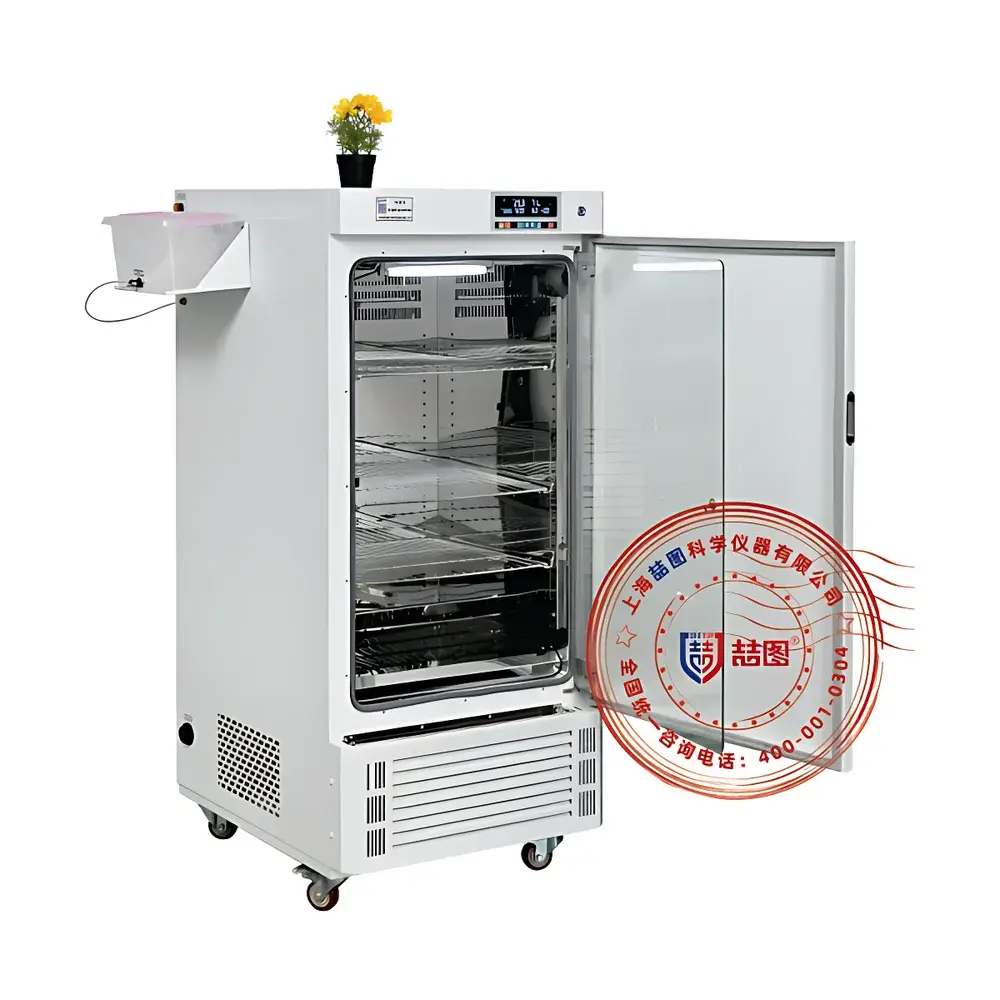
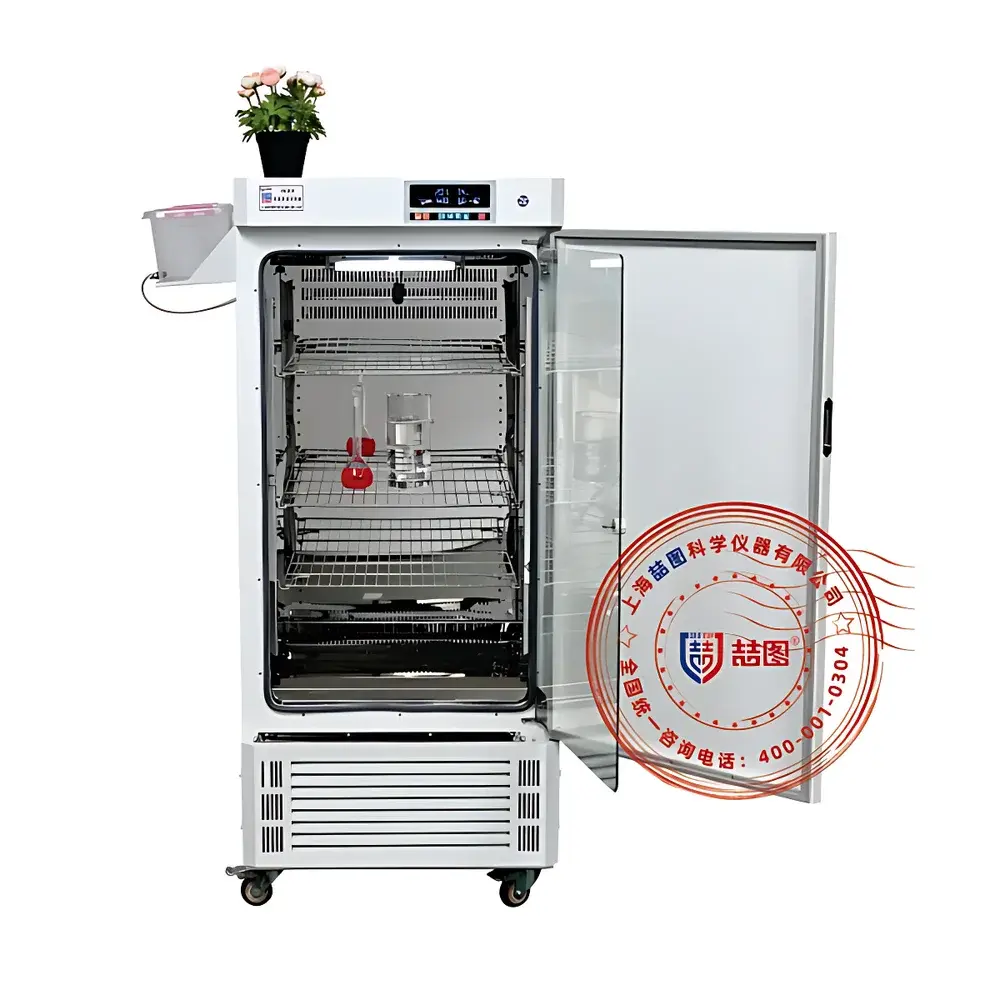
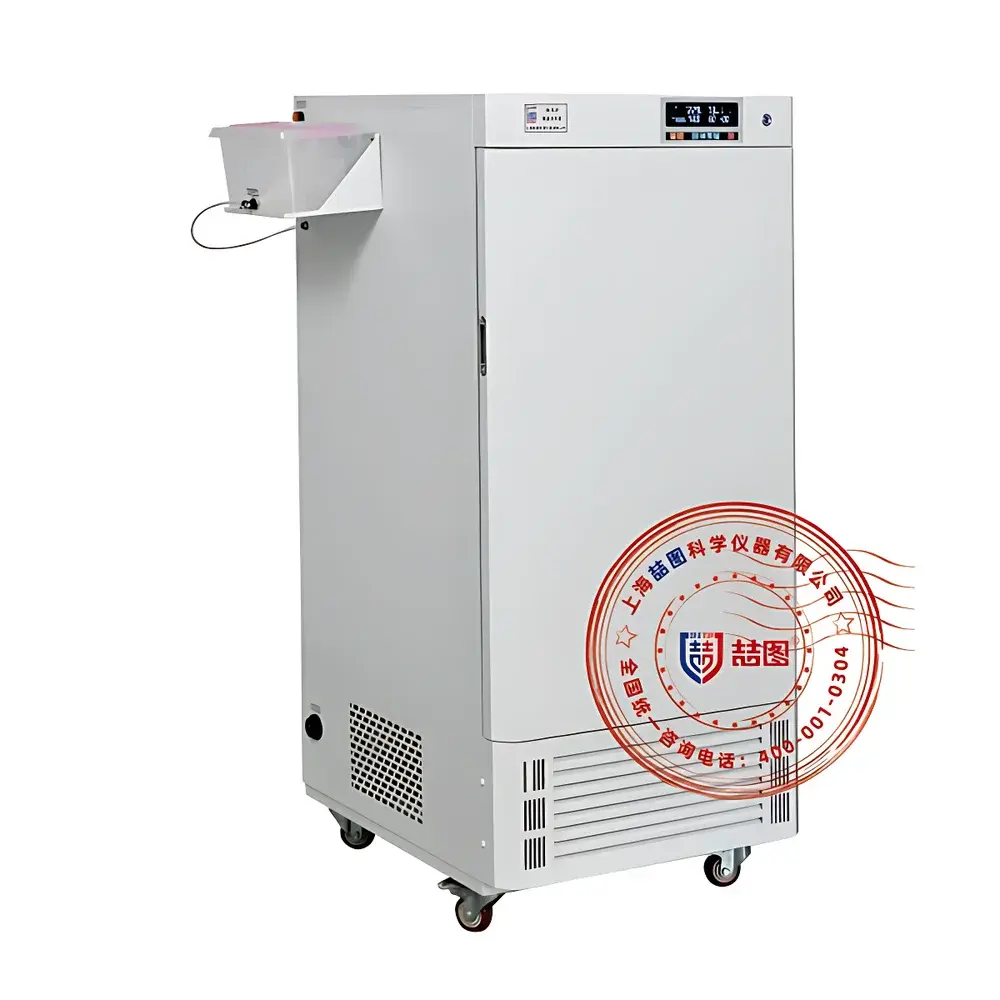
DRETOP ZHS-100M Temperature and Humidity Controlled Incubator
| Brand | DRETOP |
|---|---|
| Origin | Shanghai, China |
| Manufacturer Type | Direct Manufacturer |
| Model | ZHS-100M |
| Heating Method | Air-Jacketed |
| Humidity Reservoir | External Water Tank |
| Temperature Range (with Humidification) | RT+10°C to 85°C |
| Temperature Range (without Humidification) | RT+10°C to 85°C |
| Temperature Fluctuation | ±1°C |
| Humidity Range | 80–95% RH |
| Humidity Accuracy | ±3% RH |
| Chamber Capacity | 100 L |
| Internal Dimensions (W×D×H) | 450 × 380 × 590 mm |
Overview
The DRETOP ZHS-100M Temperature and Humidity Controlled Incubator is an engineered environmental simulation system designed for precise, long-term maintenance of temperature and relative humidity (RH) conditions in life science laboratories and industrial R&D settings. It operates on a dual-control principle: air-jacketed heating ensures rapid thermal response and stable setpoint maintenance, while a dedicated external water reservoir—coupled with a microcomputer-integrated humidity control module—enables reproducible RH regulation between 80% and 95% RH. Unlike refrigerated incubators, the ZHS-100M is optimized for high-temperature, high-humidity applications where cooling is not required, making it particularly suitable for accelerated stability testing (e.g., ICH Q1A–Q1E), textile aging studies, pharmaceutical excipient compatibility screening, and microbiological culture under elevated ambient conditions. Its chamber construction—stainless steel interior, reinforced cold-rolled steel outer shell, and double-door observation window with magnetic seal—meets fundamental requirements for contamination control, thermal insulation integrity, and operational durability in GLP-compliant environments.
Key Features
- Air-jacketed heating system with Ni-Cr alloy heaters and PID-controlled digital temperature regulation, delivering ±1°C temperature fluctuation across the full operating range (RT+10°C to 85°C)
- External humidity reservoir design minimizes internal condensation risk and simplifies maintenance; integrated evaporation control maintains ±3% RH accuracy within 80–95% RH band
- 30-segment programmable controller enables automated multi-step environmental profiles (e.g., ramp-hold cycles), supporting unattended operation for extended stability studies
- Large backlit LCD interface with touch-sensitive keys provides real-time display of setpoints, actual values, elapsed time, and alarm status—designed for intuitive operator interaction
- Stainless steel interior chamber with adjustable, removable shelves facilitates thorough cleaning, autoclave-compatible decontamination, and flexible sample arrangement
- Double-glazed observation door (tempered inner glass + magnetic outer gasket) ensures visual monitoring without compromising thermal or humidity integrity
- Four-caster mobility system with independent locking feet allows repositioning in shared lab spaces while maintaining vibration-free stability during operation
Sample Compatibility & Compliance
The ZHS-100M accommodates standard laboratory vessels—including Petri dishes, multi-well plates, serum bottles, and sealed stability chambers—within its 100 L stainless steel chamber (450 × 380 × 590 mm internal dimensions). Its non-refrigerated architecture avoids frost formation or condensate pooling, preserving sample integrity during prolonged exposure to warm, humid environments. While not certified to ISO 14644 (cleanroom classification) or FDA 21 CFR Part 11 out-of-the-box, the unit supports audit-ready documentation when paired with optional RS485 serial interface for external data logging. It complies with basic electrical safety standards per IEC 61010-1 and is compatible with laboratory quality management systems requiring traceable environmental parameters per ISO/IEC 17025 and ASTM E2911 (Standard Guide for Environmental Chambers Used in Stability Testing).
Software & Data Management
The ZHS-100M features embedded firmware supporting local data retention through power-loss recovery and parameter memory functions. Optional accessories—including RS485 communication port, external printer interface, and independent over-temperature limiter—enable integration into centralized lab monitoring networks. When connected to third-party SCADA or LIMS platforms via Modbus RTU protocol (via RS485), the incubator can feed timestamped temperature/humidity logs into electronic batch records. Though it does not include built-in 21 CFR Part 11 compliant audit trail software, its hardware-level event logging (e.g., door open/close detection, alarm triggers, setpoint changes) provides foundational traceability required for GMP-aligned stability programs.
Applications
- ICH-guided accelerated stability testing of pharmaceuticals and biologics under high-humidity stress conditions (e.g., 40°C/75% RH, 30°C/90% RH)
- Textile and polymer material aging studies assessing moisture-induced degradation, colorfastness, or dimensional stability
- Microbial growth assessment for environmental isolates under controlled hygrothermal conditions
- Food packaging permeability testing and shelf-life modeling under simulated tropical storage environments
- Seed germination and plant tissue culture experiments requiring consistent warm-humid atmospheres
- Raw material qualification and formulation development where humidity-driven chemical interactions must be isolated
FAQ
Does the ZHS-100M include refrigeration capability?
No. The ZHS-100M is a heating-and-humidification-only incubator. For applications requiring sub-ambient temperature control, refer to DRETOP’s ZHS-SC or ZHS-HC series models.
Can humidity be maintained below 80% RH?
No—the ZHS-100M is calibrated and validated for 80–95% RH operation. Lower RH ranges require alternative models with active dehumidification or desiccant-based control.
Is the internal chamber volume verified per ISO 15212-1?
Chamber capacity is nominal (100 L); users requiring metrologically certified volume should perform in-house volumetric calibration using NIST-traceable methods.
What is the maximum allowable ambient room temperature for stable operation?
For optimal performance, ambient temperature should remain ≤30°C with adequate ventilation; operation above 32°C may affect humidity control repeatability and thermal uniformity.
Are validation protocols (IQ/OQ/PQ) provided with the unit?
DRETOP supplies basic factory calibration certificates. Full qualification documentation—including templates for Installation Qualification (IQ), Operational Qualification (OQ), and Performance Qualification (PQ)—is available upon request as a value-added service.





