
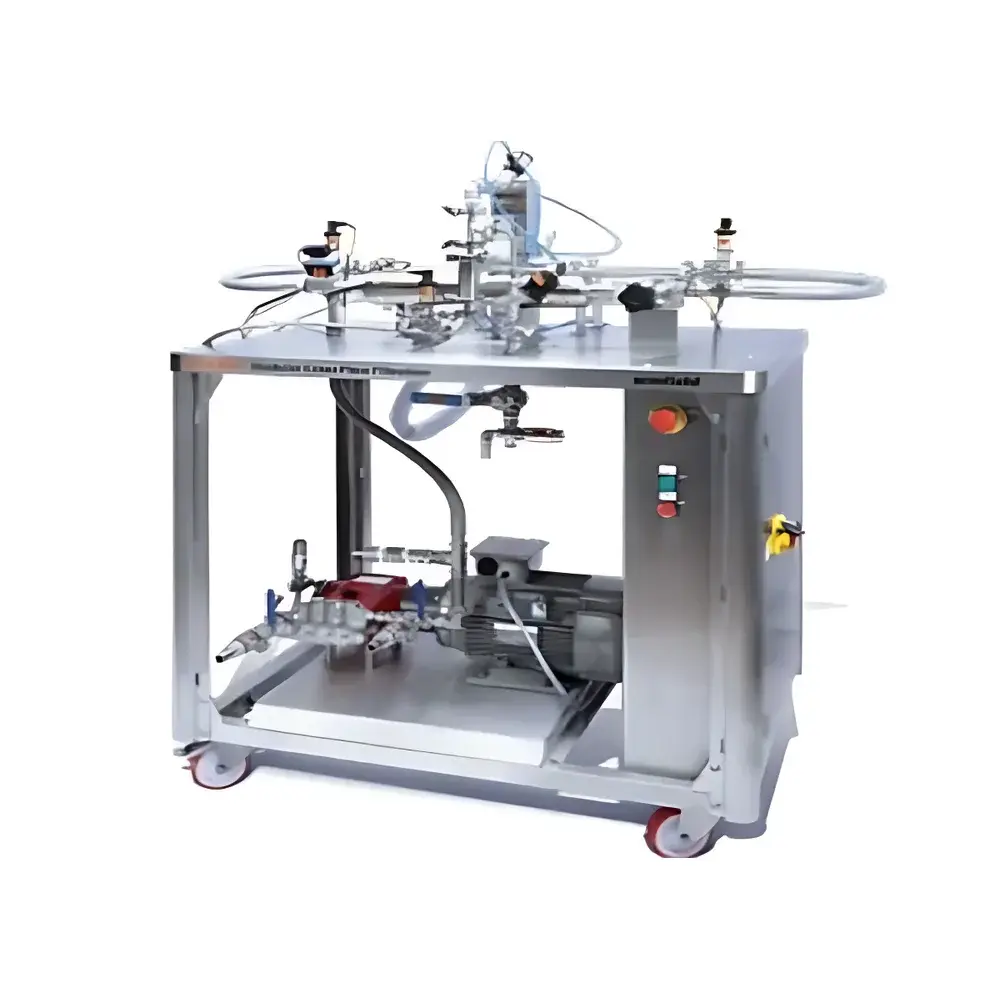
Armfield FT18MKII Modular Cross-Flow Membrane Filtration Unit
| Brand | Armfield |
|---|---|
| Origin | United Kingdom |
| Model | FT18MKII |
| Maximum Operating Pressure | 50 bar |
| Membrane Module Options | Ceramic, Spiral-Wound, Hollow-Fiber, Tubular |
| CIP Capability | Yes |
| Backwash Capability | Select Modules |
| Transmembrane Pressure (TMP) Monitoring | Yes (Inlet/Outlet of Retentate & Permeate Lines) |
| Permeate Flow Measurement | Electronic Flowmeter + Optional Mass-Balance Mode |
| Data Logging | Full Sensor Array with Timestamped Export |
| Software Integration | Armfield PC-Based Control & Visualization Suite |
Overview
The Armfield FT18MKII Modular Cross-Flow Membrane Filtration Unit is an engineered laboratory-scale system designed for pedagogical instruction and applied research in membrane separation processes. It operates on the fundamental principle of cross-flow filtration—where feed solution flows tangentially across the membrane surface to minimize fouling while enabling selective solute rejection based on pore size, molecular weight cutoff (MWCO), and surface charge characteristics. Unlike dead-end filtration, this configuration sustains stable flux over extended operation by continuously sweeping away accumulated particles and gel layers. The FT18MKII supports full-spectrum pressure-driven membrane operations: microfiltration (MF), ultrafiltration (UF), nanofiltration (NF), and reverse osmosis (RO), making it suitable for process development, membrane screening, and fouling mechanism studies under controlled, reproducible conditions. Its compact footprint and low minimum feed volume requirement (5–10 L) enable rapid experimental iteration in academic teaching labs and pilot-scale R&D environments.
Key Features
- Modular membrane housing accommodating four interchangeable configurations: ceramic monolith, spiral-wound, hollow-fiber, and tubular modules—enabling direct comparison of hydraulic performance, fouling resistance, and cleaning efficiency across architectures.
- Integrated pressure control system featuring dual back-pressure regulators—one for retentate line and one for permeate line—allowing precise independent adjustment of transmembrane pressure (TMP) and cross-flow velocity.
- Real-time monitoring of critical operational parameters: retentate inlet/outlet pressure, permeate pressure, permeate flow rate (via calibrated electronic flowmeter), and optional mass-balance-based permeate quantification.
- Configurable cleaning-in-place (CIP) protocol support with adjustable chemical dosing compatibility and temperature monitoring ports; optional backwash capability available for select module types to assess hydraulic cleaning efficacy.
- Variable-speed feed pump with digital speed control, enabling systematic study of shear-dependent flux behavior and concentration polarization thresholds.
- Rugged stainless-steel frame with IP54-rated electrical enclosures, CE-compliant instrumentation, and fail-safe pressure relief mechanisms aligned with EN 858 and PED 2014/68/EU standards.
Sample Compatibility & Compliance
The FT18MKII accommodates aqueous and mildly organic feed streams typical of food, beverage, pharmaceutical, and wastewater applications—including skim milk, whey, fruit juice concentrates, fermentation broths, wine must, and saline solutions. All wetted parts comply with FDA 21 CFR §177.2420 (food-contact polymers) and EU Regulation (EC) No. 1935/2004. Pressure sensors meet IEC 61508 SIL2 functional safety requirements. The system supports GLP-compliant data integrity through time-stamped audit trails, user-access controls, and non-editable binary log files—fully traceable for ISO/IEC 17025-accredited laboratories. Calibration certificates for all primary sensors (pressure, flow, temperature) are provided per ISO/IEC 17025:2017 Annex A.2.
Software & Data Management
Armfield’s proprietary PC-based software provides real-time visualization of all sensor outputs—including TMP, cross-flow velocity (calculated from pump speed and channel geometry), permeate flux, and cumulative permeate volume. The interface allows remote actuation of the feed pump, back-pressure valves, and CIP solenoid valves. Data acquisition occurs at configurable intervals (100 ms to 5 s), stored in a structured binary format (.armlog) with embedded metadata (operator ID, experiment name, timestamp, calibration IDs). Export options include CSV and Excel-compatible XLSX formats for statistical analysis in MATLAB, Python (pandas), or JMP. The software includes built-in calculation modules for specific flux (LMH), rejection coefficient (R%), and resistance-in-series modeling (Rm, Rc, Rp)—facilitating quantitative membrane characterization per ASTM D4185 and ISO 15203.
Applications
- Dairy Processing: Microbial removal from raw milk, casein/whey protein fractionation, demineralization of whey, lactose reduction via NF, and RO-based water recovery.
- Fermentation & Brewing: Yeast cell harvesting post-fermentation, alcohol removal from wine/beer (dealcoholization), vinegar clarification, and spent yeast lysis product recovery.
- Juice & Beverage: Pectinase-resistant clarification of apple/grape juice, anthocyanin stabilization, and low-temperature concentration without thermal degradation.
- Pharmaceuticals: Virus clearance validation (≥4-log reduction per USP ), monoclonal antibody concentration, endotoxin reduction via UF, and purified water polishing (PW/WFI).
- Water Reuse: Brackish water desalination feasibility testing, municipal wastewater tertiary treatment, and fouling index (Silt Density Index, SDI) determination per ASTM D4189.
FAQ
What membrane types are compatible with the FT18MKII?
The unit accepts four standardized module formats: ceramic monolith (Al₂O₃/ZrO₂), polymeric spiral-wound (cellulose acetate, polyamide), polyethersulfone (PES) hollow-fiber, and stainless-steel-supported tubular membranes—all with industry-standard 1/2″ NPT or DIN 11851 connections.
Can the system operate under GMP conditions?
Yes—when paired with Armfield’s optional 21 CFR Part 11-compliant software add-on (including electronic signatures, audit trail encryption, and role-based access control), the FT18MKII meets core GMP documentation requirements for process validation studies.
Is temperature control integrated?
No—temperature regulation requires external integration with Armfield FT63/FT64 laboratory chillers or user-supplied jacketed feed tanks; the FT18MKII includes PT100 sensor ports for third-party PID loop coupling.
How is permeate flow accuracy verified?
The electronic flowmeter is factory-calibrated against gravimetric standards traceable to NPL (UK); optional mass-balance mode cross-validates flow via high-precision load cells (±0.1 g resolution) on the permeate collection vessel.
What maintenance intervals are recommended?
Daily visual inspection of O-rings and tubing; quarterly verification of pressure transducer zero drift and flowmeter linearity; annual recalibration of all primary sensors per ISO/IEC 17025-accredited providers.





