
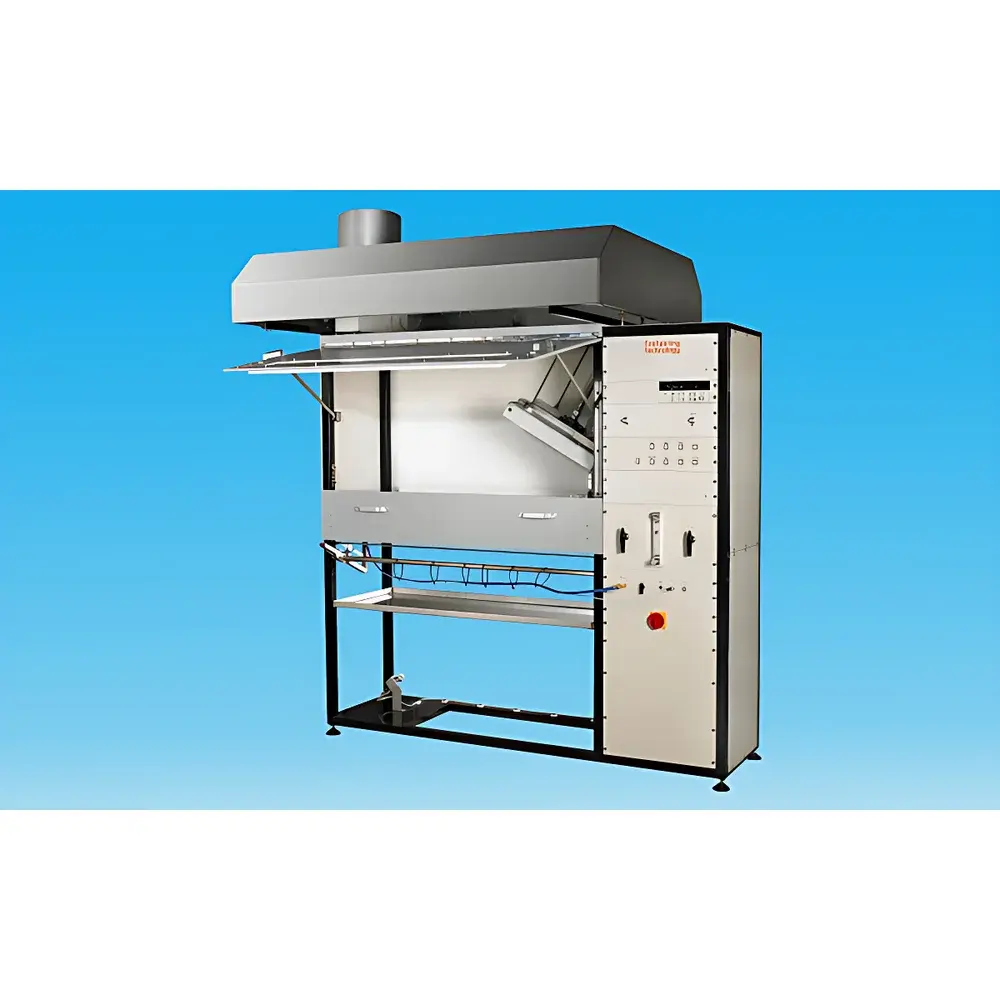
FTT FRP Floor Radiant Panel Tester
| Brand | FTT |
|---|---|
| Origin | United Kingdom |
| Model | FRP |
| Standards Compliance | EN ISO 9239-1, ASTM E648, ASTM E970, NFPA 253, GB/T 11785 |
| Radiation Source | Gas-fired flat-panel radiator inclined at 30° |
| Radiant Heat Flux Range | 1.1–10.9 kW/m² (extendable to 25.0 kW/m²) |
| Critical Radiant Flux Resolution | 0.1 kW/m² |
| Sample Orientation | Horizontal |
| Ignition | Pilot burner with stainless steel nozzle |
| Smoke Measurement | DIN 50055-compliant optical smoke density system mounted on exhaust duct |
| Dimensions (W×D×H) | 1900 × 750 × 1900 mm |
| Construction | Stainless steel hood, calibrated angular positioning plate, dual-access observation door with sliding platform |
Overview
The FTT FRP Floor Radiant Panel Tester is a precision-engineered apparatus designed to determine the critical radiant flux (CRF) — the minimum incident heat flux at which flame spread across horizontal floor covering materials ceases — in accordance with internationally harmonized fire safety standards. Operating on the principle of controlled radiant heating, the FRP subjects standardized specimens to a defined thermal radiation field generated by a gas-fired flat-panel radiator inclined at 30° relative to the horizontal test surface. This configuration replicates realistic fire exposure conditions where radiant energy dominates ignition and flame propagation dynamics. The instrument quantifies CRF by progressively reducing radiant flux until flame spread self-extinguishes over a defined length; the corresponding flux value—expressed in kW/m²—is derived via linear interpolation of flame front progression data. As mandated under EU Construction Products Regulation (CPR), this test forms the technical basis for classification of floor coverings into Euroclass ratings (e.g., Bfl-s1, Cfl-s1), ensuring compliance with harmonized assessment frameworks across all member states.
Key Features
- Gas-fired radiant panel with precise angular alignment (30° ± 0.5°) and automated ignition sequence, integrated with fail-safe thermal cutoff and flame supervision circuitry.
- Stainless steel conical smoke collection hood with dedicated optical density port, compliant with DIN 50055 requirements for real-time smoke obscuration measurement during exhaust flow.
- Dual-access hinged test chamber door incorporating borosilicate observation window and motorized sliding sample platform for repeatable specimen positioning without operator intervention.
- Calibrated angular positioning plate enabling visual verification and mechanical adjustment of radiation geometry during setup and routine calibration.
- Integrated pilot burner assembly featuring corrosion-resistant stainless steel nozzle and adjustable gas flow control for consistent ignition across diverse substrate types.
- Modular design accommodating extended radiant flux operation up to 25.0 kW/m² for research-grade evaluation beyond standard regulatory limits.
Sample Compatibility & Compliance
The FRP accepts rigid and flexible floor coverings—including carpet, vinyl, linoleum, rubber, cork, and composite laminates—in standardized dimensions (1050 mm × 250 mm) as specified in EN ISO 9239-1. Substrates may be tested either directly on the metal base plate or over representative underlays (e.g., foam, felt, or plywood) per application-specific protocols. All operational parameters—including radiant flux gradient, exposure duration, and flame front tracking methodology—are traceably aligned with EN ISO 9239-1 (identical to ISO 9239-1:2010), ASTM E648 (Standard Test Method for Critical Radiant Flux of Floor Covering Systems Using a Radiant Heat Energy Source), ASTM E970 (for low-slope roof assemblies), NFPA 253 (Standard Method of Test for Critical Radiant Flux of Floor Covering Systems), and GB/T 11785 (Chinese national standard). Instrument calibration procedures follow ISO/IEC 17025 guidelines, with documented uncertainty budgets for radiant flux output and thermocouple response.
Software & Data Management
The FRP is supplied with FTT’s proprietary CRF Analysis Suite, a Windows-based application supporting real-time acquisition of thermocouple readings (radiant panel surface, specimen backside, and exhaust gas), flame front position (via high-resolution linear encoder), and optical smoke density (via 0–10 V analog signal from DIN 50055 sensor). Data logging occurs at 10 Hz resolution with automatic timestamping, metadata tagging (operator ID, sample ID, ambient conditions), and export to CSV or XML formats compatible with LIMS integration. Audit trails comply with FDA 21 CFR Part 11 requirements, including electronic signatures, user access controls, and immutable record retention. Software includes built-in calculation modules for CRF derivation per EN ISO 9239-1 Annex A, automatic report generation (PDF/HTML), and deviation alerts during test execution.
Applications
- Regulatory certification of commercial and residential floor coverings for CE marking and CPR compliance.
- Comparative evaluation of flame-retardant treatments, backing formulations, and fiber blends in R&D laboratories.
- Fire performance validation of acoustic underlays, thermal insulation layers beneath flooring systems, and modular raised floor panels.
- Technical support for fire safety engineering assessments in building code compliance (e.g., UK Building Regulations Approved Document B, German Musterbauordnung).
- Third-party testing accreditation (e.g., UKAS, DAkkS, CNAS) for laboratories seeking ISO/IEC 17025 scope extension to fire reaction testing.
FAQ
What standards does the FRP fully support out-of-the-box?
EN ISO 9239-1, ASTM E648, ASTM E970, NFPA 253, and GB/T 11785 are natively implemented in test protocols, calibration routines, and reporting templates.
Can the FRP test non-horizontal configurations such as wall-to-floor transitions?
No—the FRP is strictly configured for horizontal specimen orientation per normative requirements; vertical or angled mounting is outside its validated scope.
Is smoke measurement mandatory for all tests?
Smoke density measurement is optional per EN ISO 9239-1 but required for full Euroclass classification (e.g., s1 classification); the DIN 50055-compliant probe is factory-integrated and fully software-synchronized.
How often must the radiant panel be calibrated?
Annual calibration is recommended, with intermediate verification using NIST-traceable blackbody reference sources and flux mapping per ISO/IEC 17025 clause 6.5.
Does the system support remote monitoring during test execution?
Yes—via Ethernet-connected PC with secure VNC or RDP access; live video feed from internal chamber camera and real-time parameter dashboards are available through the CRF Analysis Suite.



