
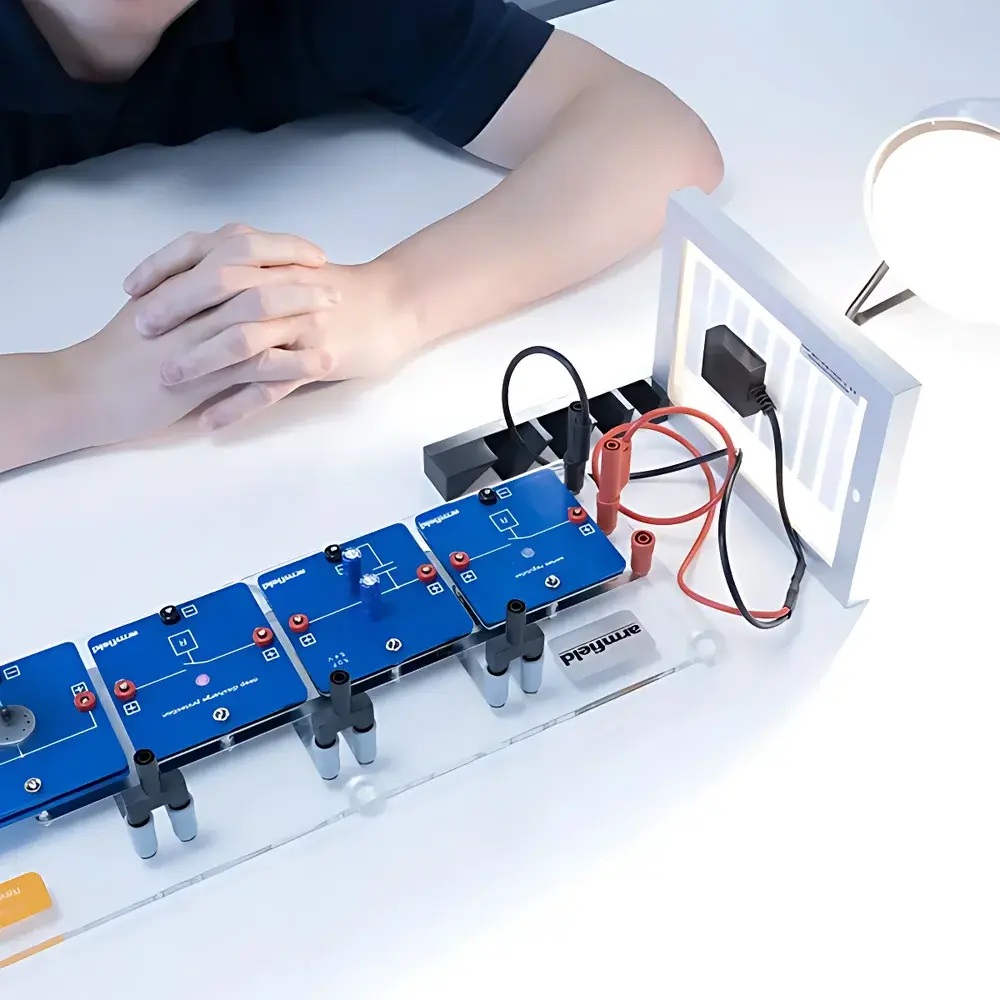
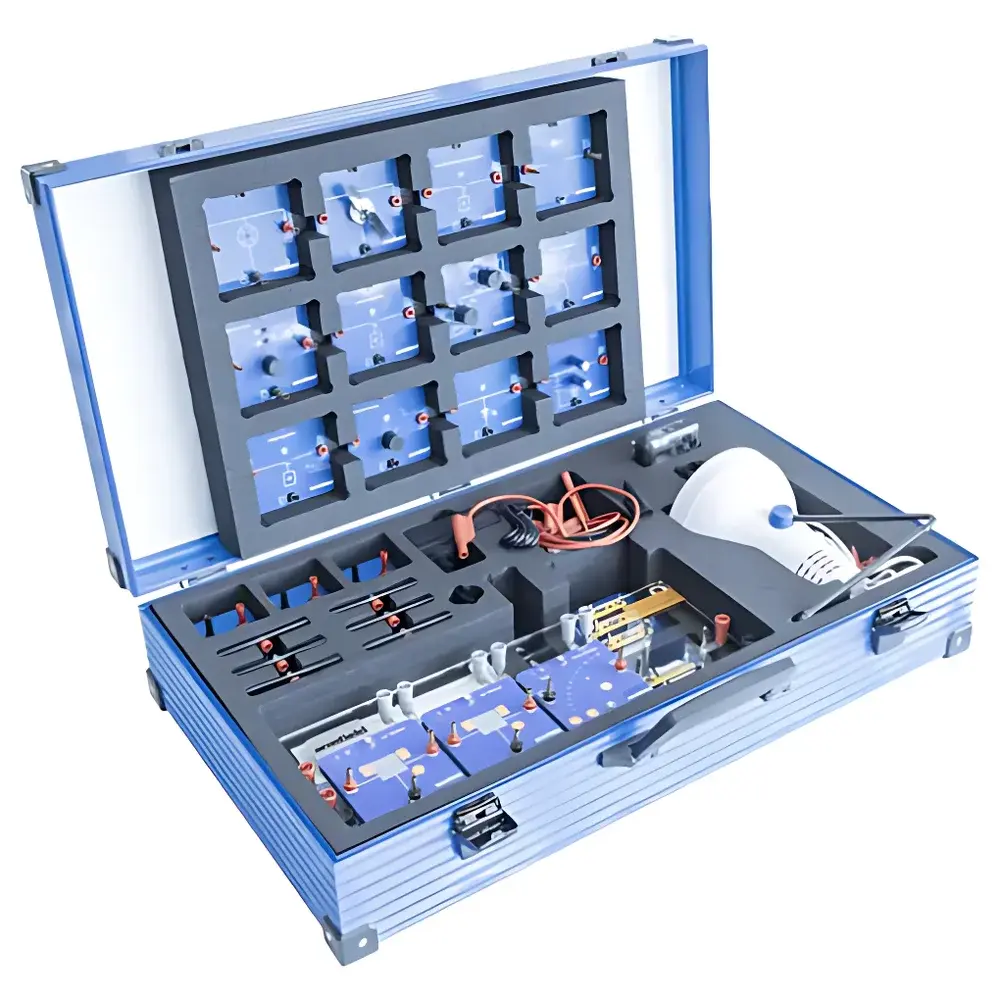
Armfield RE10 Photovoltaic Energy Training System
| Brand | Armfield |
|---|---|
| Origin | United Kingdom |
| Model | RE10 |
| Dimensions (L×W×H) | 0.640 m × 0.165 m × 0.370 m |
| Operating Temperature | +10°C to +50°C |
| Storage Temperature | −10°C to +70°C |
| Relative Humidity (non-condensing) | 0–95% RH |
| Net Weight | 7.5 kg |
| Enclosure | Anodized aluminum portable case |
Overview
The Armfield RE10 Photovoltaic Energy Training System is a comprehensive, modular educational platform engineered for hands-on instruction in photovoltaic (PV) science and engineering principles. Designed specifically for undergraduate laboratories, vocational training centers, and renewable energy curricula, the RE10 enables students to investigate the fundamental physics of solar energy conversion—from photon absorption and charge carrier generation in semiconductor junctions to system-level integration of DC-DC regulation, maximum power point tracking (MPPT), and grid-tied inversion. Unlike simulation-only or black-box demonstration kits, the RE10 provides full electrical access to each functional block—including individual solar cells, diode arrays, PWM regulators, shunt/series voltage regulators, MPPT controllers, deep-discharge protection circuits, and AC inverters—allowing quantitative characterization under controlled illumination, variable load, and thermal conditions. Its architecture supports both open-circuit analysis and real-time dynamic loading, facilitating empirical validation of I-V curve behavior, fill factor degradation, temperature coefficients, partial shading effects, and regulator efficiency across operating points.
Key Features
- Modular hardware design with plug-and-play interconnection via safety-rated banana-jack terminals and standardized PCB-mounted modules;
- Integrated high-brightness LED light source (80 W equivalent) with adjustable intensity and spectral profile to simulate variable irradiance conditions (100–1000 W/m² range);
- Four discrete silicon solar cells (0.5 V, 840 mA) and one monocrystalline PV module (5.33 V, 370 mA) for comparative performance studies;
- Dedicated measurement instrumentation including digital multimeters with data logging capability for simultaneous voltage, current, and power acquisition;
- Full suite of regulatory and control modules: shunt regulator, series regulator, PWM controller, MPPT tracker, deep-discharge protector, and 12 V DC-to-AC inverter with multi-level output waveform analysis;
- Robust anodized aluminum portable case (640 × 165 × 370 mm) with internal foam-cut compartments for secure transport and classroom storage;
- Compliance with EN 61000-6-3 (EMC emission limits) and EN 61000-6-2 (immunity requirements) for laboratory environments.
Sample Compatibility & Compliance
The RE10 accommodates a wide range of photovoltaic sample configurations: single-cell devices, series/parallel cell strings, partially shaded arrays, and thermally coupled modules. All electrical interfaces adhere to IEC 61215-compliant test protocols for lab-scale PV characterization. The system supports experimental alignment with ASTM E1036 (electrical performance testing of PV modules), ISO 9001-aligned calibration traceability for embedded sensors, and pedagogical alignment with IEEE 1547-2018 (interconnection standards for distributed resources). Safety compliance includes IEC 61010-1:2010 Class II double-insulated construction and UL/CSA-listed components where applicable. No external high-voltage or grid connection is required—operation is fully self-contained at ≤24 V DC.
Software & Data Management
While the RE10 operates as a standalone analog/digital hybrid platform, it integrates seamlessly with standard PC-based data acquisition tools (e.g., LabVIEW, MATLAB, or Python-based DAQ libraries) via analog output ports and TTL-triggered sampling. All experiment procedures are documented in a 120-page bilingual (English/French/German) instructor’s manual containing circuit schematics, theoretical derivations, expected result benchmarks, and GLP-aligned reporting templates. Experimental datasets—including I-V sweeps, MPPT convergence traces, and regulator efficiency curves—can be exported in CSV format for statistical analysis, uncertainty propagation modeling, and accreditation-ready lab reports compliant with UK QAA and ABET criteria.
Applications
- Undergraduate courses in electrical engineering, energy systems, and sustainable technology;
- Vocational certification programs aligned with EU Directive 2009/28/EC on renewable energy skills;
- Research into PV degradation mechanisms under controlled thermal and irradiance stress;
- Design validation of custom charge controllers and battery management logic;
- Comparative evaluation of MPPT algorithms (perturb-and-observe vs. incremental conductance);
- Teaching of power electronics fundamentals: buck/boost topologies, gate drive timing, ripple analysis;
- Development of student-led capstone projects involving hybrid microgrid emulation and energy storage integration.
FAQ
Is the RE10 compatible with third-party data acquisition systems?
Yes—the system provides isolated analog outputs (0–5 V) for voltage, current, and irradiance signals, along with digital trigger lines for synchronized sampling.
Can the LED light source replicate AM1.5G spectral irradiance?
The high-intensity white LED array approximates broadband visible-NIR emission; for spectrally resolved experiments, optional calibrated reference cells and spectral filters are available via Armfield’s accessory catalog.
Does the RE10 support real-time temperature monitoring of solar cells?
Thermistor-based temperature sensing points are integrated into the solar module mount and regulator PCBs, with analog outputs accessible at designated terminals.
Are experiment protocols aligned with international accreditation standards?
All core experiments map directly to learning outcomes specified in the European Qualifications Framework (EQF) Level 6 and the UK Engineering Council’s UK-SPEC competencies for energy systems engineers.
What maintenance or recalibration is required?
No periodic recalibration is needed—the system uses factory-trimmed precision resistors and stable semiconductor references; routine verification against NIST-traceable multimeters is recommended annually.





