
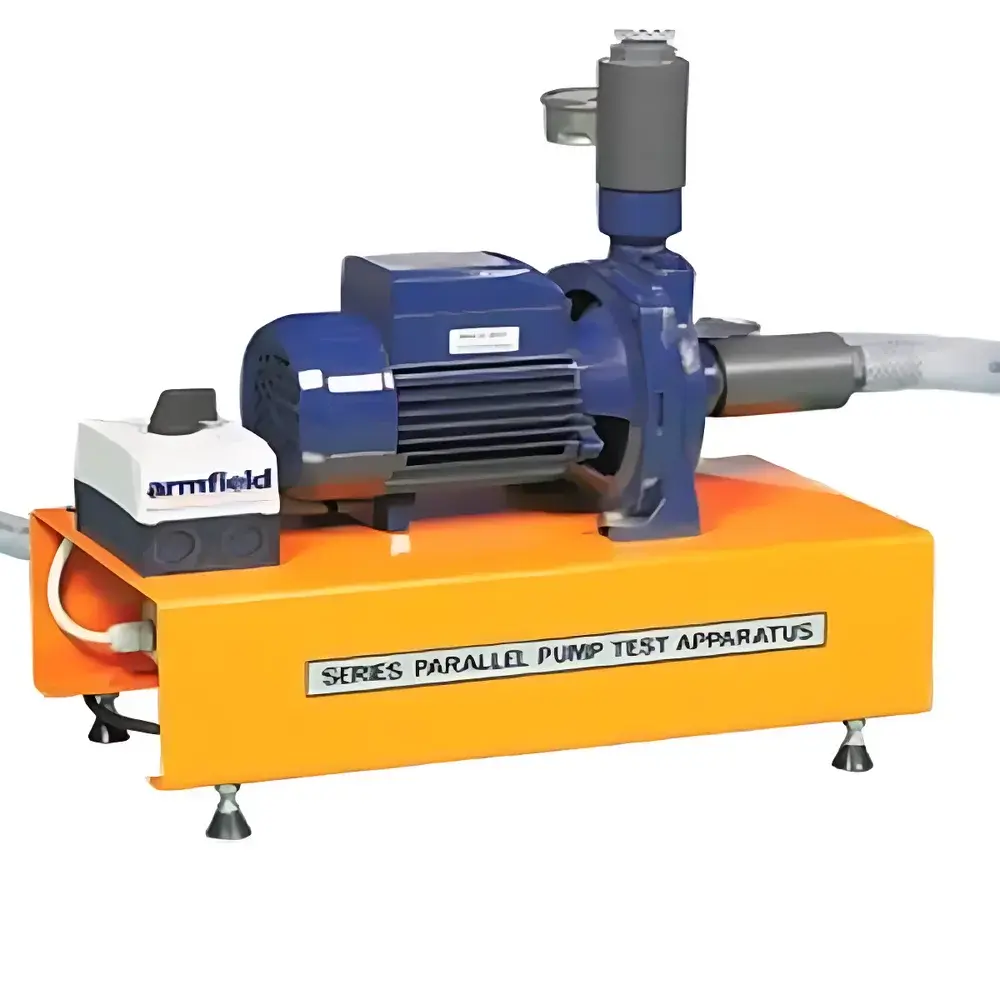
Armfield F1-26 Series/Parallel Pump Unit
| Brand | Armfield |
|---|---|
| Origin | United Kingdom |
| Model | F1-26 |
| Configuration | Modular Series or Parallel Pumping System |
| Mounting | Floor-standing Base with Integrated ON/OFF Switch |
| Flow Control | Adjustable Flow Control Valve |
| Pressure Monitoring | Built-in Pressure Gauge on Discharge Manifold |
| Connectivity | Quick-connect Fittings for Flexible Hydraulic Bench Integration |
| Optional | Educational Software Package for Data Acquisition and Experiment Simulation |
Overview
The Armfield F1-26 Series/Parallel Pump Unit is a modular, education-focused hydraulic demonstration system engineered for undergraduate and postgraduate fluid mechanics laboratories. Designed for integration with Armfield’s standard hydraulic workbenches (e.g., F1-10, F1-15), the unit enables rigorous experimental investigation of fundamental pump behavior under controlled series and parallel configurations. It operates on the principle of positive displacement via identical fixed-speed centrifugal pumps—each driven by a robust AC motor with thermal overload protection—allowing direct comparison of head–flow (H–Q) characteristics, system curve interaction, and energy transfer efficiency in multi-pump networks. Unlike single-pump setups, the F1-26 provides empirical validation of theoretical network hydraulics, including flow splitting, pressure summation, and operational stability limits when pumps operate at mismatched duty points.
Key Features
- Two identical, factory-calibrated centrifugal pumps mounted on a rigid floor-standing steel frame with vibration-damping feet and integrated mains isolation switch.
- Discharge manifold equipped with a calibrated pressure gauge (0–10 bar range) and a precision needle-type flow control valve for repeatable throttling and system resistance adjustment.
- Modular quick-connect hose fittings (6 mm bore, EPDM-lined) enabling rapid reconfiguration between series (pump discharge → suction) and parallel (common suction/discharge headers) arrangements without tools or disassembly.
- Transparent acrylic manifolds and flow paths facilitate real-time visual verification of flow direction, air entrainment, and cavitation onset during transient operation.
- Electrical interface compliant with IEC 61000-6-3 (EMC) and IEC 61000-6-2 (immunity); supplied with CE-marked power cable and terminal block for bench-level integration.
Sample Compatibility & Compliance
The F1-26 is intended for use with clean water or aqueous glycol solutions (≤30% concentration) within ambient temperature ranges (5–40 °C) and pH 6–8. It is not rated for abrasive, corrosive, or viscous fluids (>50 cP). All wetted components—including impellers, casings, and seals—are manufactured from corrosion-resistant brass, stainless steel (AISI 304), and food-grade EPDM elastomers, conforming to BS EN 12100 (machinery safety) and UKCA marking requirements. The unit supports pedagogical alignment with core syllabi referenced in the European Federation of Chemical Engineering (EFCE) Fluid Mechanics Curriculum and satisfies laboratory accreditation criteria under ISO/IEC 17025:2017 for educational calibration traceability.
Software & Data Management
An optional Windows-based educational software suite is available for the F1-26, supporting real-time acquisition of pressure, flow rate (via calibrated orifice plate or turbine sensor input), and motor current. The software includes pre-built experiment templates aligned with standard lab manuals (e.g., “Pump Characteristic Curves”, “System Curve Analysis”, “Series vs. Parallel Efficiency Comparison”) and generates exportable CSV and PDF reports. Audit trails, user access levels, and timestamped data logging comply with GLP principles; raw datasets retain full metadata (pump configuration, valve position, ambient conditions) to support reproducibility assessments in academic research contexts.
Applications
- Empirical derivation of individual and combined pump characteristic curves (H–Q, η–Q, P–Q).
- Verification of series pumping: additive head generation at constant flow, including analysis of shut-off pressure rise and potential overpressure risks.
- Analysis of parallel pumping: flow distribution imbalance, common suction line effects, and the influence of check valve placement on stability.
- Transient response studies—e.g., pump trip scenarios, valve closure-induced water hammer simulation (with optional pressure transients module).
- Integration into larger hydraulic loop experiments such as pipe network analysis, minor loss quantification, and pump selection exercises per ISO 5199 and ANSI/HI 9.6.6 guidelines.
FAQ
Can the F1-26 be used with fluids other than water?
Yes—within strict limits: only clean, non-abrasive, low-viscosity aqueous solutions (e.g., diluted glycol up to 30% v/v) are permitted. Solvents, oils, acids, or particulate-laden fluids will damage seals and void warranty.
Is calibration certification included with the unit?
The F1-26 ships with a factory test report verifying pump speed (±1 rpm), pressure gauge linearity (±0.5% FS), and flow path integrity. NIST-traceable calibration certificates are available as a separate order option.
Does the optional software support remote lab delivery?
Yes—the software includes LAN-enabled client-server mode, allowing instructor-led demonstrations and student-accessible virtual instrumentation via institutional LMS integration (LTI 1.3 compatible).
What safety interlocks are built into the system?
Thermal cut-out on each motor, manual emergency stop button on the base panel, and automatic shutdown if manifold pressure exceeds 10 bar (mechanical relief valve setpoint).
How is maintenance performed on the pumps?
Impeller clearance and seal integrity checks are accessible via front-panel covers; Armfield provides detailed maintenance SOPs and spare parts kits (P/N F1-26-MK1) with 2-year shelf life for consumables.




