
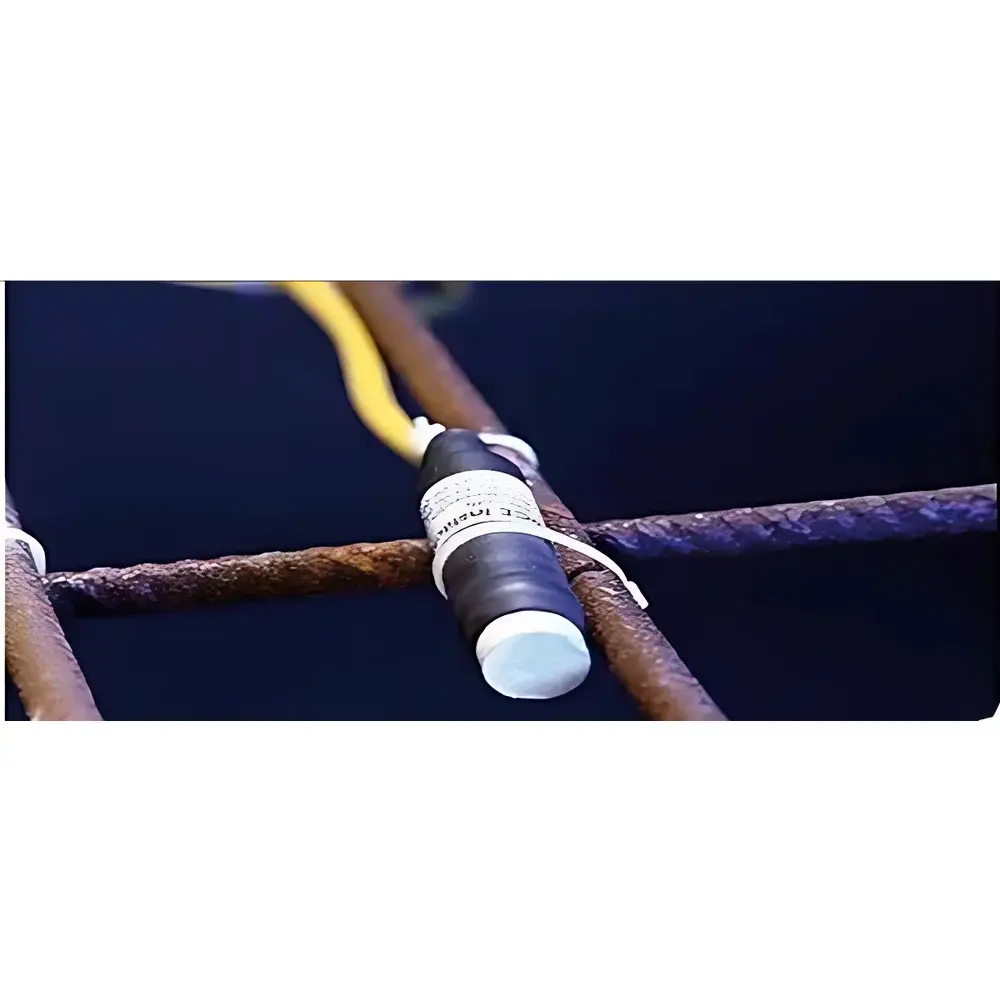
Force ERE 20 Reference Electrode for Concrete Corrosion Monitoring
| Brand | Force |
|---|---|
| Origin | Denmark |
| Model | ERE 20 |
| Type | Embedded Half-Cell Reference Electrode |
| Electrode Material | Manganese Dioxide (MnO₂) |
| Electrolyte pH | ~13.5 |
| Housing | Stainless Steel (AISI 316) |
| Ionic Membrane | Cementitious Mortar |
| Input Impedance Requirement | >100 MΩ |
| Compliance | EN 12696:2016, ASTM C876, ISO 15663-2 |
| Installation | Embeddable in Fresh or Existing Concrete |
| Output Interface | Standard BNC or Screw-Terminal Voltage Output |
| Operating Temperature Range | −10 °C to +60 °C |
| Long-Term Drift | < ±2 mV/year (typical, under stable alkaline conditions) |
Overview
The Force ERE 20 is a permanently embeddable, high-stability half-cell reference electrode engineered specifically for long-term electrochemical potential monitoring in reinforced concrete structures. It operates on the principle of a solid-state MnO₂/alkaline electrolyte system, delivering reproducible and drift-minimized open-circuit potentials (OCP) relative to the standard hydrogen electrode (SHE). Unlike portable copper/copper sulfate (Cu/CuSO₄) or silver/silver chloride (Ag/AgCl) electrodes, the ERE 20 is designed for permanent integration—either cast-in-place during concrete placement or retrofitted into existing structures via coring and grouting. Its thermodynamically stable redox couple (MnO₂/MnOOH) functions reliably within the highly alkaline pore solution of sound concrete (pH ≈ 13.5), where potential exhibits near-linear dependence on hydroxide ion activity. This enables quantitative interpretation of corrosion risk per ASTM C876 thresholds (−100 mV vs. Cu/CuSO₄ = 0% probability of corrosion; −200 mV = >90% probability), while maintaining traceability to international standards including EN 12696:2016 for cathodic protection (CP) system assessment.
Key Features
- Permanently embeddable stainless steel (AISI 316) housing with integrated cementitious ionic membrane—ensures hydraulic and chemical compatibility with concrete matrix and minimizes boundary potential errors.
- MnO₂ sensing element immersed in saturated alkaline electrolyte (pH ≈ 13.5), providing intrinsic stability against chloride ingress, carbonation front migration, and drying/wetting cycles.
- Low thermal coefficient (< 0.2 mV/°C) and minimal long-term drift (< ±2 mV/year under controlled alkaline exposure), verified per IEC 60584 and EN 62271-1 calibration protocols.
- Standardized output interface (BNC or screw-terminal) compatible with industrial data loggers, CP monitoring systems, and SCADA platforms—supports both periodic manual readout and continuous remote acquisition via GSM/GPRS modems.
- No internal liquid junction or porous frit—eliminates clogging, leakage, or electrolyte depletion risks common in conventional reference electrodes used in aggressive civil infrastructure environments.
Sample Compatibility & Compliance
The ERE 20 is validated for use across diverse concrete compositions—including Portland cement, slag-blended, fly ash-modified, and low-pH alkali-activated systems—provided the local pore solution remains alkaline (pH > 12.6). It is not intended for direct use in fully carbonated zones (pH < 9.5) or highly acidic soils without protective encapsulation. The electrode meets functional requirements of EN 12696:2016 Annex A (reference electrode performance for CP monitoring), ASTM C876–22 (half-cell potential measurement of steel in concrete), and ISO 15663-2:2021 (corrosion monitoring in concrete structures). Its construction adheres to IP68 ingress protection and conforms to CE marking directives for electrical safety in construction site instrumentation. All units undergo batch-certified potential verification against NIST-traceable Ag/AgCl reference cells prior to dispatch.
Software & Data Management
While the ERE 20 itself is a passive analog sensor, its voltage output integrates natively with third-party data acquisition ecosystems supporting IEEE 1451.2 TEDS templates. When paired with compliant loggers (e.g., Campbell Scientific CR1000X, Delta-T DL6, or custom CP management software), it supports automated timestamped OCP logging, trend analysis, polarization resistance mapping, and alarm-triggered reporting. Audit trails comply with GLP-aligned metadata tagging (location ID, installation date, calibration history). For regulatory submissions under ISO 9001 or EN 1504-9, raw potential data can be exported in CSV or XML format with embedded uncertainty budgets per GUM (JCGM 100:2008).
Applications
- Long-term corrosion potential monitoring in bridges, parking structures, marine piers, and nuclear containment buildings.
- Performance validation and maintenance scheduling of galvanic or impressed-current cathodic protection (ICCP) systems per EN 12696.
- Early detection of carbonation front progression and chloride-induced depassivation in durability assessment programs.
- Field calibration anchor for mobile half-cell surveys—providing spatially fixed reference points to correct for ground potential gradients.
- Research-grade instrumentation in accelerated corrosion testing labs (e.g., ASTM G109, RILEM TC 254-HPX) where electrode stability over months/years is critical.
FAQ
Can the ERE 20 be installed in post-tensioned concrete with grouted ducts?
Yes—provided installation avoids direct contact with grout bleed water during curing and the electrode is placed outside tendon confinement zones to prevent mechanical damage during stressing.
Is recalibration required after embedding?
No routine recalibration is needed; however, baseline potential verification against a portable Ag/AgCl electrode is recommended at commissioning and annually thereafter per EN 12696 Clause 7.3.
What is the expected service life under continuous exposure?
Laboratory and field studies (DTU Civil Engineering, 2018–2023) confirm operational stability exceeding 15 years in pH-stable concrete; service life reduces significantly if exposed to sustained carbonation or chloride concentrations >5 kg/m³.
Does the cementitious membrane require hydration maintenance?
No—the mortar layer hydrates autogenously from concrete pore moisture and maintains ionic conductivity without external water supply.
Can multiple ERE 20 units be multiplexed on a single data logger channel?
No—each unit requires an isolated high-impedance input channel (>100 MΩ) to prevent cross-talk and loading errors; shared ground architecture must follow IEC 61000-6-2 EMC guidelines.



