
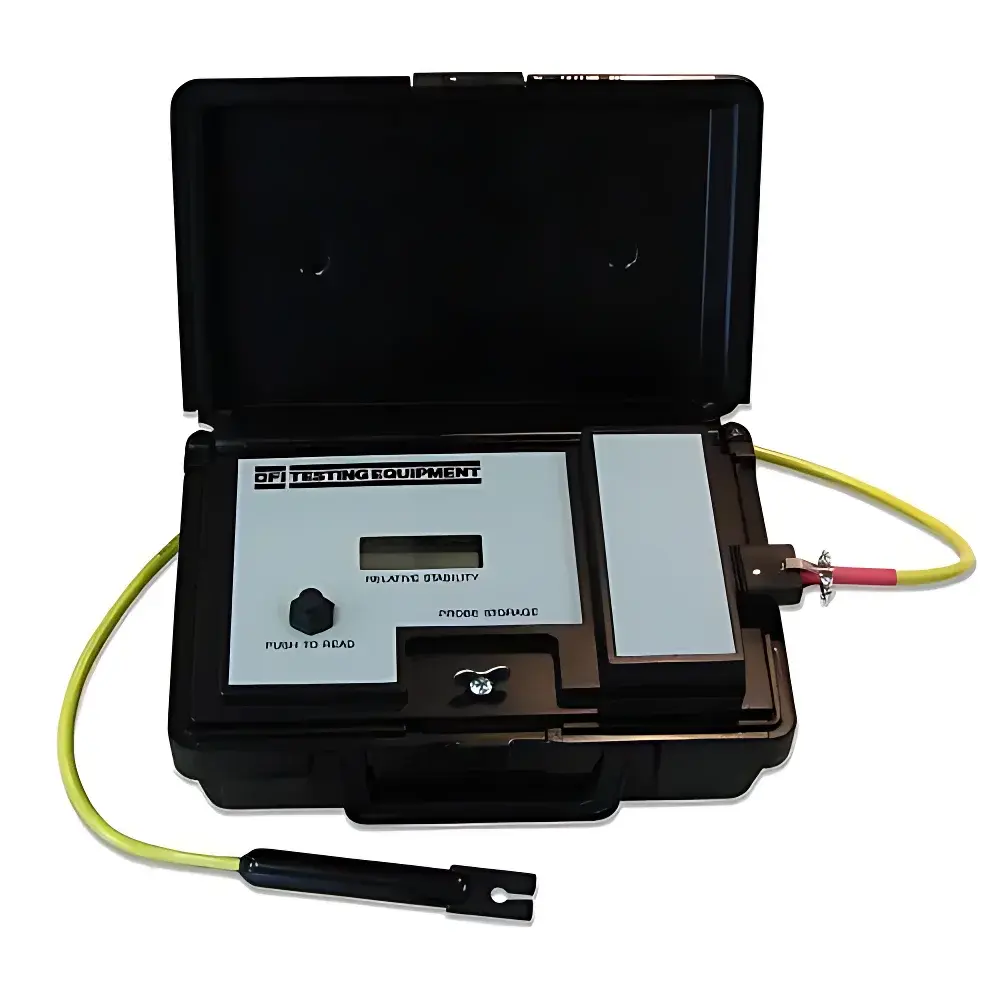
OFITE Model 131-50 Electrostability (ES) Tester
| Brand | OFITE |
|---|---|
| Origin | USA |
| Manufacturer Status | Authorized Distributor |
| Origin Category | Imported |
| Model | 131-50 |
| Price | Upon Request |
| Ammeter Waveform | Sine wave, THD < 5% |
| AC Frequency | 340 ± 10 Hz |
| Output Unit | Peak voltage |
| Voltage Ramp Rate | 150 ± 10 V/s (automated) |
| Minimum Output Range | 3–2000 V (peak) |
| Threshold Current | 61 ± 5 µA |
| Dimensions (L×W×H) | 24.1 × 16.5 × 8.9 cm |
| Weight | 1.3 kg |
| Shipping Dimensions | 28 × 28 × 18 cm |
| Shipping Weight | 4.54 kg |
| Electrode Material | Corrosion-resistant metal |
| Electrode Diameter | 3.18 ± 0.03 mm |
| Electrode Spacing | 1.55 ± 0.03 mm (at 22 °C) |
| Max Sample Temperature | 105 °C |
Overview
The OFITE Model 131-50 Electrostability (ES) Tester is a precision-engineered instrument designed for the quantitative assessment of electrostability in oil-based drilling fluids (OBMs) and synthetic-based muds (SBMs). It operates on the principle of controlled dielectric breakdown measurement: two parallel-plate electrodes are immersed in the test fluid, and a precisely regulated sinusoidal voltage ramp is applied across them. As voltage increases linearly at 150 ± 10 V/s, current remains negligible until the fluid’s dielectric integrity fails—marked by a rapid current rise to the predefined threshold of 61 ± 5 µA. The corresponding peak voltage at this transition is recorded as the ES value (in volts), serving as a direct indicator of emulsion stability, water-in-oil dispersion quality, and solid-wetting efficiency. Unlike legacy instruments employing asymmetric or spiky waveforms, the Model 131-50 implements the API RP 13I-recommended sinusoidal excitation (340 ± 10 Hz, THD < 5%), which ensures uniform field distribution, minimizes electrode polarization effects, and suppresses conductive deposit formation—thereby improving measurement reproducibility and long-term calibration stability.
Key Features
- API-compliant sinusoidal voltage waveform with total harmonic distortion < 5%, ensuring adherence to RP 13I methodology for standardized ES reporting
- Automated voltage ramp control at 150 ± 10 V/s—eliminating operator-induced variability and enhancing inter-laboratory repeatability
- Integrated ammeter with real-time current monitoring and automatic threshold detection at 61 ± 5 µA
- Corrosion-resistant metal electrodes (3.18 ± 0.03 mm diameter, 1.55 ± 0.03 mm spacing at 22 °C) optimized for thermal and mechanical stability up to 105 °C
- Self-contained portable design powered by four 9V alkaline batteries—enabling field deployment without external power sources
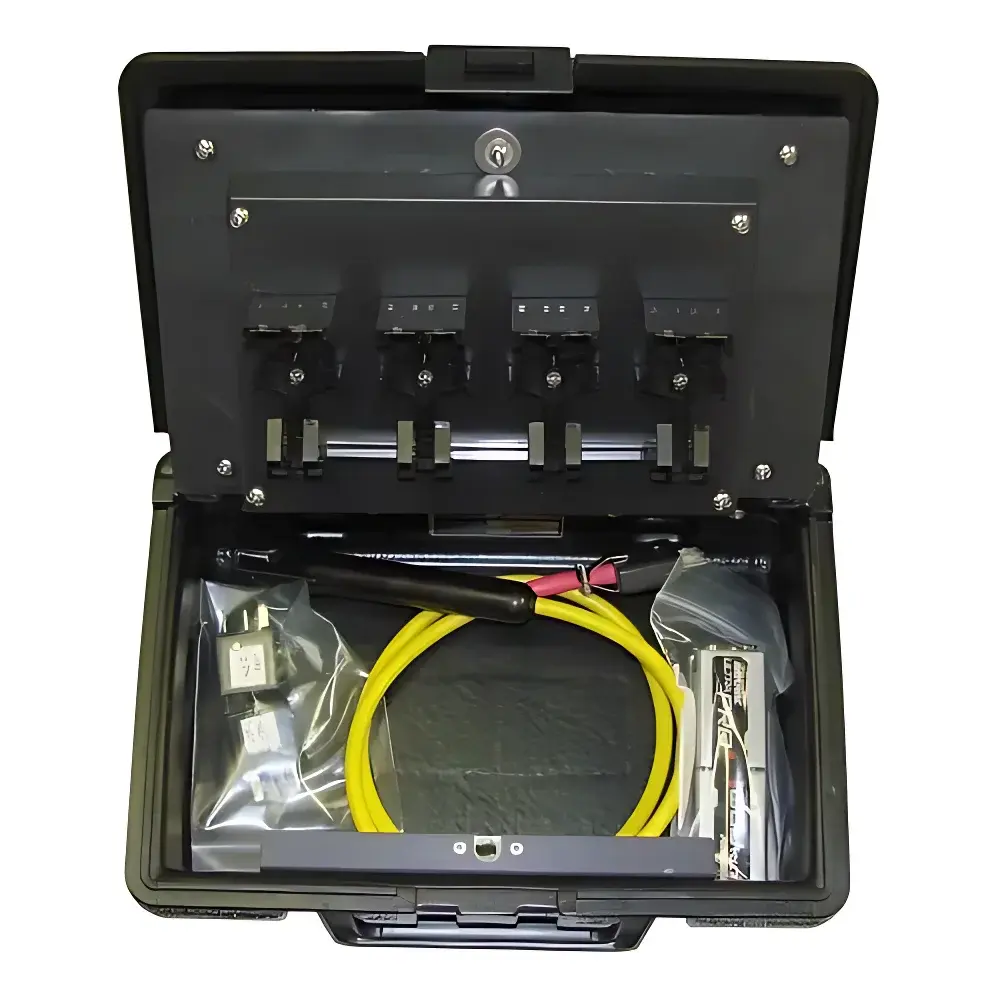
- Full test kit includes calibrated probe assembly, certified reference standards, and comprehensive documentation for traceable operation
Sample Compatibility & Compliance
The Model 131-50 is validated for use with all conventional oil-based and synthetic-based drilling fluids, including diesel-, mineral oil-, and ester-based systems containing calcium or sodium soaps, polymeric emulsifiers, and organophilic clays. Its electrode geometry and thermal rating support testing of hot-fluid samples up to 105 °C, enabling evaluation under downhole-relevant conditions. The instrument conforms to the electrical and procedural specifications outlined in API Recommended Practice RP 13I (Section 7.4.3) for electrostability determination. While not a regulatory device per se, its output supports compliance with ISO 10414-2 (Petroleum and related products — Drilling fluids — Field testing — Part 2: Oil-based muds) and serves as objective evidence in GLP-aligned quality control records. All components meet UL/CSA electrical safety requirements for Class II portable instrumentation.
Software & Data Management
The Model 131-50 is a standalone analog-digital hybrid instrument with no embedded firmware or data logging capability. ES values are read directly from the front-panel analog meter and manually recorded. This architecture intentionally avoids software dependencies, ensuring operational continuity in remote field locations and eliminating validation overhead associated with electronic data capture. For laboratories requiring digital traceability, users may integrate the instrument into LIMS or ELN workflows via manual entry with dual-operator verification—a practice aligned with FDA 21 CFR Part 11 principles for non-automated systems. Calibration certificates for electrodes and reference standards are supplied with NIST-traceable uncertainty statements, supporting audit readiness for ISO/IEC 17025-accredited labs.
Applications
- Quality assurance of emulsifier package performance during OBM formulation and field mixing
- Routine monitoring of ES trends across mud pits to detect phase inversion, water contamination, or surfactant depletion
- Supporting rheological interpretation—low ES values ( 800 V) indicate robust emulsion integrity
- Comparative evaluation of alternative base oils and synthetic fluids under identical test conditions
- Training and certification programs for mud engineers and laboratory technicians in accordance with IADC and IWCF competency frameworks
FAQ
What does the ES value represent physically?
It is the peak voltage at which the oil-based fluid undergoes dielectric breakdown under controlled sinusoidal excitation—correlating directly with the energy required to disrupt the water-in-oil emulsion structure.
Why is a sine wave preferred over DC or square-wave excitation?
Sinusoidal excitation minimizes electrode polarization, reduces localized heating, and prevents preferential deposition of solids—yielding higher measurement consistency and lower standard deviation across replicate tests.
Can the instrument be used for water-based muds?
No. The ES test is specific to non-aqueous systems. Water-based muds exhibit inherently low resistivity and will trigger immediate current rise, rendering ES values non-diagnostic.
How often should the electrodes be recalibrated?
Electrodes should be verified for dimensional accuracy (diameter and spacing) before each shift when used continuously; full recalibration—including reference standard verification—is recommended every 90 days or after 200 test cycles, whichever occurs first.
Is battery life sufficient for extended field use?
Four 9V alkaline batteries provide ≥ 20 hours of continuous operation under typical usage (10–15 tests/hour), with low-battery indication integrated into the analog meter circuitry.





