
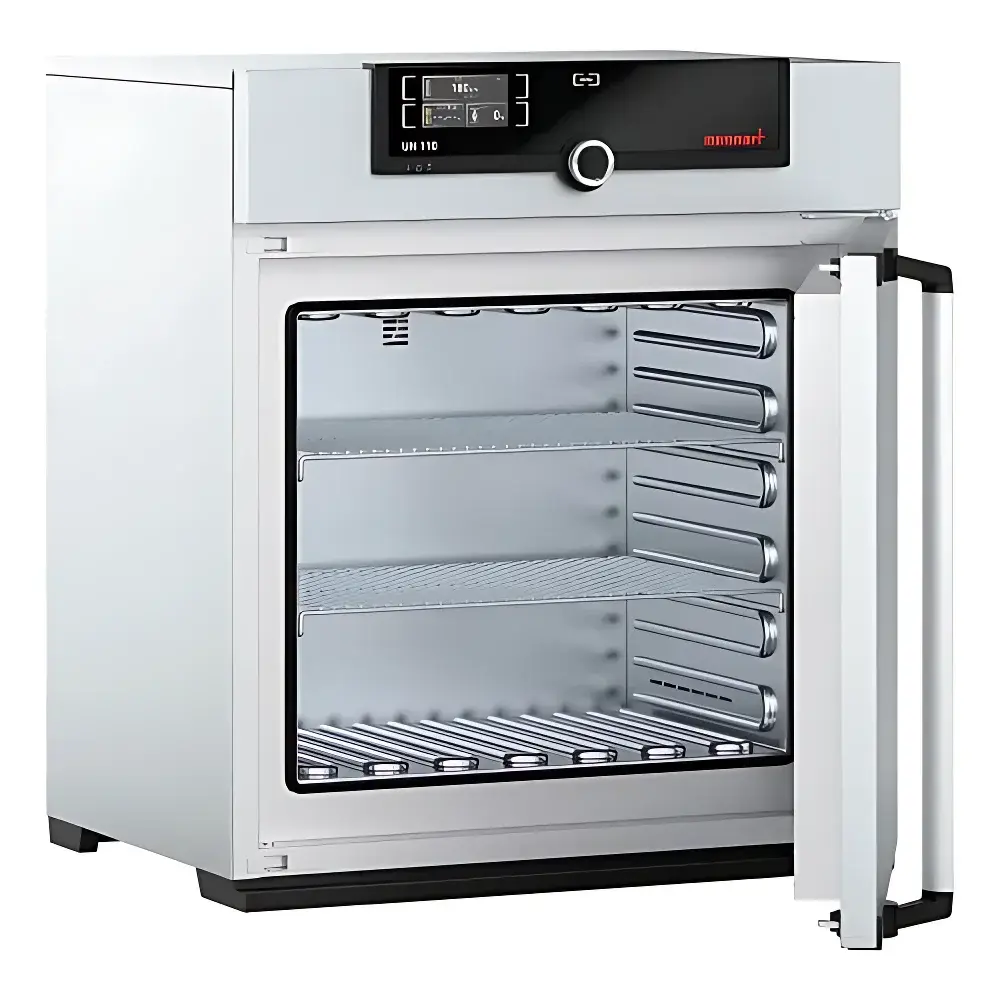
OFITE Model 174-50-1 Forced-Air Laboratory Oven
| Brand | OFITE |
|---|---|
| Origin | USA |
| Manufacturer Authorization | Authorized Distributor |
| Import Status | Imported |
| Model | 174-50-1 |
| Voltage | 230 V |
| Internal Volume | 108 L (3.8 ft³) |
| Max Operating Temperature | 300 °C (572 °F) |
| External Dimensions | 74 × 87 × 64 cm |
| Net Weight | 72.5 kg |
| Shipping Dimensions | 83 × 106 × 80 cm |
| Shipping Weight | 103 kg |
| Construction | Stainless Steel (Interior & Exterior) |
| Air Circulation | Natural Convection |
| Control System | Digital Timer + Digital Temperature Display |
| Safety Features | Dual Independent Over-Temperature Protection Circuits |
Overview
The OFITE Model 174-50-1 is a precision-engineered, natural-convection laboratory oven designed for consistent thermal processing in quality control, materials testing, and routine analytical workflows. Unlike forced-air ovens with mechanical blowers—whose airflow patterns may induce non-uniform temperature gradients—the 174-50-1 relies on optimized natural convection to achieve stable, repeatable heat distribution across its 108-liter chamber. This design minimizes sample disturbance while maintaining ±1.5 °C temperature uniformity at 300 °C (per ASTM E2203), making it suitable for applications where mechanical agitation or turbulent airflow could compromise sample integrity—such as drying moisture-sensitive polymers, conditioning filter media, or stabilizing reference standards prior to gravimetric analysis. Constructed entirely of electropolished stainless steel (both interior and exterior), the unit resists corrosion from solvents, saline environments, and repeated cleaning cycles common in petroleum, environmental, and geotechnical laboratories.
Key Features
- Stainless steel chamber and housing—fully welded seams, no painted surfaces, compliant with ISO 15190:2020 requirements for laboratory equipment corrosion resistance
- Digital microprocessor-based temperature controller with real-time display and adjustable setpoint resolution of 0.1 °C
- Independent digital timer (0–999 minutes), programmable for unattended operation with automatic shutdown
- Dual redundant over-temperature protection: primary solid-state limit switch + secondary mechanical high-limit cutout, both independently wired and certified to UL 61010-1
- Calibration-ready design: includes dedicated 1/4″ NPT port for external probe insertion and traceable calibration documentation support
- Low thermal mass insulation—ceramic fiber blanket rated for continuous service up to 350 °C, minimizing energy consumption and improving ramp stability
Sample Compatibility & Compliance
The 174-50-1 accommodates standard laboratory ware including porcelain crucibles, stainless steel trays, glass desiccators (with lid removed), and ASTM D2879-compliant volatility pans. Its 300 °C maximum operating temperature meets requirements for ASTM D2989 (moisture content in drilling muds), API RP 13B-1 (fluid loss testing), and ISO 527-2 (tensile conditioning of plastics). The stainless steel interior eliminates outgassing concerns associated with enamel or painted chambers, ensuring compatibility with volatile organic compound (VOC) analysis prep and residue quantification per EPA Method 1664. Unit complies with CE marking directives (2014/30/EU EMC, 2014/35/EU LVD), and supports GLP audit readiness through configurable event logging (power-on, setpoint change, door opening, over-temp alarm) when integrated with optional data acquisition modules.
Software & Data Management
While the 174-50-1 operates as a standalone instrument with embedded firmware, it supports analog output (4–20 mA) for connection to SCADA or LIMS platforms. Optional RS-485 Modbus RTU interface enables remote monitoring of temperature, timer status, and fault codes—facilitating integration into FDA 21 CFR Part 11–compliant environments when paired with validated third-party software. All configuration changes and alarm events are timestamped and stored in non-volatile memory for minimum 30-day local history retention, satisfying internal QA record-keeping requirements without external hardware.
Applications
- Drying and conditioning of oilfield drilling fluid samples per API RP 13B-1 and ISO 10414-2
- Moisture determination in soil, cement, and aggregate per ASTM D2234/D2234M and AASHTO T 265
- Pre-weighing stabilization of filter papers and crucibles in gravimetric particulate matter analysis (e.g., EPA Method 201A)
- Thermal aging of elastomers and gasket materials under controlled ambient conditions (ASTM D573)
- Residue evaporation and solvent recovery preparation in hydrocarbon analysis workflows
FAQ
Is the OFITE 174-50-1 certified for use in hazardous locations?
No—it is rated for general-purpose laboratory use only (Class I, Division 2 not applicable). For classified areas, consult OFITE’s explosion-proof oven series.
Can the unit be calibrated to NIST-traceable standards?
Yes. The oven includes a dedicated sensor port and supports third-party calibration using accredited dry-block calibrators or portable PRT probes. OFITE provides calibration certificate templates aligned with ISO/IEC 17025 documentation requirements.
What maintenance intervals are recommended?
Inspect door gasket integrity and clean chamber monthly; verify temperature uniformity annually per ASTM E2203; replace ceramic insulation only if physically damaged or thermally degraded (typical service life >10 years at ≤250 °C continuous operation).
Does the 174-50-1 meet FDA or pharmacopeial requirements for stability testing?
It satisfies physical design criteria in USP <1151> and ICH Q5C for non-climate-controlled thermal conditioning, but is not a qualified stability chamber per ICH Q1A(R2); validation must be performed per user-defined protocols.




