
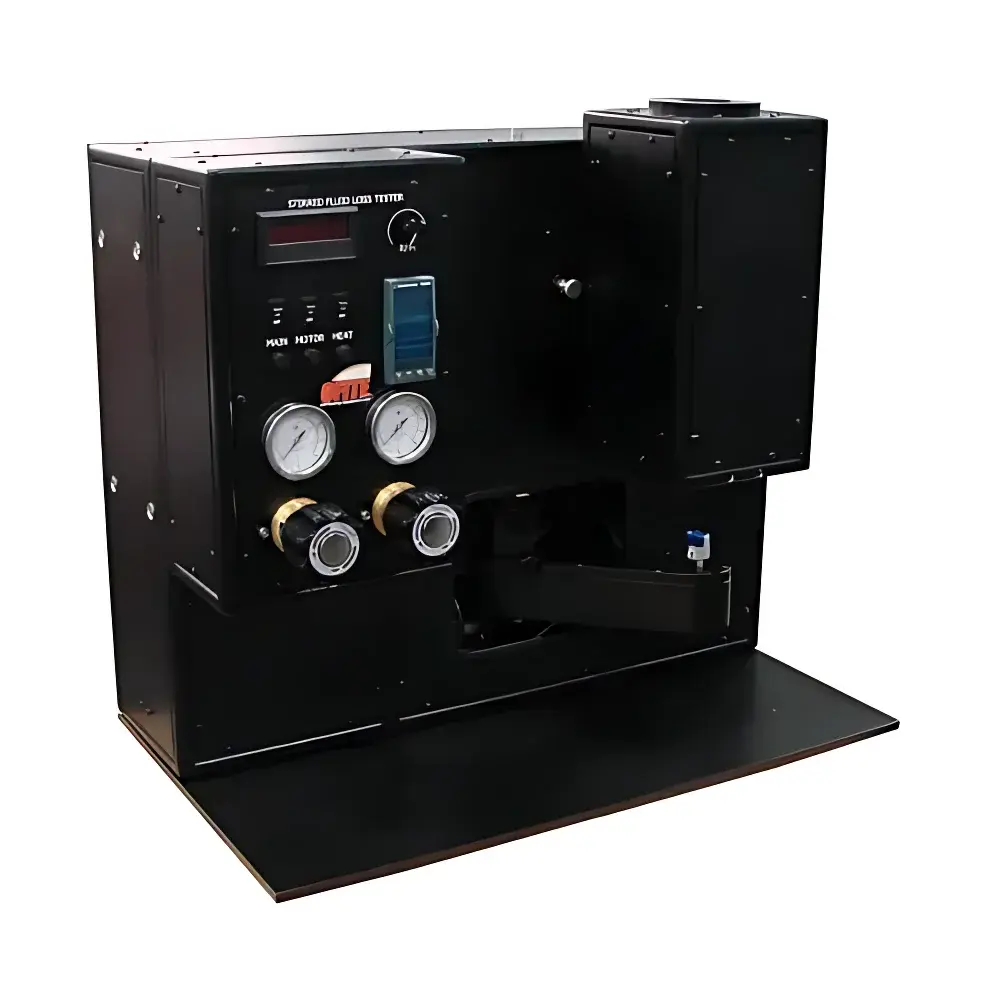
OFITE Model 120-70-1 Stirred High-Temperature High-Pressure Fluid Loss Tester
| Brand | OFITE |
|---|---|
| Origin | USA |
| Manufacturer Status | Authorized Distributor |
| Origin Category | Imported |
| Model | 120-70-1 |
| Quotation | Upon Request |
| Max Pressure | 13.8 MPa |
| Max Temperature | 232.2 °C |
| Temperature Control Accuracy | ±1.0 °C (digital PID) |
| Sample Cup Rotation Speed | 200 rpm |
| Sample Volume | 500 mL |
| Filtrate Collection Time | 30 min |
| Filtrate Volume Reporting Unit | cm³ (cc) |
| Power Supply | 220 V, 50 Hz, 10 A |
| Cooling Water Requirement | 40 PSI |
| Nitrogen Supply Range | 13.8–17.2 MPa |
| Dimensions (packed) | 97 × 66 × 86 cm |
| Weight (packed) | 99.8 kg |
Overview
The OFITE Model 120-70-1 Stirred High-Temperature High-Pressure (HTHP) Fluid Loss Tester is an engineered solution for quantifying fluid loss behavior of oilwell cement slurries under downhole-relevant thermal and hydraulic conditions. It operates on the principle of controlled filtration through a standardized filter medium—typically a 325-mesh stainless steel screen—under sustained differential pressure across the slurry column. The instrument replicates the dynamic environment encountered during cementing operations by combining continuous mechanical agitation (at 150 rpm per API RP 10B-2), precise thermal regulation up to 232.2 °C, and confining pressures up to 13.8 MPa. This integrated approach ensures that measured fluid loss values reflect realistic slurry performance, particularly with respect to filtrate volume (reported in cm³ over 30 minutes), cake thickness development, and rheological stability during curing. Unlike static filtration devices, the stirred configuration prevents sedimentation and maintains homogeneous slurry suspension throughout the test duration—a critical factor for evaluating modern low-fluid-loss cement systems containing dispersants, fluid-loss additives, or nanomaterials.
Key Features
- API RP 10B-2 compliant stirred fluid loss testing with 150 rpm agitation for 20 minutes prior to filtration, followed by 30-minute filtrate collection under constant pressure
- Digital PID temperature controller with ±1.0 °C accuracy and rapid thermal response, enabling stable setpoint maintenance across the full 20–232.2 °C operating range
- Integrated heating/cooling sample cup assembly—eliminates external chillers and reduces thermal lag during cooldown cycles
- Patented dual-seal filtration chamber design with quick-release clamping, facilitating efficient cleaning and minimizing cross-contamination between tests
- Modular pressure manifold compatible with high-purity nitrogen supply (13.8–17.2 MPa), featuring calibrated back-pressure regulators and redundant safety relief valves
- Robust gear-driven stirring mechanism using API-standard impeller geometry (identical to that used in atmospheric consistency testers), ensuring reproducible shear history
- Self-contained filtrate collection system with graduated receiving cylinder and integrated back-pressure control to maintain constant ΔP during measurement
Sample Compatibility & Compliance
The Model 120-70-1 accommodates standard 500 mL cement slurry samples prepared per ASTM C109/C109M and API RP 10B-2 protocols. Its filtration geometry—including screen diameter, effective filtration area, and flow path length—is dimensionally identical to that specified in API RP 10B-2 Annex A for HTHP fluid loss apparatuses, ensuring direct comparability with industry reference data. The unit supports testing of Class A through G cements, foamed slurries, latex-modified systems, and nanoparticle-enhanced formulations. All pressure-containing components conform to ASME B31.4 and PED 2014/68/EU standards. Temperature and pressure transducers are NIST-traceable and certified for use in GLP-compliant laboratories. Data acquisition meets FDA 21 CFR Part 11 requirements when interfaced with validated LIMS or electronic lab notebook platforms.
Software & Data Management
While the base Model 120-70-1 operates as a stand-alone analog-digital hybrid instrument, optional OFITE DataLink™ software enables real-time logging of temperature, pressure, and elapsed time via RS-232 or USB interface. The software generates timestamped test reports compliant with ISO/IEC 17025 documentation requirements, including automatic calculation of fluid loss rate (cm³/30 min), derived cake permeability estimates, and deviation alerts for out-of-specification excursions. Audit trails record operator ID, calibration dates, and parameter modifications—supporting regulatory inspections under GMP or API Q1 quality management frameworks. Raw data exports are available in CSV and PDF formats, fully compatible with statistical process control (SPC) tools and enterprise QA databases.
Applications
- Qualification of fluid-loss control additives (e.g., bentonite, carboxymethyl cellulose, synthetic polymers) under simulated wellbore conditions
- Development and validation of low-permeability filter cakes for reservoir protection in open-hole and casing-cemented completions
- Comparative evaluation of cement slurry stability across varying water-to-cement ratios, retarder concentrations, and mixing procedures
- Supporting API certification submissions for new cement blends intended for deepwater, HPHT, or sour service environments
- Root-cause analysis of premature thickening or excessive filtrate invasion observed during field cementing operations
- Training and competency assessment for cementing engineers and laboratory technicians in accordance with IADC WellSharp® standards
FAQ
What standards does the OFITE 120-70-1 comply with?
It fully conforms to API RP 10B-2 (2022 edition) for HTHP fluid loss testing, including agitation protocol, filtration geometry, and reporting conventions.
Can the instrument be used for non-cement applications, such as drilling fluid testing?
No—the 120-70-1 is specifically configured for oilwell cement slurries; its thermal mass, pressure rating, and filtration media are optimized for cement hydration kinetics and solid-phase buildup, not for low-solids mud systems.
Is nitrogen the only acceptable pressurizing gas?
Yes—only dry, oil-free nitrogen is permitted per API RP 10B-2 Section 7.3.2 to prevent oxidation of slurry components and ensure repeatable filter cake formation.
How often does the filtration screen require replacement?
Under routine use with properly screened slurries, the 325-mesh stainless steel screen typically lasts ≥50 tests; visual inspection for pitting or deformation is recommended after every 10 runs.
Does the unit include calibration certificates for temperature and pressure sensors?
Each shipment includes factory calibration certificates traceable to NIST for both primary sensors; annual recalibration is advised per ISO/IEC 17025 Clause 6.5.2.





