
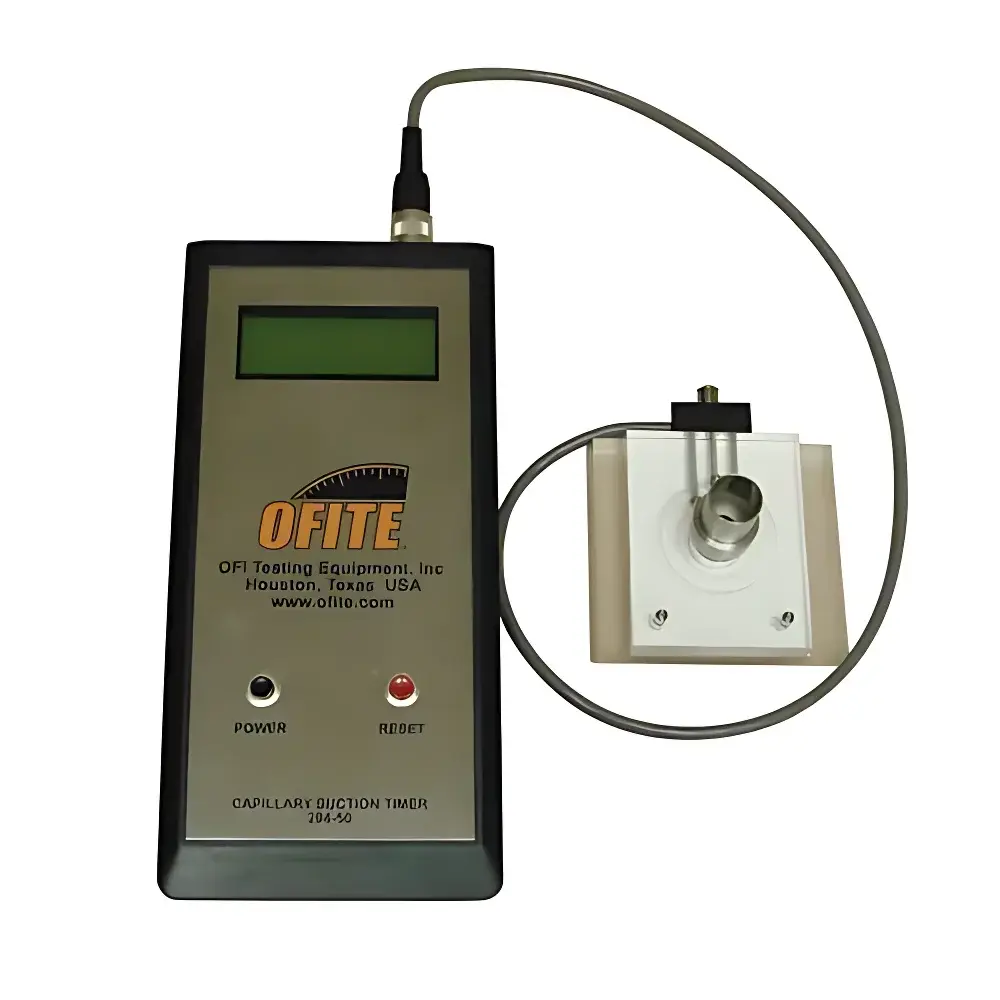
OFITE Model 294-50 Capillary Suction Time (CST) Tester
| Brand | OFITE |
|---|---|
| Origin | USA |
| Manufacturer Status | Authorized Distributor |
| Origin Category | Imported |
| Model | 294-50 |
| Pricing | Available Upon Request |
Overview
The OFITE Model 294-50 Capillary Suction Time (CST) Tester is a field-deployable, benchtop instrument engineered for rapid, quantitative assessment of colloidal behavior and dewaterability in fine particulate suspensions. Based on the capillary suction time principle originally developed at the UK Water Pollution Research Laboratory, the device measures the time required for a fixed volume of suspension to penetrate a standardized filter paper under capillary action—providing a direct, reproducible index of sludge filterability, clay dispersion stability, and drilling fluid–shale interaction kinetics. Unlike pressure-driven filtration methods, CST operates without external force, eliminating compressibility artifacts and enabling consistent comparison across samples with varying solids content, polymer dosage, or electrolyte composition. Its primary domain spans wastewater treatment optimization, potable water coagulation/flocculation control, and upstream oilfield chemistry—particularly in shale inhibition studies where low-CST values correlate with reduced clay swelling and improved wellbore stability.
Key Features
- Digital LCD display with high-resolution timing resolution (0.1 s), ensuring precise and unambiguous readout under laboratory or field conditions
- Compact, battery-powered architecture: operates on a single 9 V alkaline battery, supporting >200 tests per charge without AC dependency
- Robust mechanical design: dimensions of 25 × 12 × 5 cm (10″ × 4.75″ × 2″) and mass of 0.68 kg (1 lb 8 oz) enable portability between treatment plants, drilling fluid labs, and research facilities
- Standardized test geometry: utilizes OFITE-certified #294-05 CST filter paper (300 sheets/box) for high-viscosity or slow-filtration systems; compatible with ASTM D2492-compliant paper specifications when alternate grades are employed
- Minimal operator intervention: gravity-fed capillary action eliminates need for pumps, valves, or pressure regulators—reducing calibration drift and maintenance requirements
Sample Compatibility & Compliance
The CST Tester accommodates aqueous suspensions with total suspended solids (TSS) ranging from 0.5% to 12% w/w, including activated sludge, anaerobically digested biosolids, flocculated alum/iron hydroxide precipitates, bentonite–water dispersions, and synthetic-based drilling fluid cuttings slurries. It complies with methodology references cited in ISO 16262:2014 (Water quality — Determination of dewaterability of sewage sludge — Capillary suction time method) and supports GLP-aligned data recording when paired with OFITE’s optional traceable calibration logbook. While not a regulatory compliance device per se, CST data are routinely accepted in EPA Region 4 NPDES permit reviews and serve as a key performance indicator in USP guidance for process validation of solid–liquid separation unit operations.
Software & Data Management
The Model 294-50 is a standalone hardware instrument with no embedded firmware or digital connectivity. All measurements are recorded manually or transcribed into LIMS-compatible spreadsheets. For audit-trail integrity, users are advised to document test parameters—including sample source, conditioning history (e.g., polymer type/dose, pH, mixing time), ambient temperature, and paper lot number—in accordance with 21 CFR Part 11–aligned SOPs. OFITE provides a recommended data template (v3.1) for CST reporting that aligns with ISO/IEC 17025 documentation requirements for accredited environmental testing laboratories.
Applications
- Wastewater Treatment: Optimization of polymer dosing for belt filter presses and centrifuges; evaluation of DAF sludge thickening efficiency; monitoring of digester supernatant conditioning prior to land application
- Drinking Water Production: Real-time assessment of coagulant efficacy during jar testing; detection of destabilized floc structures caused by seasonal organic loading shifts
- Oil & Gas Drilling Fluids: Screening of shale inhibitors (e.g., KCl, glycols, cationic polymers); quantification of filtrate invasion potential in reactive shales; correlation of CST reduction with static yield point increase in rheological profiling
- Academic & Regulatory Research: Colloid stability modeling (DLVO theory validation), sedimentation kinetics studies, and benchmarking of novel flocculants against industry standards such as polyacrylamide and chitosan derivatives
FAQ
What is the measurement principle behind CST?
Capillary Suction Time is defined as the elapsed time for 1 mL of suspension to migrate 1 cm across the surface of standardized filter paper under capillary forces alone—no applied pressure or vacuum.
Can CST values be correlated with specific rheological parameters?
Yes—empirical correlations exist between CST and yield stress (τy) in sludge matrices, particularly when normalized to solids concentration; however, these relationships must be established per site-specific sludge composition.
Is the #294-05 filter paper mandatory?
No—it is recommended for highly viscous or low-permeability systems; standard #294-01 paper is suitable for most municipal sludges and drilling fluid base muds.
Does the instrument require annual recalibration?
No formal recalibration is specified by OFITE; however, periodic verification using reference suspensions (e.g., 1% kaolin in 0.01 M NaCl) is advised per ISO 16262 Annex B.
How does CST differ from specific resistance to filtration (SRF)?
SRF requires pressurized filtration and accounts for cake compressibility; CST reflects initial colloidal resistance only and is insensitive to compressive stress—making it more sensitive to surface charge and polymer bridging effects.






