
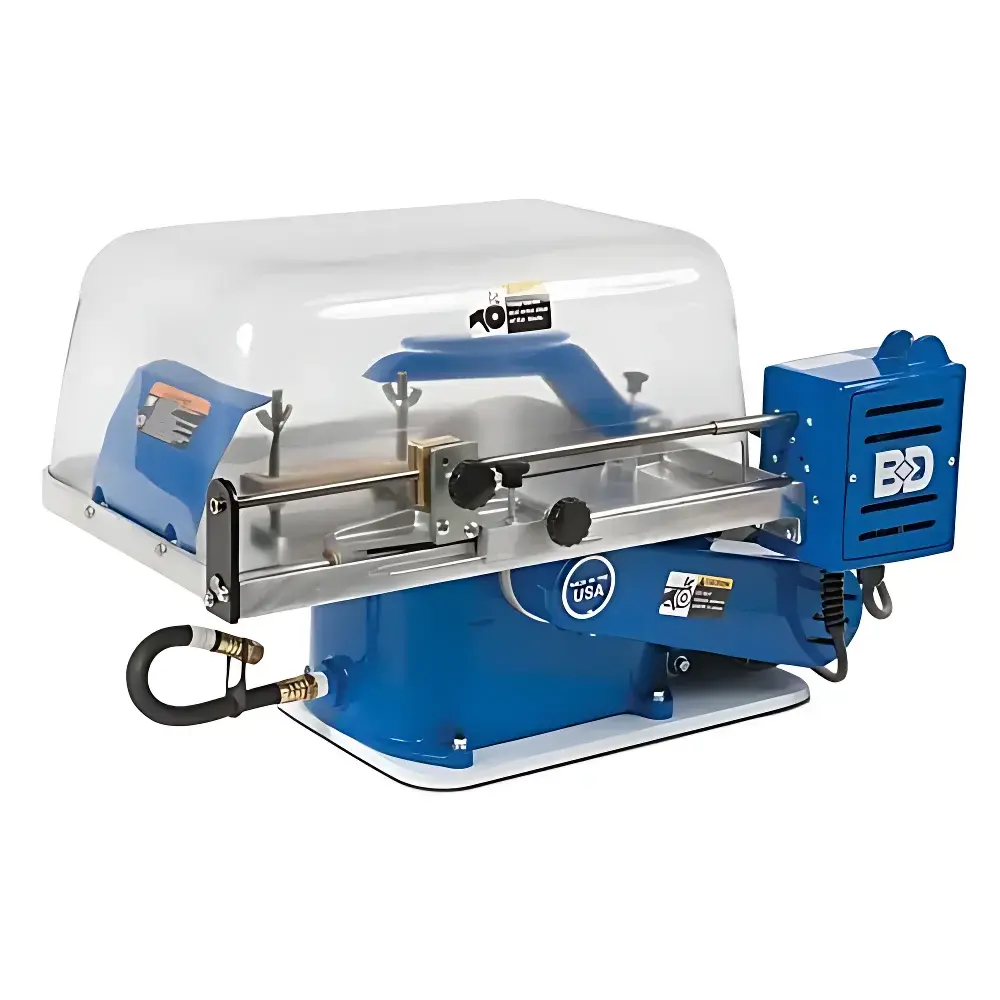
OFITE Model 127-68-1 Automatic Feed Rock Saw
| Brand | OFITE |
|---|---|
| Origin | USA |
| Manufacturer Status | Authorized Distributor |
| Origin Category | Imported |
| Model | 127-68-1 |
| Pricing | Upon Request |
| Motor | Leeson, 1/3 HP, 5.8 A, 1725 RPM |
| Arbor Size | 5/8" |
| Blade Capacity | 8"–10" |
| Manual Cutting Depth | 3" |
| Powered Feed Cutting Depth | 2-5/8" |
| Max Jaw Opening | 3-1/4" |
| Table Dimensions | 15-3/8" × 19-1/2" (391 × 495 mm) |
| Overall Dimensions | 27" × 17" × 19" (686 × 432 × 483 mm) |
| Net Weight | 70 lb (31.8 kg) |
| Shipping Weight | 80 lb |
| Voltage/Frequency | 230 V, 50 Hz |
| Blade Spec | 10" × 0.040" × 5/8" bore, sintered diamond-impregnated |
| Feed Rate | 3/16" per minute (single-speed powered feed) |
| Construction | Cast aluminum housing, worktable, blade guard, and power feed enclosure |
| Safety Shield | PETG high-impact copolymer |
| Bearing Assembly | Sealed arbor-bearing unit |
| Clutch Mechanism | Brass friction clutch plate |
| Base Material | 1/2" polypropylene |
| Vise System | Vertical rock vise with 360° rotation capability in manual mode |
Overview
The OFITE Model 127-68-1 Automatic Feed Rock Saw is a precision-engineered laboratory-grade rock cutting instrument designed for consistent, repeatable sectioning of geological specimens—including shale, limestone, sandstone, granite, and other consolidated core materials—under controlled conditions. Built upon the proven mechanical architecture of the Barranca BD10 diamond saw platform, this model integrates a dedicated single-speed powered feed system to eliminate operator-dependent variability during slabbing operations. Its core measurement principle relies on controlled linear advancement of the specimen into a rotating diamond-impregnated blade under constant load and speed, enabling reproducible slice thickness and minimal kerf loss. The unit operates at a fixed rotational speed of 1725 RPM and delivers a precisely regulated feed rate of 3/16 inch per minute—optimized for balancing cut quality, blade longevity, and thermal management in hard-rock applications. Designed for integration into core logging labs, petrophysical testing facilities, and geological research centers, the 127-68-1 complies with standard mechanical safety practices for stationary abrasive cutting equipment and supports routine calibration traceability per ASTM D3878 and ISO 14689-1.
Key Features
- Robust cast aluminum structural frame, table surface, blade guard, and power feed housing—engineered for dimensional stability and long-term resistance to coolant-induced corrosion.
- Hinged tabletop design allows full access to the cutting zone for efficient slurry and coolant residue removal without disassembly.
- Vertical rock vise with hardened steel jaws and micrometer-adjustable clamping force; capable of 360° rotation when used in manual mode for angled or multi-faceted specimen alignment.
- Sealed arbor-bearing assembly prevents ingress of abrasive particulates and extends blade shaft service life under continuous operation.
- PETG high-impact copolymer transparent shield provides full visual monitoring while meeting ANSI Z87.1 impact resistance requirements.
- Brass-friction clutch plate system ensures smooth engagement/disengagement of the powered feed mechanism—minimizing mechanical shock during start-stop cycles.
- 1/2-inch thick polypropylene base dampens vibration transmission and enhances operational stability on standard lab countertops.
- Pre-installed 10-inch sintered diamond blade (0.040″ kerf, 5/8″ arbor) optimized for low-dust, high-efficiency cutting of siliceous and carbonate-rich formations.
Sample Compatibility & Compliance
The 127-68-1 accommodates cylindrical core samples up to 3-1/4 inches in diameter and planar rock slabs up to 19-1/2 inches in length. Its adjustable vise geometry supports irregularly shaped specimens, including split-core halves and trimmed outcrop blocks. The saw is routinely deployed in laboratories adhering to API RP 13B-1 (drilling fluid testing), ASTM D5433 (core preparation for porosity/permeability analysis), and ISO 14688-1 (geotechnical classification). While not intrinsically rated for hazardous locations, its electrical configuration (230 V, 50 Hz) conforms to IEC 61000-6-2/6-4 EMC standards. All mechanical guards meet OSHA 1910.212 and EN 626-1 requirements for fixed abrasive cutting machinery.
Software & Data Management
This is a standalone electromechanical instrument with no embedded microprocessor or digital interface. Operation is fully manual via front-panel toggle switches and mechanical feed lever actuation. No firmware, data logging, or connectivity features are included—consistent with industry-standard rock saws intended for GLP-compliant environments where audit trails rely on procedural documentation rather than electronic records. Maintenance logs, blade usage tracking, and calibration verification (e.g., feed rate verification using calibrated depth gauges) are performed manually and retained per institutional SOPs aligned with ISO/IEC 17025 Clause 7.7.
Applications
- Preparation of thin sections for petrographic microscopy (prior to grinding/polishing stages).
- Sectioning of whole-round core for X-ray CT scanning, spectral gamma logging, or resistivity profiling.
- Production of standardized test specimens for unconfined compressive strength (UCS), Brazilian tensile strength, and point load index assays.
- Cutting of reservoir analog materials (e.g., ceramic or polymer composites) in experimental flow-through studies.
- Routine slabbing of drill cuttings aggregates for lithological sorting and mineralogical screening.
FAQ
Is the 127-68-1 compatible with water-based coolants only?
Yes—the machine is designed exclusively for use with non-corrosive, pH-neutral aqueous coolants; oil-based or glycol mixtures are not recommended due to potential degradation of PETG shielding and polypropylene base components.
Can the feed rate be adjusted or overridden manually?
No—the powered feed system is fixed at 3/16 inch per minute and lacks variable-speed control; however, the vise may be advanced manually using the handwheel when the clutch is disengaged.
What maintenance intervals are recommended for the sealed arbor bearings?
Per OFITE’s technical bulletin TB-127-68, bearings require inspection every 500 operating hours and replacement after 2,000 hours or visible wear—no lubrication is required due to factory-sealed construction.
Does this model support blade dressing or truing in situ?
No—blade conditioning must be performed externally using a dedicated diamond dresser; the unit does not include a dressing port or auxiliary tooling interface.
Is CE marking applicable to the 127-68-1 configuration?
The 230 V / 50 Hz variant (127-68-1) is supplied with EU Declaration of Conformity covering Machinery Directive 2006/42/EC and Low Voltage Directive 2014/35/EU; full CE documentation is provided with shipment.






