
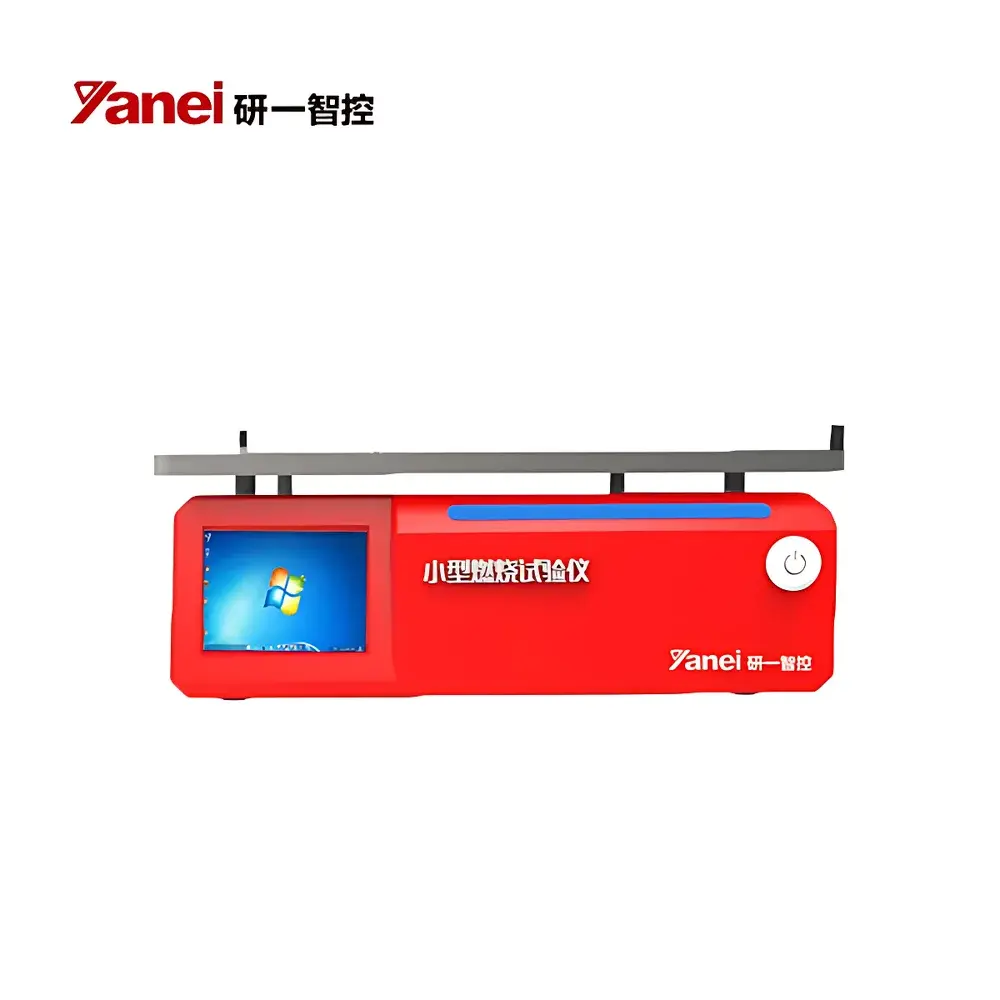
Yanei DG23-D Small-Scale Combustibility Tester for Hazardous Chemical Classification
| Brand | Yanei |
|---|---|
| Origin | Zhejiang, China |
| Manufacturer Type | Direct Manufacturer |
| Country of Origin | China |
| Model | DG23-D |
| Pricing | Available Upon Request |
| Operating Environment | −5°C to 40°C, <95% RH |
| Test Chamber Dimensions | 30 cm × 30 cm |
| Camera Resolution | 300 K pixels |
| Wireless Camera Transmission Range | 100 m (line-of-sight) |
| Fire Suppression Cover Dimensions | 32 cm × 32 cm × 5 cm |
| Ignition Method | Electric Fuse |
Overview
The Yanei DG23-D Small-Scale Combustibility Tester is an engineered instrument designed for standardized assessment of combustibility behavior in solid and liquid hazardous substances under controlled thermal stimulus. It operates on the principle of small-scale flame propagation testing—where a defined ignition source initiates combustion in a confined sample, and the resulting flame spread, duration, intensity, and self-extinguishment characteristics are objectively recorded and evaluated. This method aligns with internationally recognized hazard classification frameworks used in transport safety, waste characterization, and regulatory compliance. The DG23-D implements the core physical test protocol described in UN Manual of Tests and Criteria, Rev. 5, Section 13.7.1, Test 3(d), and is fully compatible with Chinese national standards including GB 30000.2–2013 (Classification of Explosives), GB 5085.5 (Reactivity Identification of Hazardous Wastes), and GB 19455–2004 (Safety Specifications for Testing Reactive Properties of Civil Explosives). Its purpose is not qualitative observation alone but reproducible, auditable determination of whether a material meets criteria for Class 4.1 (Flammable Solids) or exhibits reactive hazard potential requiring special handling.
Key Features
- Integrated industrial-grade PC motherboard with embedded 7-inch capacitive touchscreen interface, enabling standalone operation without external computing hardware.
- Adhesive-mount high-stability camera (300 K pixel resolution) with line-of-sight wireless transmission up to 100 m—optimized for real-time visual documentation of flame onset, propagation, and suppression events.
- Remote electric fuse ignition system with operational range exceeding 30 m, minimizing personnel exposure during initiation phase.
- Dedicated fire suppression cover (32 cm × 32 cm × 5 cm) fabricated from non-reactive, heat-resistant material; mechanically deployable to terminate combustion within seconds when predefined thresholds are exceeded.
- Onboard environmental monitoring module measuring ambient temperature and relative humidity—critical for test validity per ASTM E659 and ISO 5660 prerequisites.
- Wireless mesh networking capability supporting centralized control of multiple DG23-D units from a single host workstation, with synchronized timestamping and encrypted data routing.
- Comprehensive software suite providing parameter configuration (e.g., ignition delay, observation window duration), automated event logging, PDF report generation, and audit-trail-enabled user access control.
Sample Compatibility & Compliance
The DG23-D accommodates samples in powder, granular, paste, or low-viscosity liquid form, with mass limits defined per referenced standards (typically ≤10 g for solids, ≤2 mL for liquids). Sample containment uses standardized stainless-steel trays conforming to UN Test 3(d) dimensional tolerances. All test procedures are structured to satisfy traceability requirements under GLP (Good Laboratory Practice) and support regulatory submissions to CNCA, EC, and DOT authorities. Instrument firmware and software architecture comply with data integrity principles outlined in FDA 21 CFR Part 11—including electronic signature enforcement, immutable audit logs, and role-based permission tiers. Calibration records, maintenance history, and test result metadata are stored locally and exportable in CSV/Excel formats for third-party verification.
Software & Data Management
The preinstalled Yanei CombustTest Suite v3.2 provides a validated, locked-down environment for test execution and data governance. It features dual-mode operation: guided wizard mode for routine screening and advanced mode for method development. Each test session generates a unique identifier linked to operator ID, instrument serial number, environmental readings, raw video stream (H.264 encoded), frame-captured stills at critical timepoints (t=0 s, t=peak flame height, t=extinguishment), and annotated metadata fields (e.g., sample batch ID, storage condition, pre-test drying duration). Data archives are encrypted at rest using AES-256 and support scheduled backups to network-attached storage or cloud repositories meeting ISO/IEC 27001 certification requirements. Export functions include ISO/IEC 17025-compliant certificate templates and customizable dashboards for trend analysis across batches or facilities.
Applications
- Pre-shipment classification of industrial chemicals, intermediates, and by-products under UN TDG and ADR/RID regulations.
- Waste reclassification studies for landfill disposal eligibility per GB 5085 series and EPA SW-846 Method 1030B equivalents.
- Formulation screening during R&D of flame-retardant additives, battery electrolytes, and polymer composites.
- Verification testing for SDS authoring—specifically Section 9 (Physical and Chemical Properties) and Section 14 (Transport Information).
- Internal safety audits and process hazard analysis (PHA) supporting OSHA 1910.1200 and GB/T 33000–2016 compliance programs.
FAQ
Does the DG23-D meet UN Test 3(d) acceptance criteria for official transport classification reports?
Yes—the mechanical design, ignition energy profile, chamber geometry, and observation methodology strictly adhere to the physical specifications and procedural sequence defined in UN Manual of Tests and Criteria, Rev. 5, Section 13.7.1.
Can test video recordings be exported for independent expert review?
Yes—raw H.264 video files, time-synchronized with sensor logs, are exportable via USB or network share in standard MP4 container format with embedded metadata.
Is calibration traceable to national metrology institutes?
Temperature and humidity sensors are factory-calibrated against NIM (National Institute of Metrology, China) reference standards; full calibration certificates are provided with each unit and updated annually per internal SOP-CT-007.
What cybersecurity protocols are implemented for remote network operation?
Wireless communication employs WPA3-Enterprise authentication, TLS 1.3 encryption for command channels, and MAC address whitelisting—configured to align with IEC 62443-3-3 SL2 requirements for laboratory instrumentation.
How is instrument performance verified between formal calibrations?
Built-in diagnostic routines execute daily upon power-up, verifying camera focus stability, fuse continuity, wireless latency (<50 ms), and touchscreen responsiveness—all logged automatically and flagged if deviation exceeds ±3% tolerance bands.






