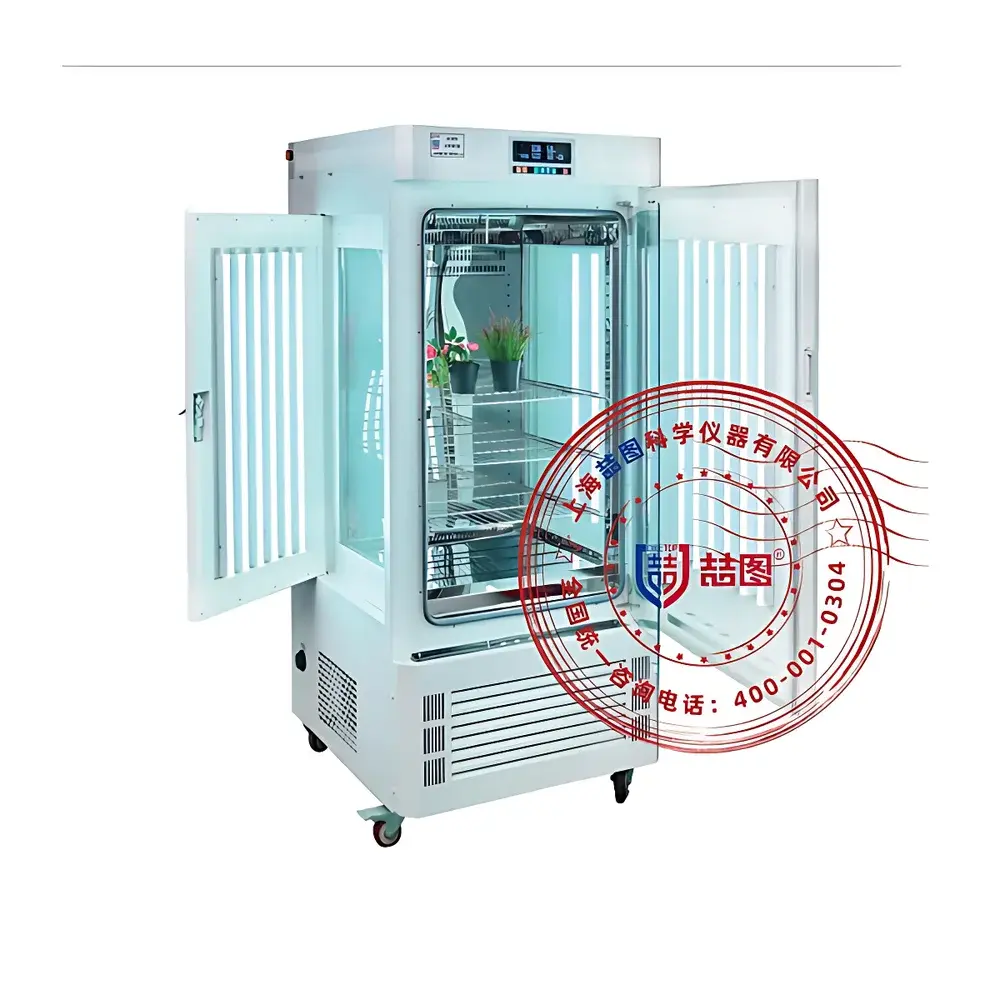
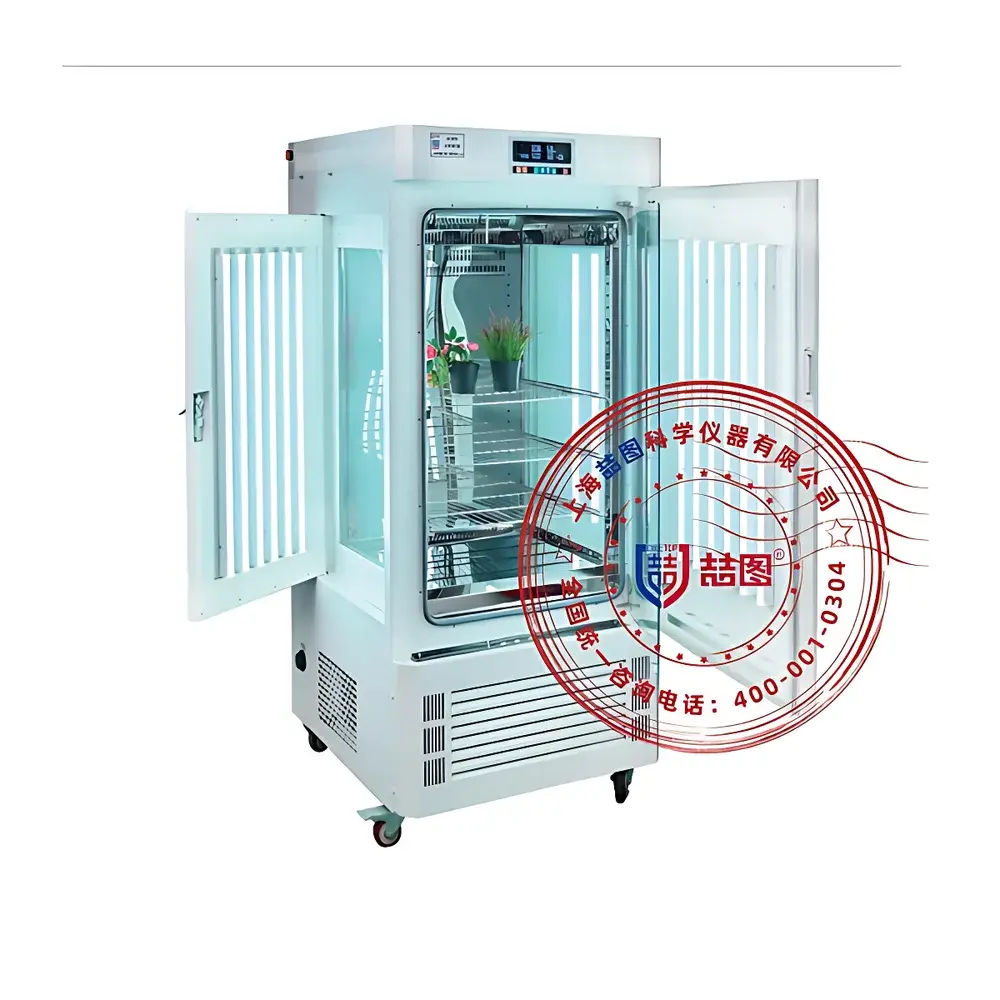
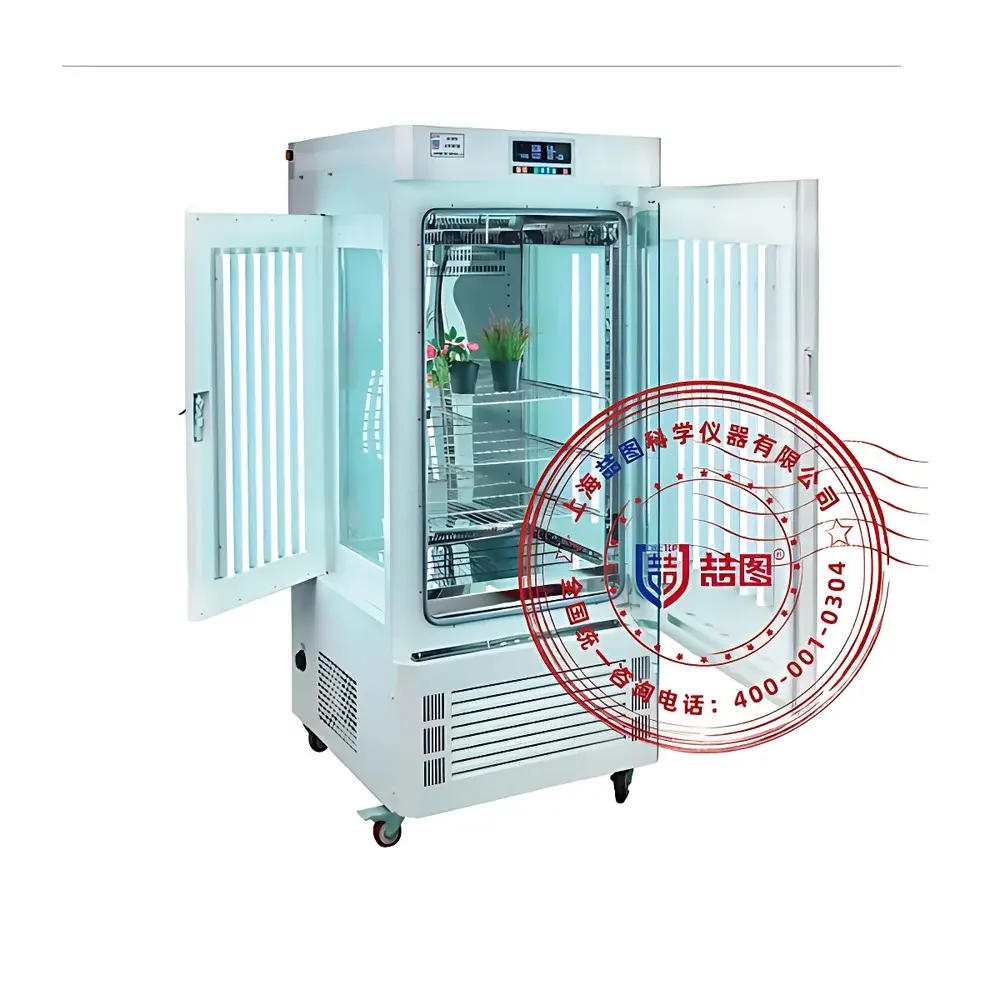
DRETOP ZGC-150VTS Plant Growth Chamber
| Brand | DRETOP |
|---|---|
| Origin | Shanghai, China |
| Manufacturer Type | Direct Manufacturer |
| Model | ZGC-150VTS |
| Illumination Method | Vertical LED Panel Illumination |
| Temperature Range | 10–65°C (with light), 0–65°C (without light) |
| Temperature Uniformity | ±0.5°C |
| Illuminance Range | 0–12,000 lx |
| Capacity | 150 L |
| External Dimensions | 700 × 640 × 1480 mm |
| Power Supply | AC 220 V, 50 Hz |
| Input Power | 1500 W |
| Internal Chamber Dimensions | 500 × 400 × 750 mm |
| Shelf Quantity | 3 adjustable stainless steel shelves |
| Light Source | Aluminum-based SMD LED panel (full-spectrum, white baseline |
| Control Interface | Color touchscreen with 30-segment programmable logic |
| Compliance | Designed for GLP-aligned environmental simulation |
Overview
The DRETOP ZGC-150VTS Plant Growth Chamber is an engineered environmental simulation system designed for reproducible, long-term plant physiology studies, photobiological assays, and controlled-environment microbiology. It operates on a dual-regulation principle: precision thermoregulation via Peltier-assisted refrigeration and resistive heating, combined with spectrally tunable, vertically oriented LED illumination. Unlike conventional incubators, the ZGC-150VTS integrates photoperiodic control with thermal dynamics—enabling synchronized diurnal cycling of temperature and irradiance to emulate natural climatic rhythms. Its architecture meets the functional requirements of ISO 17025-accredited labs conducting standardized growth trials (e.g., OECD 208, ASTM E2917), where consistency in light spectral distribution (380–780 nm), temporal stability (<±2% illuminance drift over 100 h), and thermal homogeneity (≤±0.5°C across chamber volume) are prerequisites for publication-grade data.
Key Features
- Vertical SMD LED illumination system with digital lux readout—eliminates shadowing artifacts common in side-mounted or top-down configurations.
- 30-segment programmable touchscreen controller supporting multi-step photoperiods (e.g., 16 h light / 8 h dark), ramped temperature transitions, and conditional event triggers (e.g., “activate cooling if ambient exceeds 32°C”).
- Stainless steel interior (AISI 304) with seamless welded corners and removable, autoclavable shelves—validated for ISO 14644-1 Class 5 cleanroom-compatible decontamination protocols.
- Dual-mode thermal management: high-efficiency R134a-free refrigerant circuit paired with NiCr alloy heating elements, enabling stable setpoint maintenance across full operating range (0–65°C).
- Modular safety architecture including independent overtemperature cutoff (mechanical backup), compressor cycle protection (min. 3-min off-time between starts), and non-volatile memory for parameter retention after power loss.
- Optional wavelength customization: factory-integrated red (660 nm) and blue (450 nm) LED channels support species-specific photomorphogenesis studies—aligned with USDA ARS spectral response databases for Arabidopsis, lettuce, and Phalaenopsis.
Sample Compatibility & Compliance
The ZGC-150VTS accommodates standard plant culture vessels (e.g., Magenta boxes, 100-mm Petri dishes, hydroponic rafts up to 450 mm width) and microbial plates without airflow obstruction. Its internal geometry (500 × 400 × 750 mm) permits vertical stacking of up to three 400-mm-tall growth containers. The chamber complies with IEC 61000-6-3 (EMC emission limits) and IEC 61000-6-2 (immunity to electrostatic discharge). While not certified to UL/CSA standards out-of-box, it ships with documentation supporting third-party validation for FDA 21 CFR Part 11 compliance when configured with RS485 data logging and audit-trail-enabled firmware (optional upgrade). All materials contacting the chamber interior meet USP Class VI biocompatibility requirements.
Software & Data Management
The embedded controller records timestamped temperature and illuminance values at user-defined intervals (1 s to 60 min), storing ≥30 days of continuous data internally. Export is supported via USB flash drive (CSV format) or RS485 Modbus RTU interface for integration into LabArchives, LabTutor, or custom SCADA systems. Firmware v2.4+ includes configurable alarm thresholds (e.g., “alert if illuminance drops below 80% setpoint for >5 min”), automatic calibration reminders (based on LED operational hours), and password-protected access tiers (operator, supervisor, administrator). Audit trails capture all parameter modifications—including who changed settings, when, and from which interface—fulfilling GLP Annex 11 and ISO/IEC 17025 clause 7.7 traceability mandates.
Applications
- Photomorphogenic response assays: quantifying hypocotyl elongation under monochromatic red/blue light gradients per ASTM E3086.
- BOD5 incubation per Standard Methods 5210B—leveraging precise 20°C ±0.5°C dark-phase stability.
- Seed germination kinetics under controlled photoperiods (e.g., stratification + light induction per ISTA Rules Section 6.3).
- Mycelial growth profiling of Aspergillus spp. across temperature-light interaction matrices (ISO 11133 Annex C).
- Pre-acclimation studies for space biology experiments—validated for sustained operation at 45° tilt (tested per NASA-HDBK-1002).
FAQ
Does the ZGC-150VTS support spectral tuning beyond white light?
Yes—factory-installed red (660 nm) and blue (450 nm) LED modules enable discrete or blended irradiance profiles. Spectral power distribution (SPD) reports are provided with each unit.
Can the chamber maintain uniform temperature during extended light-on cycles?
Yes—the vertical LED array minimizes radiant heating of samples; active cooling compensates for LED junction heat, ensuring ≤0.8°C vertical gradient (measured per ISO 15502 Annex B).
Is remote monitoring possible without additional hardware?
No—RS485 interface is standard, but Ethernet/WiFi gateway requires optional DRETOP-GW1 module. Local USB export suffices for routine QC documentation.
What validation documentation is included?
Factory calibration certificates (temperature: NIST-traceable Pt100 probe; illuminance: calibrated silicon photodiode), material compliance statements (RoHS, REACH), and electrical safety test reports (IEC 61010-1).
How is light intensity calibrated across the chamber volume?
Each unit undergoes 9-point lux mapping (center + eight cardinal positions) at 100%, 50%, and 10% output—data archived in the device’s configuration file and available upon request.