
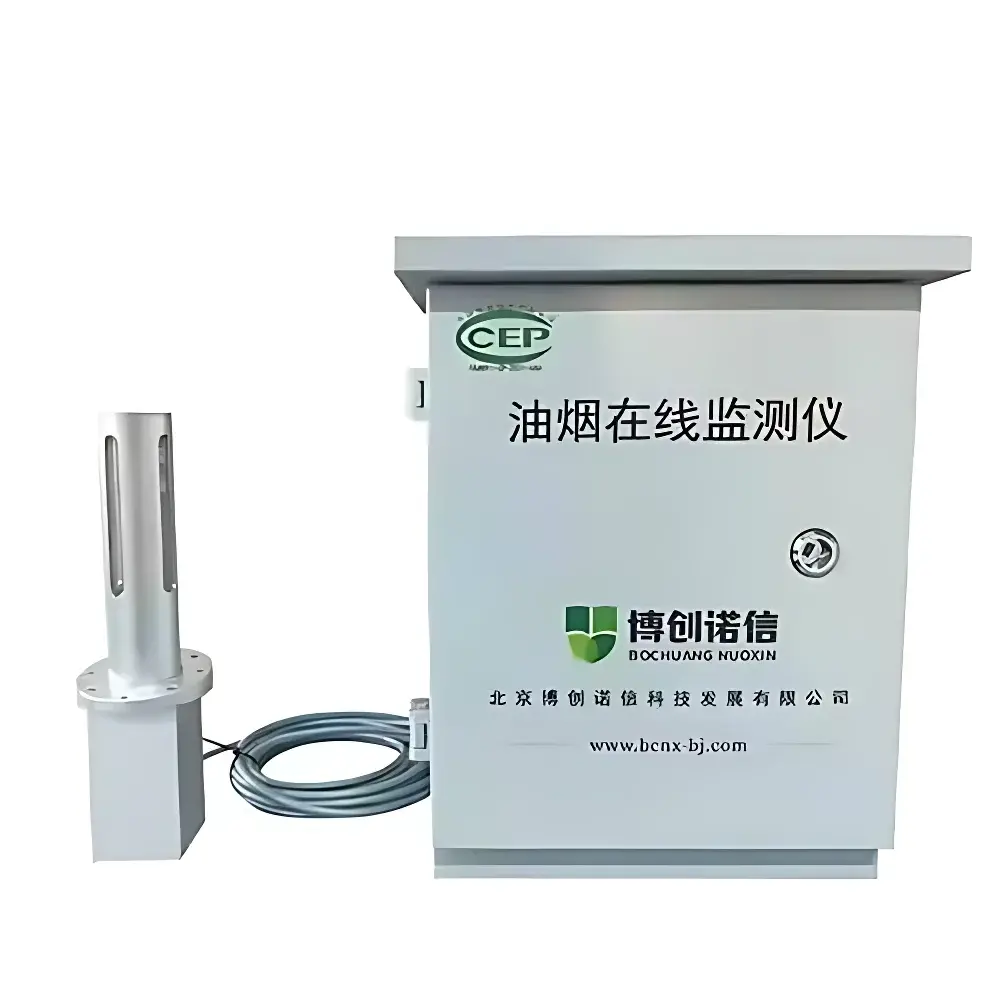
BCNX-YY08 Oil Fume Online Monitoring System
| Origin | Beijing, China |
|---|---|
| Manufacturer Type | Authorized Distributor |
| Origin Category | Domestic (PRC) |
| Model | BCNX-YY08 |
| Price Range | USD 0.14–714 (FOB) |
| Detection Principle | Multi-Parameter Integrated Sensing (Optical Scattering + Semiconductor/PID for NMHC + Dedicated Oil Mist Transduction) |
| Mobility | Fixed Online Installation |
| Application Domain | Commercial Food Service Establishments (Restaurants, Canteens, Street Food Hubs) |
Overview
The BCNX-YY08 Oil Fume Online Monitoring System is an industrial-grade, permanently installed environmental monitoring instrument engineered for continuous, real-time quantification of three critical air pollutants in kitchen exhaust ducts: cooking oil mist concentration, particulate matter (PM), and non-methane hydrocarbons (NMHC). Designed to meet the operational and regulatory demands of municipal environmental protection bureaus and third-party compliance auditors, the system employs a tri-sensor architecture—integrating a proprietary oil mist transducer based on calibrated optical attenuation, a laser-based light scattering module for PM detection, and a dual-mode NMHC sensor utilizing either metal-oxide semiconductor (MOS) or photoionization detection (PID) technology, selectable per site requirements. All measurements are synchronized at one-minute intervals, with data timestamped, validated, and transmitted via RS485/Modbus RTU or optional 4G LTE to centralized cloud platforms compliant with China’s HJ 212–2017 communication protocol. The device operates autonomously under harsh duct conditions (0–70 °C, 5–95% RH non-condensing), requiring no routine calibration gas or consumables during standard deployment.
Key Features
- Dedicated oil mist sensing element with ±10% measurement accuracy against reference gravimetric methods (per HJ 629–2011), supported by active zero-point drift compensation (≤±0.5 mg/m³ over 1 hour)
- Simultaneous triple-parameter acquisition: oil mist (0–30,000 µg/m³), PM (0–20 mg/m³, with configurable ranges), and NMHC (0–30 ppm or 0–1000 ppm, resolution 0.1 ppm)
- Integrated I/O interface supporting up to four external controlled devices (e.g., exhaust fans, UV-C oxidizers, electrostatic precipitators), enabling status monitoring and remote ON/OFF control via dry-contact relay outputs
- Configurable reporting interval (1–3600 seconds), adjustable via local LCD menu or remote platform command
- Overcurrent protection circuitry: automatic disconnection after 6 seconds if load current exceeds preset threshold, ensuring electrical safety and equipment longevity
- Robust mechanical design: stainless-steel probe housing (φ24 × 248 mm), IP65-rated enclosure, and 220 VAC ±10%, 8 W power consumption
Sample Compatibility & Compliance
The BCNX-YY08 is validated for use in high-humidity, high-grease environments typical of commercial kitchen exhaust systems. Its probe geometry allows direct insertion into rectangular or circular ducts (minimum 25 mm installation hole). Measurement performance aligns with Chinese national standards GB/T 16157–1996 (stationary source emission sampling), HJ 629–2011 (oil mist determination), and HJ 38–2017 (NMHC by GC-FID or PID). While not certified to ISO 14644 or EPA Method 202, its data output format supports integration into municipal environmental monitoring networks operating under HJ 212–2017 and provincial air quality management platforms. The system meets basic electromagnetic compatibility (EMC) per GB/T 17626 series and electrical safety per GB 4793.1–2007.
Software & Data Management
Data from the BCNX-YY08 is structured as ASCII-encoded Modbus registers, including raw sensor values, diagnostic flags (e.g., probe contamination warning, voltage anomaly), and controlled-device status bits. Local display presents real-time readings, historical trends (7-day buffer), and event logs on a 4.3-inch TFT LCD. Cloud platform integration enables role-based access control, automated report generation (daily/weekly summary PDFs), alarm thresholds (SMS/email notifications), and audit-trail logging—supporting GLP-aligned documentation requirements. Firmware updates are performed remotely via secure HTTPS, with version rollback capability. Data retention complies with China’s Cybersecurity Law Article 37 for locally stored environmental monitoring records.
Applications
Primary deployment occurs in regulated food service facilities subject to local air pollution ordinances—including chain restaurants, university canteens, hospital kitchens, and centralized catering hubs. The system supports enforcement workflows by providing time-stamped, tamper-evident data for emissions verification, maintenance scheduling (e.g., filter replacement alerts triggered by rising PM/oil mist ratios), and dynamic compliance scoring. Municipal environmental agencies utilize aggregated BCNX-YY08 datasets to identify spatial hotspots, evaluate policy effectiveness (e.g., impact of mandatory purification installation mandates), and prioritize field inspections. Integration with building management systems (BMS) enables demand-controlled ventilation—reducing energy use while maintaining regulatory compliance.
FAQ
What standards does the BCNX-YY08 comply with for oil mist measurement?
It adheres to HJ 629–2011 (Chinese standard for oil mist concentration in exhaust gas) and references GB/T 16157–1996 for sampling methodology.
Can the NMHC sensor be calibrated onsite without specialized equipment?
No—field calibration requires certified span gas (e.g., propane in nitrogen) and a calibrated flow controller; however, zero-point verification using synthetic air is supported via internal software routines.
Is the system compatible with international environmental reporting frameworks such as ISO 14001?
While not pre-certified, its structured data output, audit-log functionality, and traceable measurement intervals enable integration into ISO 14001-compliant EMS when deployed with documented SOPs and calibration records.
What is the expected service life of the optical PM sensor under continuous grease exposure?
With scheduled quarterly manual cleaning of the optical window using isopropyl alcohol and lint-free wipes, the manufacturer specifies a minimum functional lifespan of 24 months in typical restaurant duct environments.
Does the device support Modbus TCP for Ethernet-based SCADA integration?
No—only Modbus RTU over RS485 is natively supported; Ethernet connectivity requires an external RS485-to-TCP gateway configured in transparent mode.
Related Products







