
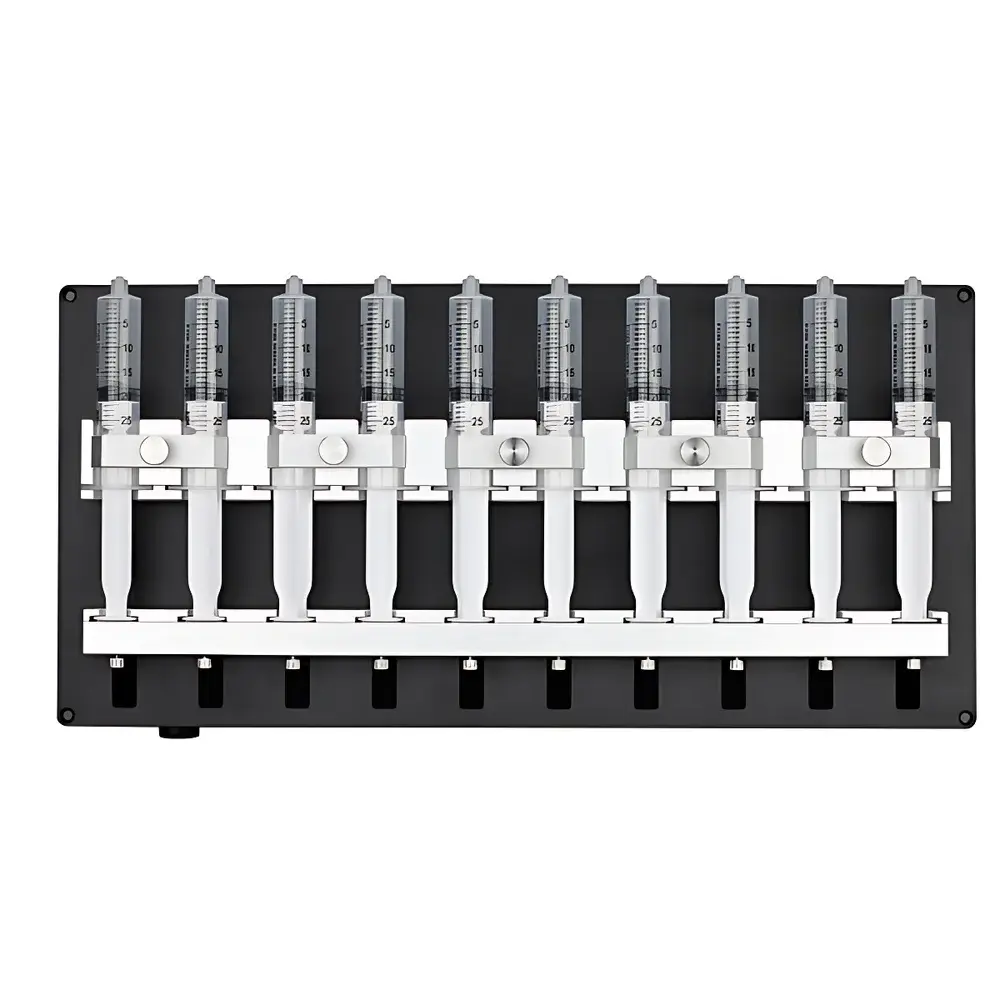
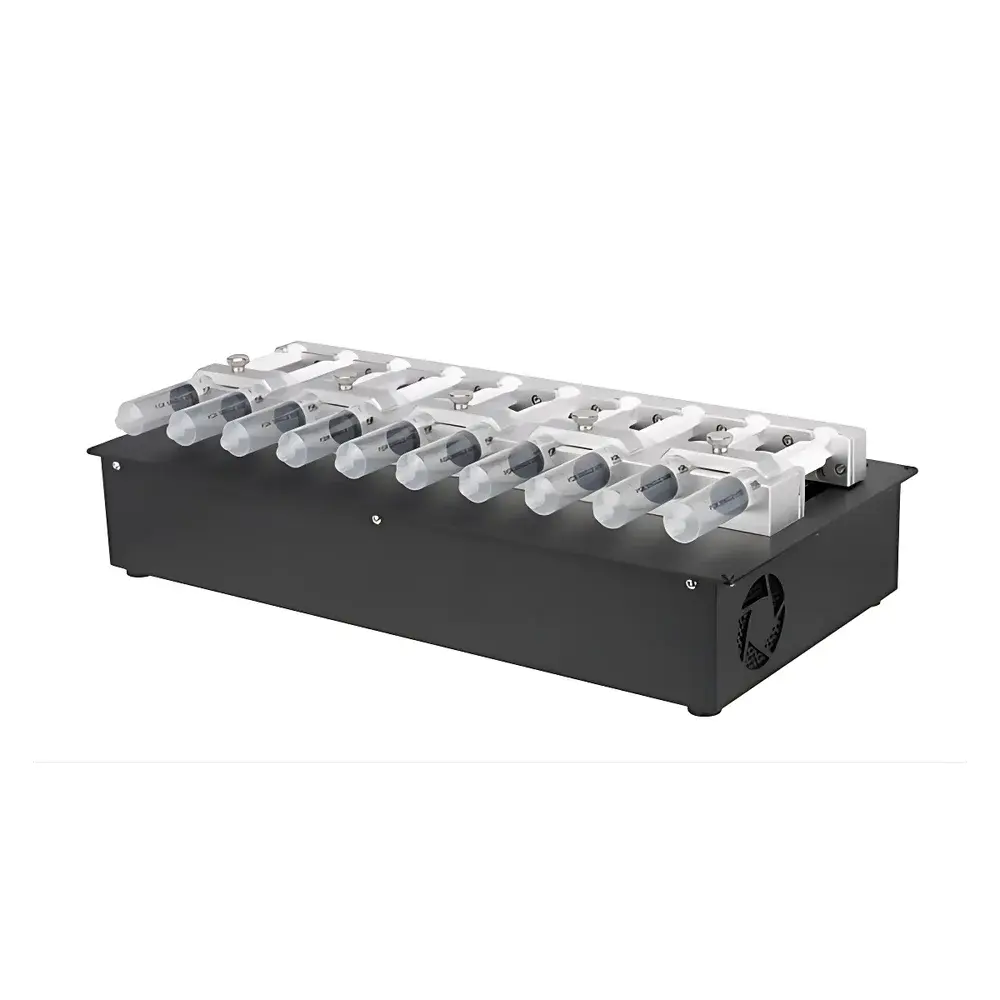
Acmer SP75-1030 Industrial Syringe Pump
| Brand | Acmer |
|---|---|
| Origin | Hebei, China |
| Manufacturer Type | Authorized Distributor |
| Product Category | Domestic |
| Model | SP75-1030 |
| Pump Type | Industrial Syringe Pump |
| Flow Rate | 23.1 µL/s to 9.25 mL/s |
| Accuracy | ±1% |
| Repeatability | ±0.5% |
| Syringe Compatibility | 30 mL disposable medical syringes (max. 28.5 mL usable volume) |
| Rated Stroke | 75 mm |
| Linear Speed Range | 0.0625–25 mm/s |
| Position Resolution | 0.025 mm/step (1.56 µm/step) |
| Max Piston Force | ≥500 N |
| Max Fluid Pressure Rating | 0.2 MPa |
| Power Supply | DC 24 V / 5 A |
| Dimensions (L×W×H) | 508 × 245 × 130 mm |
| Weight | 5.92 kg |
| Operating Temperature | 15–40 °C |
| Relative Humidity | <80% RH |
| Communication Interfaces | RS485 & USB (auto-baud detection at 9600/38400 bps) |
| Address Setting | 4-digit BCD DIP switch (15 addresses) |
| Microstepping Modes | 8x or 16x subdivision (48,000 microsteps per full stroke) |
| Programmable Functions | Ramp profiles, target speed, piston velocity, gap compensation, instruction sequencing, delay, loop, and motion termination |
Overview
The Acmer SP75-1030 Industrial Syringe Pump is a precision electromechanical fluid delivery system engineered for continuous, repeatable, and programmable volumetric dosing in industrial process control, chemical synthesis, bioreactor feeding, and automated analytical sample introduction. It operates on a closed-loop stepper motor-driven ball-screw mechanism, translating rotational motion into linear displacement of the syringe plunger with high positional fidelity. Unlike peristaltic or diaphragm-based pumps, this syringe pump eliminates valves and seals in the fluid path—relying exclusively on single-use medical-grade Luer-lock syringes to ensure contamination-free operation and eliminate cross-sample carryover. Its design prioritizes long-term stability under sustained duty cycles, making it suitable for integration into OEM instrumentation, pilot-scale reaction systems, and GLP-compliant material dispensing workflows where traceability, reproducibility, and low maintenance are critical.
Key Features
- Valveless architecture using standard 30 mL disposable medical syringes—reducing consumable cost and eliminating cleaning validation steps.
- High-resolution linear actuation: 48,000 microsteps per full 75 mm stroke (1.56 µm/step), enabled by selectable 8x or 16x microstepping modes.
- Dual communication interface support: RS485 (multi-drop capability) and USB, with auto-baud rate detection (9600 or 38400 bps) and configurable device addressing via 4-digit BCD DIP switch (15 unique addresses).
- Programmable motion control: Supports ramped acceleration/deceleration, multi-segment velocity profiles, gap compensation for syringe compliance, instruction sequencing, timed delays, loop execution, and emergency stop-triggered motion termination.
- Real-time status feedback: Three TTL-level digital outputs indicate RUN, PAUSE, and ERROR states; two TTL inputs accept external pause/resume commands for synchronized system integration.
- Rugged mechanical construction: Ball-screw transmission ensures minimal backlash and high axial stiffness; rated piston force ≥500 N supports viscous or pressurized fluid handling up to 0.2 MPa.
Sample Compatibility & Compliance
The SP75-1030 is validated for use with ISO-standard 30 mL Luer-lock syringes (maximum usable volume: 28.5 mL), enabling compatibility with a broad range of aqueous, organic, and mildly corrosive fluids. Its fluid path consists solely of syringe barrel, plunger, and Luer tip—no internal wetted surfaces or elastomeric components—facilitating rapid changeover and minimizing risk of leachables. While not certified to IEC 61010-1 or UL 61010B as a standalone medical device, the pump meets general industrial safety requirements for Class I, Pollution Degree 2 environments. Its open-command protocol and deterministic timing behavior support integration into FDA 21 CFR Part 11–compliant architectures when paired with audit-trail-capable host software and access-controlled user authentication layers.
Software & Data Management
The pump operates without proprietary GUI software—its command set follows a documented ASCII-based protocol over RS485 or USB, enabling direct integration with LabVIEW, Python (pySerial), MATLAB, or PLC-based control systems. All motion parameters—including flow rate, acceleration, dwell time, and loop count—are configurable via serial commands and persist in non-volatile memory. Timestamped status logs (via TTL output transitions) can be captured externally for correlation with process data streams. For regulated environments, users may implement electronic record-keeping through middleware that timestamps command issuance, acknowledges execution, and logs error codes—satisfying ALCOA+ principles for raw data integrity in GMP/QbD applications.
Applications
- Controlled reagent addition in continuous-flow chemistry reactors and microreactor platforms.
- Precise nutrient or inducer feeding in microbial fermentation and mammalian cell culture bioreactors.
- Automated calibration standard delivery in online HPLC, IC, and ICP-MS sample introduction systems.
- Low-flow solvent delivery in electrospinning, inkjet deposition, and thin-film coating R&D setups.
- Stable infusion for sensor calibration, membrane permeability testing, and dissolution apparatus auxiliary dosing.
- OEM integration into analytical instruments requiring silent, pulseless, and programmable liquid handling with sub-microliter per-second resolution.
FAQ
What syringe sizes are supported?
The SP75-1030 is calibrated and mechanically optimized for 30 mL Luer-lock syringes (maximum 28.5 mL usable volume). Use of other sizes requires manual scaling of step-to-volume conversion and is not factory-validated.
Does the pump support bidirectional flow?
No—it is unidirectional only; plunger motion is strictly linear advancement. Reverse motion is not implemented for safety and structural integrity reasons.
Can multiple pumps be synchronized over RS485?
Yes—RS485 enables daisy-chained multi-pump configurations with individual addressing; precise inter-pump timing coordination must be managed at the host controller level.
Is firmware upgradeable in the field?
Firmware updates require authorized service tools and are not user-accessible via standard communication protocols.
What is the expected lifetime of the ball-screw mechanism under continuous operation?
Rated for ≥10,000 hours of cumulative runtime at ≤70% load capacity, assuming ambient temperature ≤35 °C and relative humidity <60% RH with periodic visual inspection of lubrication integrity.



