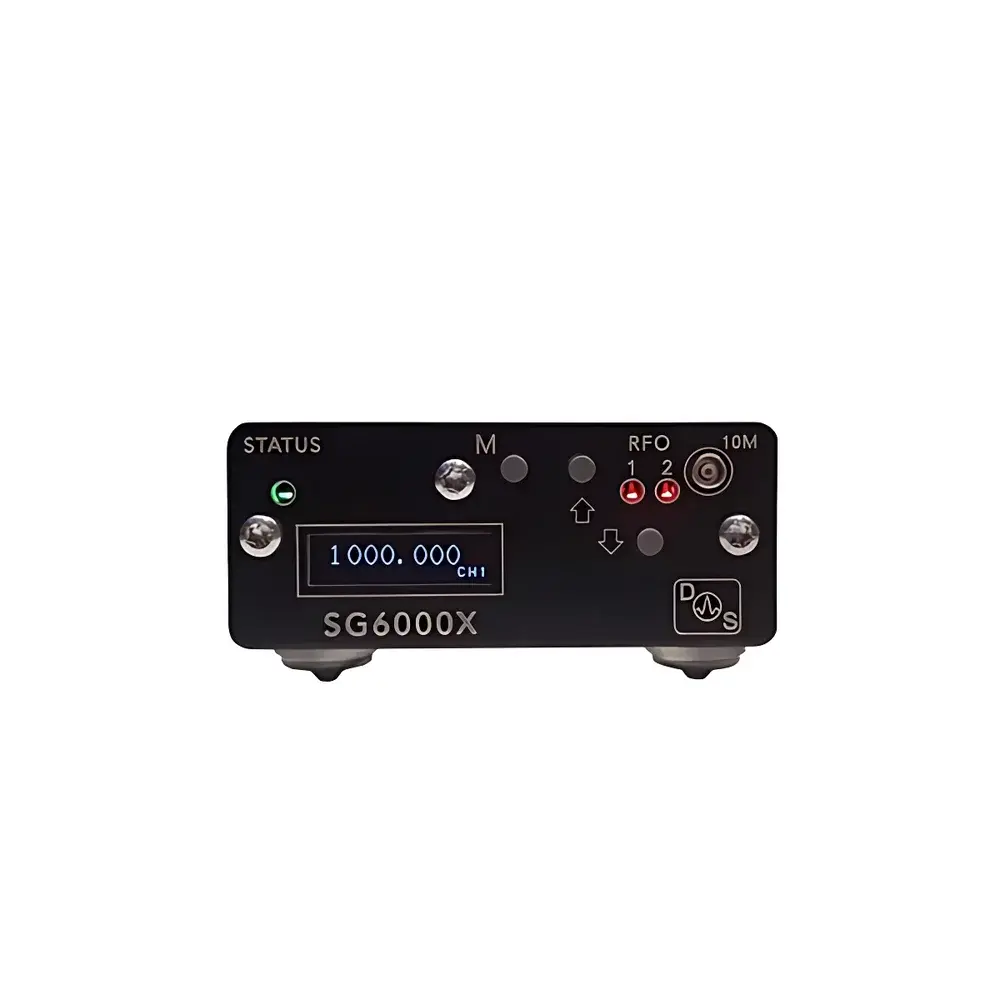
DesTest TS-SG6000X Dual-Channel 6 GHz RF Signal Generator
| Brand | DesTest Instruments |
|---|---|
| Origin | USA |
| Model | TS-SG6000X |
| Frequency Range | 25 MHz – 6000 MHz |
| Output Power | –35 dBm to > +10 dBm |
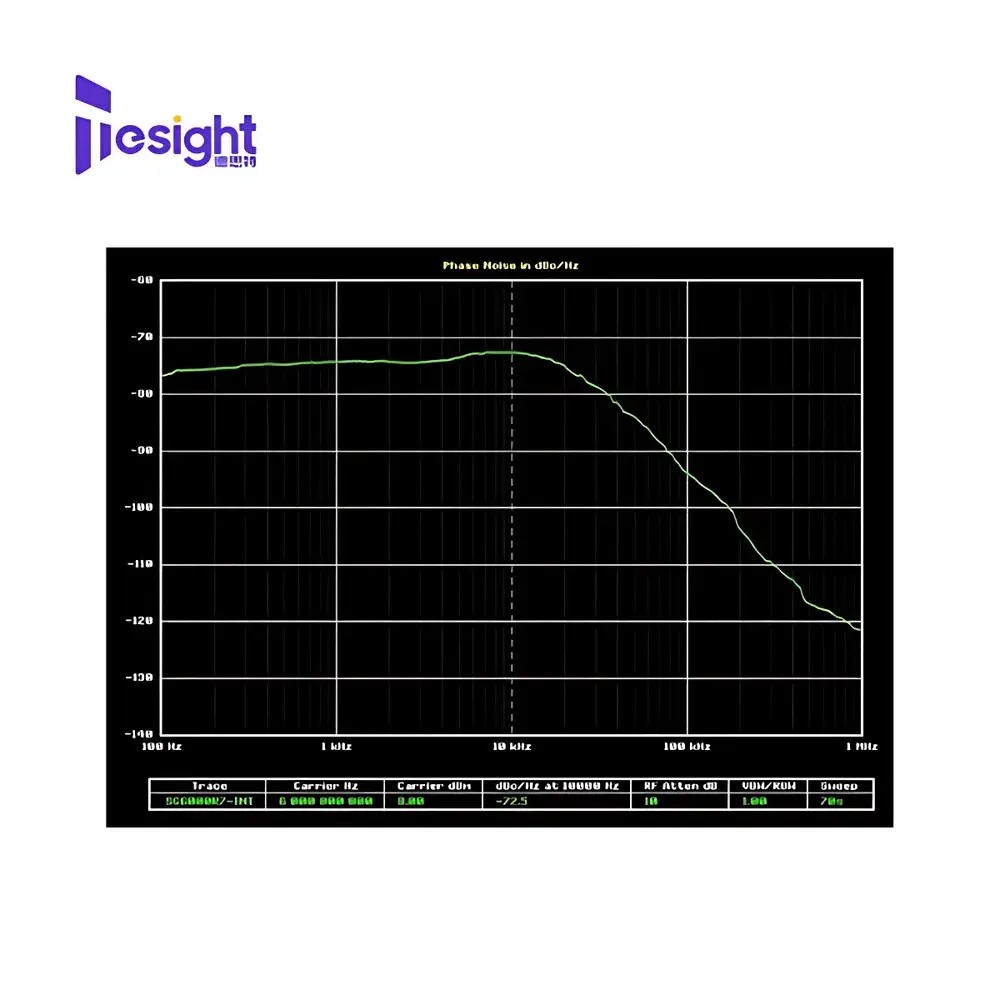
| Phase Noise | –74 dBc @ 10 kHz offset |
| Internal Digital Attenuator | 64 × 0.5 dB steps |
| Variable Analog Attenuation | –10 dB (10-bit DAC) |
| Reference Input | 10 MHz MCX |
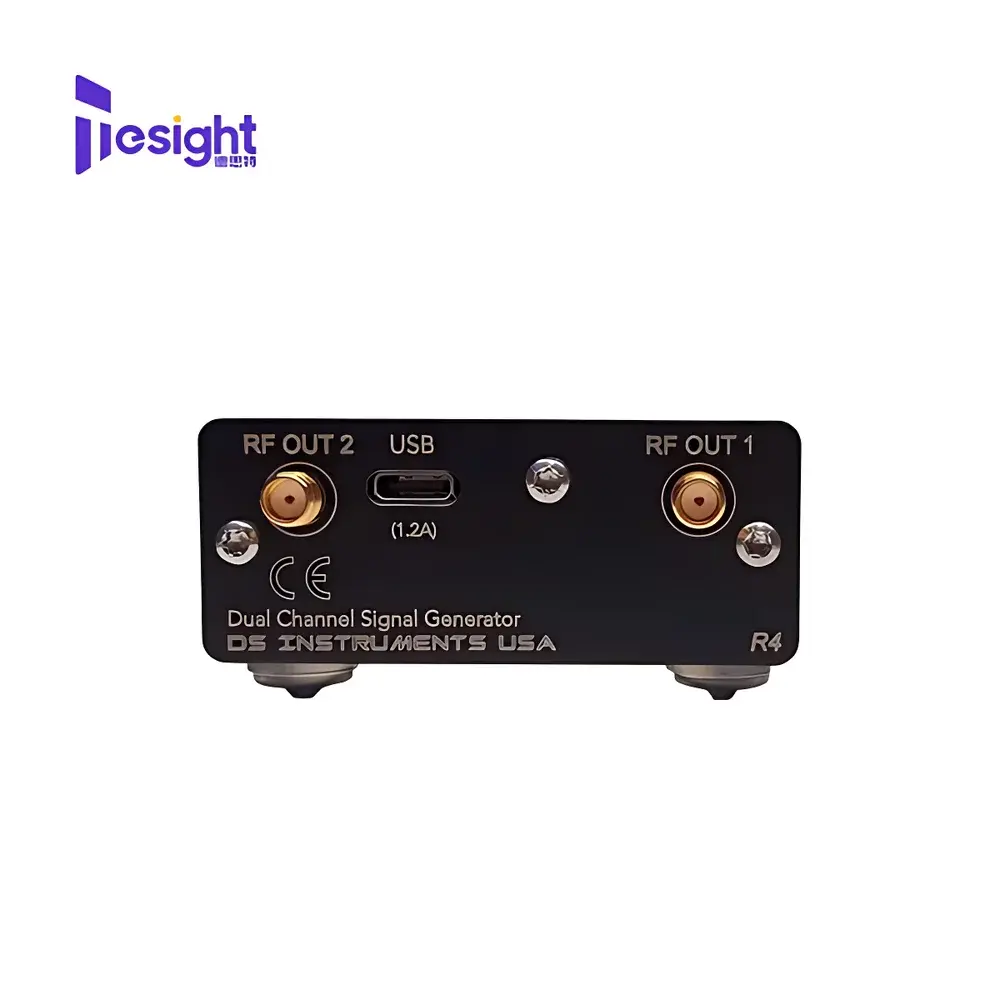
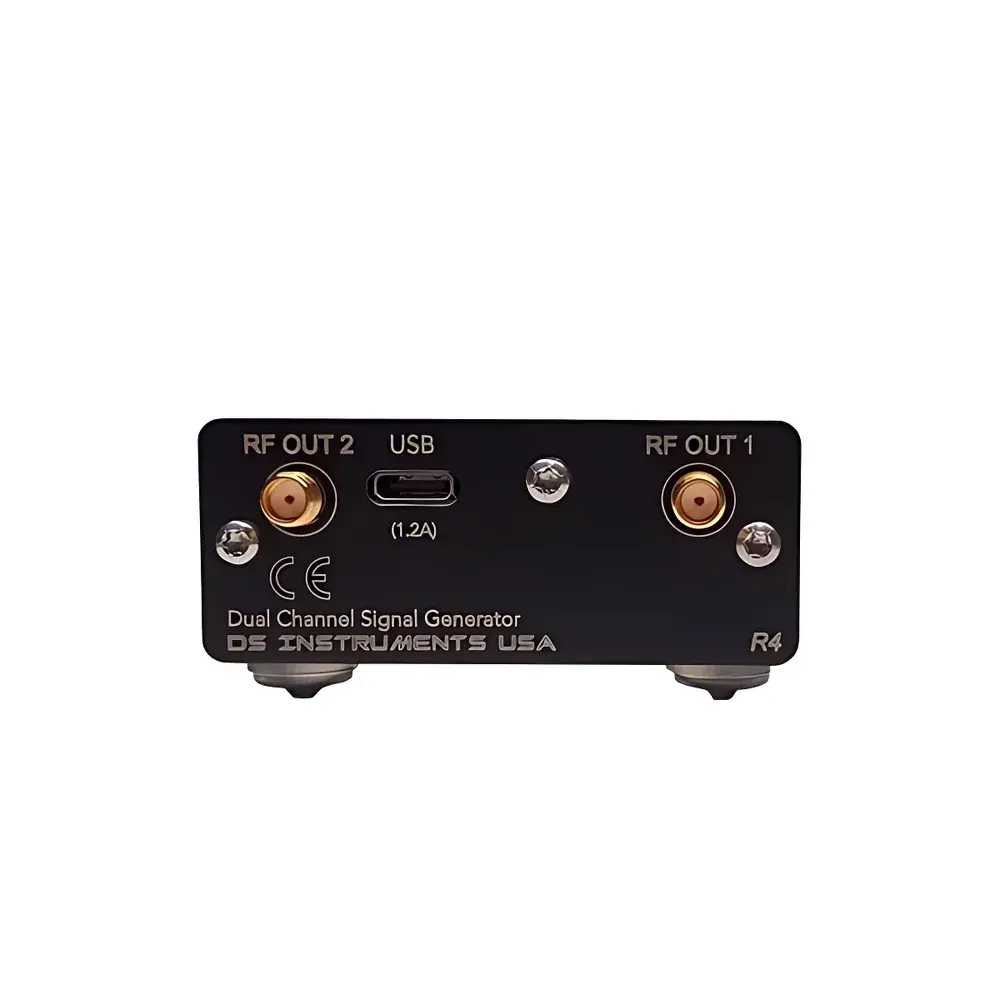
| Connectivity | USB Type-C (5 V, 1.2 A), Optional Ethernet |
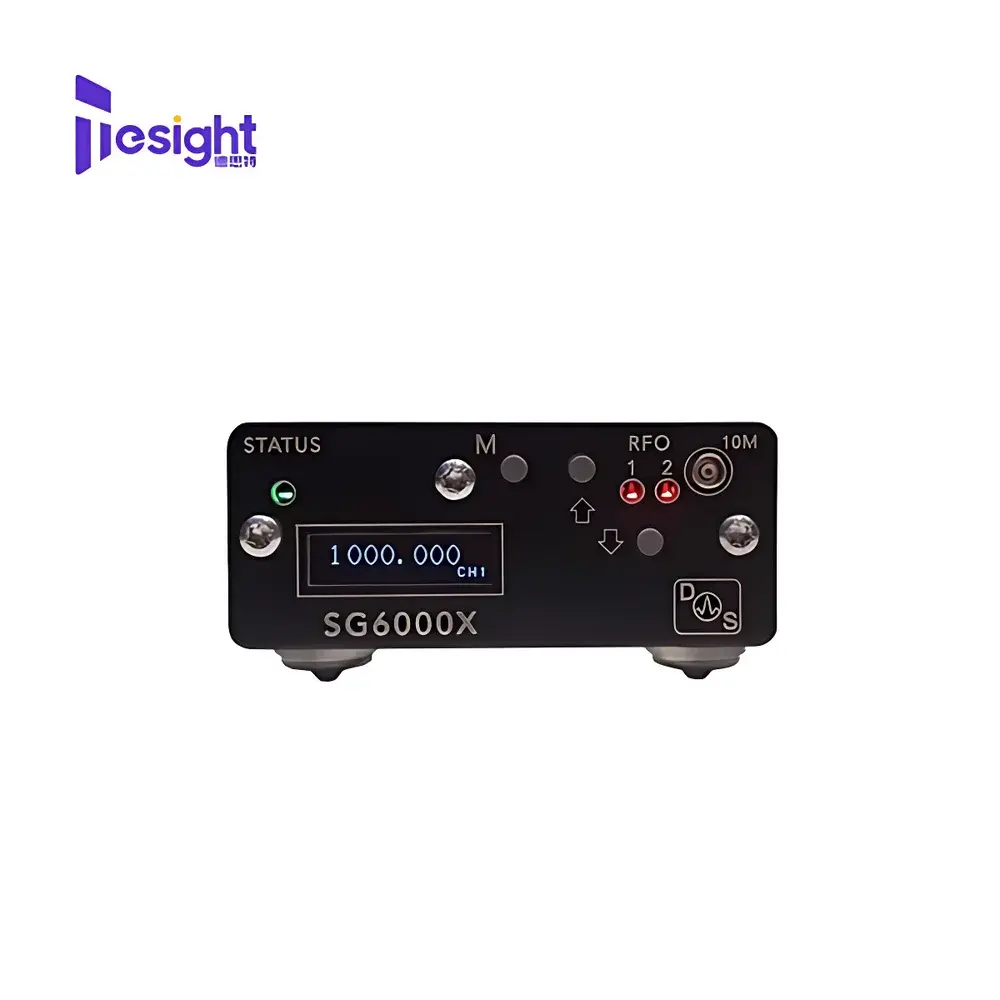
| Display | Front-panel OLED |
| RF Connectors | Two gold-plated microwave-grade SMA |
| Housing | Machined black anodized aluminum |
| Dimensions | 2.75″ × 1.25″ × 3.15″ (70 × 32 × 80 mm) |
| Impedance | 50 Ω |
| Compliance | SCPI-compliant, RoHS 3, CE-marked for EMC and LVD |
Overview
The DesTest TS-SG6000X is a compact, dual-channel RF signal generator engineered for precision, repeatability, and integration flexibility in modern wireless test environments. Operating across a continuous frequency range of 25 MHz to 6 GHz, it employs direct digital synthesis (DDS) combined with analog upconversion architecture to deliver spectrally pure, low-phase-noise outputs suitable for demanding applications including RF component characterization, receiver sensitivity testing, and local oscillator (LO) substitution in SDR and MIMO systems. Unlike legacy benchtop instruments, the TS-SG6000X integrates two fully independent RF channels—each with its own frequency, amplitude, and modulation control—within a palm-sized chassis. Its design prioritizes deterministic timing, minimal thermal drift, and high channel-to-channel isolation (>65 dB typical), enabling coherent multi-tone generation and differential stimulus configurations without external combiners or synchronization hardware.
Key Features
- Dual independent RF channels with full parameter control per channel (frequency, power, sweep, trigger)
- Output power range from –35 dBm to >+10 dBm, adjustable via 64-step digital attenuator (0.5 dB resolution) and continuous 10-bit DAC-based analog attenuation (–10 dB range)
- Phase noise performance of –74 dBc/Hz at 10 kHz offset from a 1 GHz carrier, optimized for narrowband demodulation and spectral purity-critical tasks
- Front-panel OLED display with real-time parameter feedback and intuitive navigation via tactile push-button controls
- Standard USB Type-C interface (5 V, 1.2 A) for power and SCPI command execution; optional Ethernet (10/100BASE-T) for remote operation in automated test systems
- 10 MHz reference input via MCX connector for phase-coherent synchronization with external clocks or master timing sources
- Machined aluminum enclosure providing EMI shielding, mechanical robustness, and passive thermal management—no fans or moving parts
- Fully SCPI 1999-compliant command set, enabling seamless integration with LabVIEW, Python (PyVISA), MATLAB Instrument Control Toolbox, and CI/CD test frameworks
Sample Compatibility & Compliance
The TS-SG6000X is designed for compatibility with standard 50 Ω RF infrastructure and supports common coaxial interconnects via precision gold-plated microwave SMA connectors. It meets IEC 61000-4-3 (radiated immunity), IEC 61000-4-6 (conducted immunity), and EN 55032 Class B emission limits. Its firmware implements audit-ready logging of calibration events and user-initiated configuration changes, supporting GLP/GMP-aligned workflows where traceability is required. While not FDA 21 CFR Part 11 certified out-of-the-box, its deterministic command-response behavior, deterministic timestamping of SCPI transactions, and absence of volatile runtime state make it suitable for validation under internal quality systems aligned with ISO/IEC 17025 and IEEE 1012 standards.
Software & Data Management
The generator ships with a lightweight Windows GUI built on .NET Core, offering zero-install USB enumeration and drag-and-drop waveform import for AM/FM/PM modulation profiles. More critically, its open SCPI interface enables programmatic control across OS platforms: native support for Linux (via libusb), macOS (via PyVISA), Android (using USB host APIs), and embedded Python runtimes (e.g., Raspberry Pi OS). All commands return synchronous status codes and optional error strings—no polling required. Firmware updates are delivered as signed binary packages verified via SHA-256 hash, and configuration snapshots can be exported as human-readable JSON files containing channel states, attenuation settings, and reference lock status. No cloud dependency or vendor-specific runtime is required.
Applications
- Automated production test of Wi-Fi 6/6E, Bluetooth 5.x, and UWB transceivers
- EMC pre-compliance testing using swept-sine or stepped-tone stimuli
- Antenna pattern measurement systems requiring phase-stable dual-tone excitation
- Academic RF laboratories for teaching modulation theory, spectrum analysis, and receiver chain modeling
- Aerospace and defense R&D involving radar warning receiver (RWR) stimulus and electronic warfare (EW) subsystem validation
- 5G NR FR1 component evaluation—including PA linearity, filter group delay, and mixer conversion loss
- Software-defined radio (SDR) platform calibration and LO leakage compensation
FAQ
Does the TS-SG6000X support list mode or arbitrary waveform generation?
No—it is a CW and analog-modulated (AM/FM/PM) signal generator only. It does not include baseband IQ modulation or ARB memory.
Can both channels be phase-locked to the same reference source?
Yes. When driven by the same external 10 MHz reference, both channels achieve sub-degree phase stability over temperature and time, though absolute phase alignment requires post-calibration due to fixed inter-channel path delay.
Is firmware upgrade capability available over Ethernet?
Yes—firmware updates may be performed via HTTP POST to the device’s embedded web server when Ethernet is enabled, with integrity verification enforced prior to flash programming.
What is the typical warm-up time to specified frequency accuracy?
Less than 60 seconds to achieve ±2.5 ppm frequency stability after power-on, assuming ambient temperature within 15–30 °C.
Does the unit include factory calibration data with NIST-traceable documentation?
Yes—each shipped unit includes a calibration certificate with measurement uncertainty budgets for frequency, power, and phase noise at key frequencies (100 MHz, 1 GHz, 3 GHz, 6 GHz), traceable to NIST via A2LA-accredited labs.
Related Products