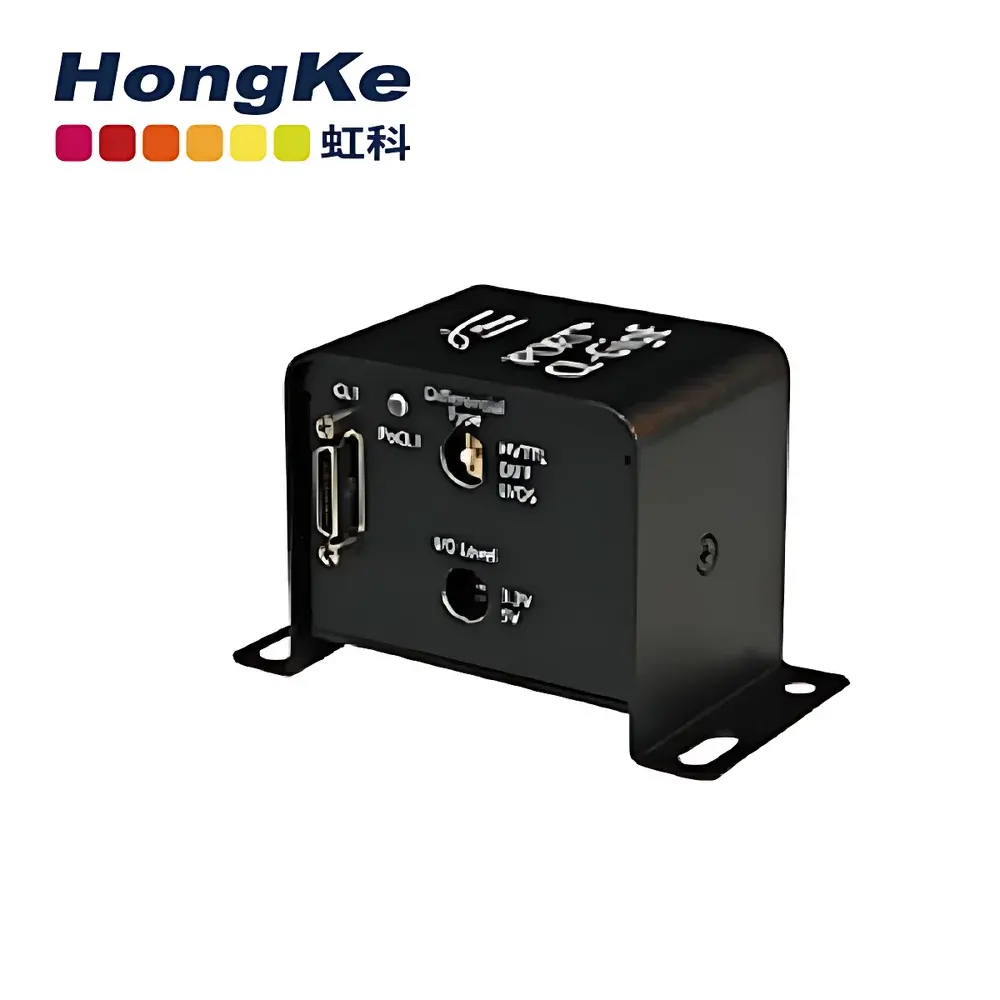
HKiPORT CL-GigE External Camera Link to GigE Vision Converter
| Origin | Canada |
|---|---|
| Manufacturer Type | Authorized Distributor |
| Origin Category | Imported |
| Model | HKiPORT CL-GigE |
| Price Range | USD 1,400 – 4,200 (FOB) |
| Operating Temperature | -40°C to +60°C |
| Interface Compatibility | Camera Link Base (26-pin MDR), GigE Vision v2.0 compliant |
| Power Delivery | PoCL (Power over Camera Link) support |
| GPIO | 4-channel opto-isolated digital I/O |
| Form Factor | External ruggedized enclosure (industrial grade) |
| SDK | eBUS SDK v5.3+ (Windows/Linux x64, C/C++, .NET, Python bindings) |
| Certification | CE, FCC Class A, RoHS compliant |
Overview
The HKiPORT CL-GigE is an industrial-grade external protocol converter engineered to bridge legacy Camera Link Base interface cameras with modern GigE Vision® infrastructure. It operates on the principle of real-time frame-level protocol translation—receiving serialized pixel data and timing signals via the Camera Link Base standard (MDR-26 connector), buffering and reformatting image payloads into compliant GigE Vision packet structures (IEEE 802.3, UDP-based streaming), and transmitting them over standard Gigabit Ethernet. This enables seamless integration of high-speed monochrome or color area-scan cameras—commonly deployed in automated optical inspection (AOI), semiconductor wafer metrology, and aerospace component verification—into Ethernet-based machine vision systems without modifying existing optics or sensor hardware. Designed for deterministic latency and bit-perfect frame integrity, the device implements hardware-accelerated packet segmentation, timestamp synchronization via PTPv2 (IEEE 1588), and full compliance with GigE Vision 2.0 specification requirements for discovery, control, and streaming.
Key Features
- Protocol-transparent conversion from Camera Link Base (up to 66 MHz pixel clock, 8/10/12-bit depth) to GigE Vision v2.0-compliant streaming
- Rugged external enclosure rated for continuous operation across -40°C to +60°C ambient temperatures, conforming to IEC 60068-2 environmental stress testing protocols
- Integrated Power over Camera Link (PoCL) support per Camera Link Standard Rev. 2.0, enabling single-cable power delivery to compatible cameras
- Four-channel opto-isolated GPIO interface (TTL-compatible, 5 V / 24 V configurable) for hardware triggering, strobe output, and status signaling—fully synchronized with image acquisition timestamps
- On-board FPGA-based frame buffering (256 MB DDR3) ensures zero-frame-loss operation under network congestion or host processing delays
- Low-latency design: end-to-end pipeline delay < 1.2 ms (measured from Camera Link pixel valid assertion to first GigE Vision UDP packet transmission)
Sample Compatibility & Compliance
The HKiPORT CL-GigE supports all Camera Link Base configuration profiles—including mono 8/10/12-bit, RGB 8-bit, and Bayer-pattern sensors—with maximum throughput of 2.04 Gbps (equivalent to ~255 MB/s sustained bandwidth). It has been validated with leading Camera Link camera models from Teledyne DALSA, FLIR (formerly Point Grey), and JAI. Regulatory compliance includes CE marking (EMC Directive 2014/30/EU, Low Voltage Directive 2014/35/EU), FCC Part 15 Class A emissions certification, and RoHS 2011/65/EU material restrictions. For regulated industries, the device supports audit-ready logging via eBUS SDK’s built-in event tracing, aligning with GLP/GMP documentation requirements for traceability of image acquisition parameters (e.g., exposure time, gain, trigger source, firmware revision).
Software & Data Management
The included eBUS SDK v5.3 provides comprehensive API support across Windows 10/11 (x64) and Linux (Ubuntu 20.04+, RHEL 8+) platforms, with native bindings for C/C++, C#, VB.NET, and Python 3.8+. Key software capabilities include GenICam-compliant feature access (via XML device description files), multi-camera synchronization using hardware-triggered master-slave topology, real-time bandwidth monitoring, and lossless frame capture with embedded metadata (timestamp, frame counter, GPIO state snapshot). All SDK components are digitally signed and support reproducible builds. The SDK also includes tools for firmware update validation, memory-mapped buffer diagnostics, and network stack tuning (jumbo frame enablement, interrupt coalescing configuration)—essential for optimizing performance in high-throughput factory-floor deployments.
Applications
- Upgrading legacy AOI systems in PCB manufacturing lines while retaining existing Camera Link cameras and lenses
- Integrating high-resolution line-scan or area-scan cameras into distributed GigE Vision networks for automotive paint defect detection
- Enabling remote diagnostics and centralized image archiving in nuclear or offshore energy inspection platforms where Ethernet cabling infrastructure is pre-installed
- Supporting time-critical bin-picking applications in collaborative robotics cells requiring sub-millisecond trigger-response consistency between vision system and motion controller
- Facilitating ISO/IEC 17025-accredited calibration labs to maintain traceability of imaging hardware through standardized GigE Vision device descriptors and firmware version reporting
FAQ
Does the HKiPORT CL-GigE support Camera Link Medium or Full configurations?
No—it is strictly designed for Camera Link Base mode (24 data bits + 2 video control bits), supporting up to 66 MHz pixel clock and a maximum bandwidth of 2.04 Gbps.
Can it operate without PoCL if the connected camera uses external power?
Yes. PoCL is optional; the device accepts externally powered Camera Link cameras and will pass through only data and timing signals.
Is GenICam compliance certified by the AIA?
Yes—the device is listed in the AIA’s official GigE Vision Device Registry (GVR ID: GVR-2023-0871) and passes all mandatory GenICam SFNC 2.4 feature compliance tests.
What network configuration is required for multi-camera synchronization?
A dedicated Layer 2 switch with IEEE 1588v2 (PTP) boundary clock support is recommended; the HKiPORT CL-GigE acts as a PTP slave and synchronizes its internal timestamp generator to the grandmaster clock.
Does the SDK support FDA 21 CFR Part 11-compliant electronic signatures?
The eBUS SDK itself does not implement Part 11 controls, but its logging and configuration export functions generate tamper-evident CSV/JSON audit trails that can be integrated into validated third-party ELN/LIMS systems meeting Part 11 requirements.