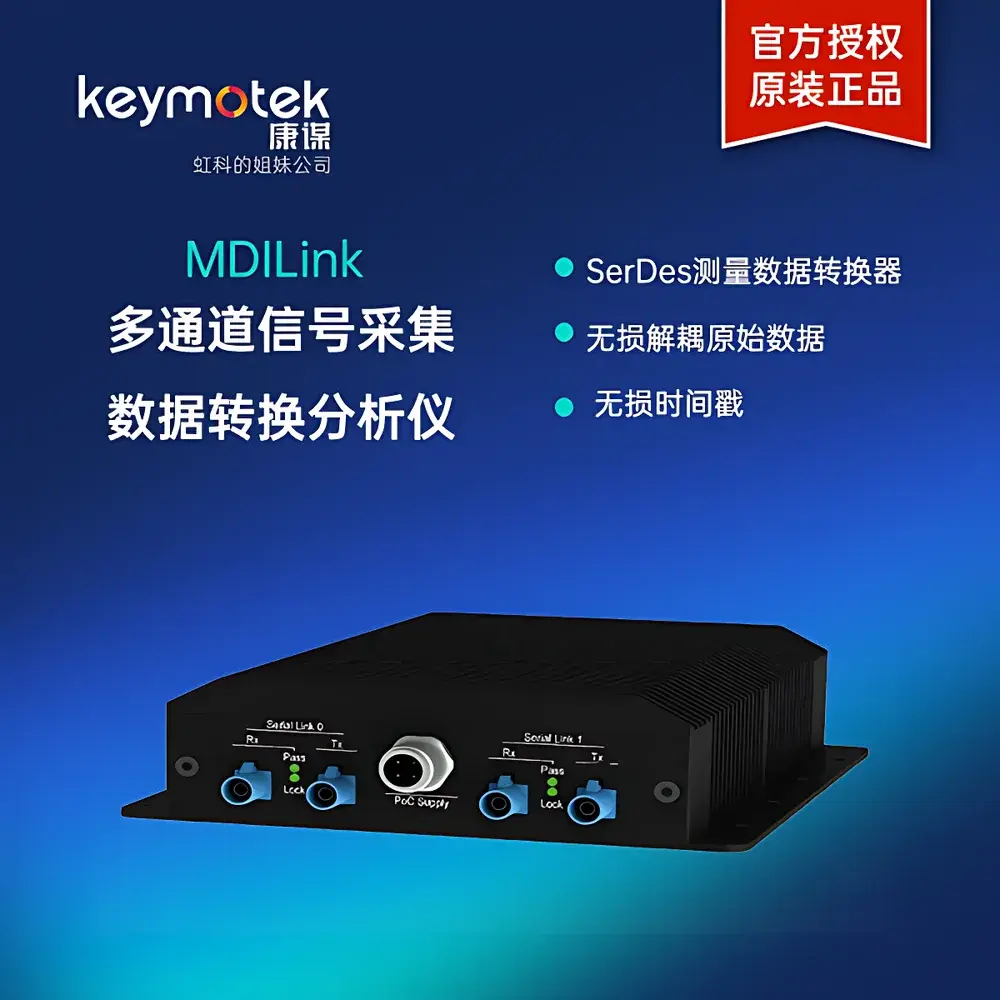
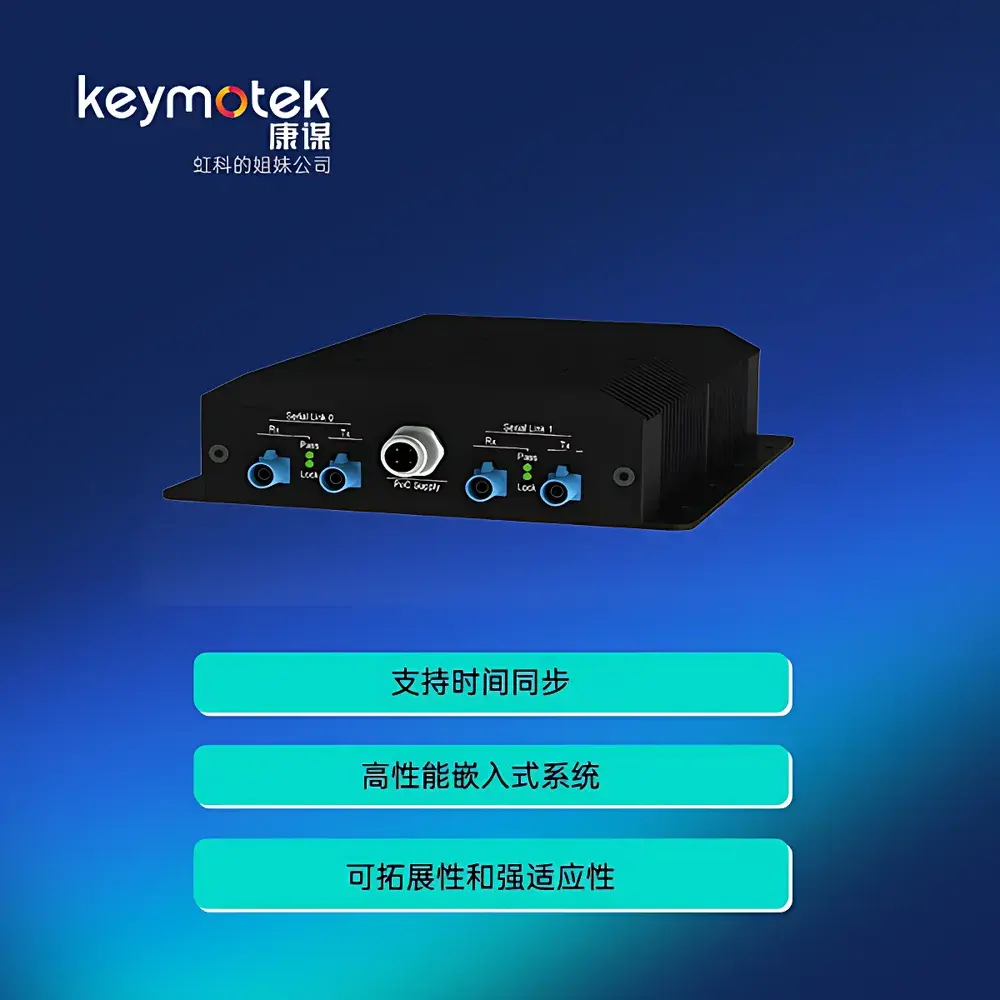

b-plus KM-B21671-MDILink Multi-Channel Signal Acquisition, Conversion & Synchronization Analyzer
| Brand | b-plus |
|---|---|
| Origin | Germany |
| Model | KM-B21671-MDI-001-0002 / KM-B21671-MDI-001-0003 / KM-B21671-MDI-001-0004 / KM-B21671-MDI-001-0007 |
| Certifications | IEEE 1588-2008 (PTP v2), IEEE 802.1AS-2020 |
| Operating Temperature | −20 °C to +70 °C |
| Storage Temperature | −40 °C to +85 °C |
| Enclosure Rating | IP20 |
| Dimensions (L×W×H) | 1597 mm × 140 mm × 38 mm |
| Power Supply | 8–32 V DC, crank-safe down to 6.5 V |
| Max Power Consumption | 25 W |
| Ethernet Interfaces | Dual 10GBASE-T (M12), 1× 1GBASE-T (M12), 1× 1GBASE-T management port |
| Sensor Triggering | Hardware-timestamped, PTP-synchronized internal trigger generator |
| Supported Protocols | CAN FD, FlexRay, CSI-2, FPD-Link III, GMSL, Automotive Ethernet (100BASE-T1/1000BASE-T1), 10GBASE-T |
| Software Integration | ADTF-compatible, RESTful API for third-party framework integration |
| Reverse Channel | I²C-based logging and configuration feedback |
Overview
The b-plus KM-B21671-MDILink is a high-fidelity, time-deterministic signal acquisition and conversion platform engineered for synchronized multi-sensor data capture in automotive R&D, ADAS validation, and embedded system testing environments. Unlike conventional data loggers, the MDILink implements a hardware-accelerated SoC architecture with integrated IEEE 1588-2008 (PTP v2) and IEEE 802.1AS-2020 compliant time synchronization—enabling sub-microsecond timestamp alignment across heterogeneous sensor modalities including camera streams (CSI-2, FPD-Link III, GMSL), vehicle buses (CAN FD, FlexRay), and high-bandwidth Ethernet interfaces (10GBASE-T). Its deterministic timing engine ensures end-to-end traceability of raw sensor data, bus messages, and ECU outputs within a single, integrity-verified recording session—critical for functional safety analysis per ISO 26262 ASIL-B/C workflows and regulatory evidence collection under UN-R155 software update management systems.
Key Features
- Modular hardware architecture supporting field-upgradable interface bricks (e.g., CSI-2 FPD-Link GMSL 10GBE XT55, 10GBE BRICK) for rapid adaptation to evolving sensor ecosystems
- Dual 10GBASE-T Ethernet download ports (M12 X-coded) enabling real-time streaming of synchronized multi-gigabit payloads without bottlenecking
- Hardware-level IEEE 1588/802.1AS time synchronization with PTP grandmaster or slave operation, delivering <100 ns inter-channel skew under controlled network conditions
- Internal timestamp generator with hardware-triggered sensor sampling—eliminating software-induced jitter in time-critical acquisition scenarios
- Robust mechanical design: compact 1597 mm × 140 mm × 38 mm chassis rated IP20, qualified for extended operation between −20 °C and +70 °C
- Comprehensive power resilience: crank-safe operation down to 6.5 V, wide-input 8–32 V DC supply, and optional ignition-controlled external power sequencing
- Open integration framework: RESTful API for configuration, status monitoring, and metadata injection; native compatibility with ADTF (Automotive Data and Time-Triggered Framework)
Sample Compatibility & Compliance
The MDILink supports direct acquisition from industry-standard automotive sensor interfaces—including MIPI CSI-2 image sensors, FPD-Link III and GMSL video links, CAN FD (up to 5 Mbit/s), FlexRay (10 Mbit/s), and 100/1000BASE-T1 automotive Ethernet. All recorded data streams are annotated with PTP-synchronized timestamps traceable to UTC via GNSS-referenced grandmaster clocks or boundary clocks deployed in the test network. The device complies with electromagnetic compatibility requirements per CISPR 25 Class 5 and meets vibration and shock specifications aligned with ISO 16750-3 for powertrain-mounted instrumentation. While not certified as a medical or aerospace-grade device, its architecture conforms to functional safety principles outlined in ISO 26262 Part 6 (software unit verification) and supports audit-ready logging for GLP-aligned validation studies.
Software & Data Management
Configuration and runtime control are performed via a secure 1GBASE-T management port using a web-based interface or programmatically through the provided REST API. All recordings include embedded metadata—sensor ID, interface type, clock domain, PTP offset statistics, and hardware-trigger event logs—stored in standardized ADTF-compatible .adtf files. The internal configuration space retains persistent settings across reboots, while I²C reverse-channel communication enables bidirectional diagnostics and firmware-assisted calibration logging. For long-term archival, recordings may be streamed directly to NAS or object storage via 10GbE without intermediate buffering, preserving temporal fidelity and eliminating timestamp interpolation artifacts common in software-based aggregation layers.
Applications
- End-to-end ADAS/AD validation: synchronized capture of camera, radar, LiDAR, and vehicle bus data for perception algorithm training and corner-case scenario reconstruction
- ECU-in-the-loop (EIL) and hardware-in-the-loop (HIL) test benches requiring deterministic, low-latency sensor fusion inputs
- Functional safety evidence generation: time-aligned raw sensor + bus traces for fault injection analysis and ASIL decomposition verification
- Automotive Ethernet conformance testing: multi-node PTP synchronization assessment and latency/jitter profiling across 10GBASE-T domains
- Research-grade embedded systems monitoring: high-throughput, timestamp-coherent acquisition from heterogeneous IoT and edge computing platforms
FAQ
Does the MDILink support GPS-disciplined PTP grandmaster operation?
Yes—when connected to a GNSS-referenced PTP grandmaster (e.g., Meinberg LANTIME M100), the MDILink operates as a transparent clock or boundary clock, maintaining sub-microsecond phase alignment across all interfaces.
Can it record raw CSI-2 data without on-device image processing?
Yes—the MDILink captures unprocessed MIPI CSI-2 packets at line level and converts them into time-stamped Ethernet frames; no pixel interpolation or compression is applied.
Is firmware update supported over-the-air (OTA)?
Firmware updates require authenticated local access via the management port; remote OTA is disabled by default to comply with ISO/SAE 21434 cybersecurity guidelines for update integrity.
What is the maximum sustained bandwidth across all interfaces simultaneously?
Under optimal thermal and power conditions, aggregate throughput exceeds 16 Gbps—limited only by host-side storage I/O and network switch capabilities—not by the MDILink’s internal fabric.
Does it provide hardware-level data integrity verification?
Yes—each recorded frame includes CRC-32 checksums for payload integrity, and all timestamps are validated against local oscillator drift metrics logged internally for post-hoc forensic analysis.