
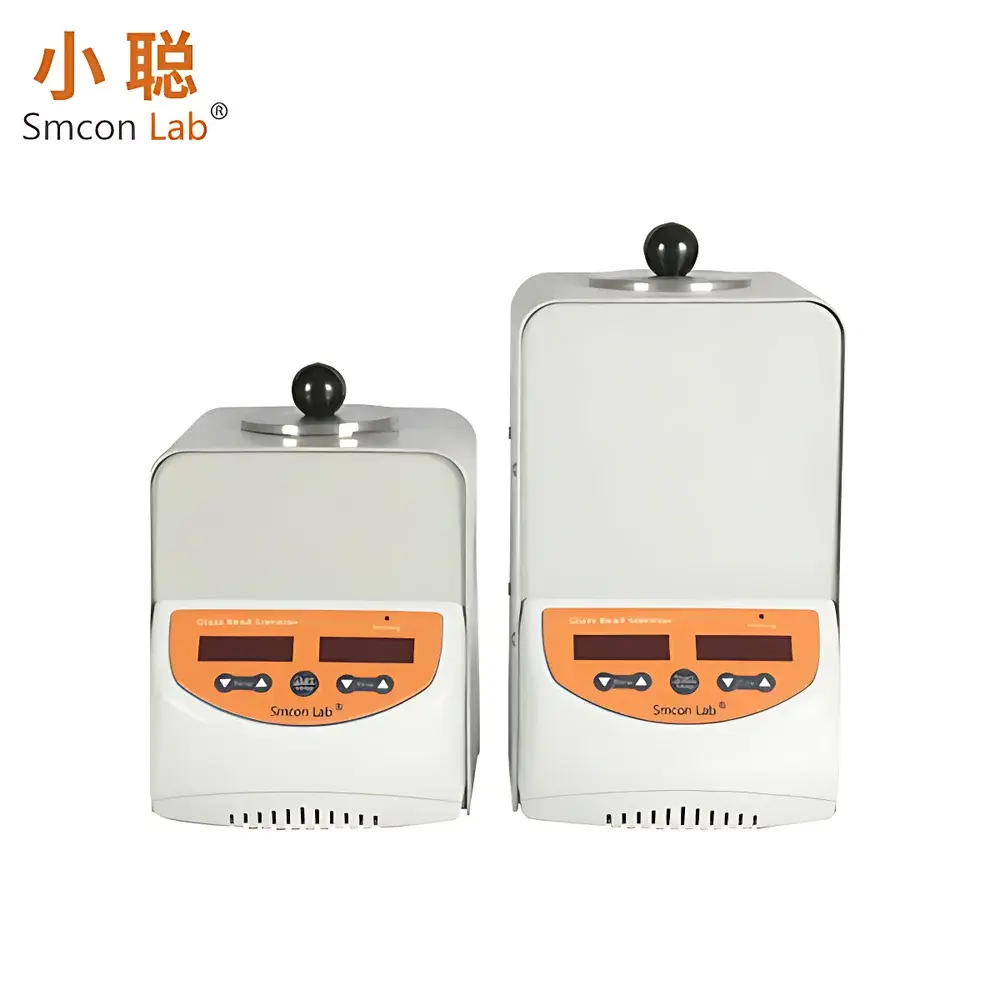
Smconlab SGBS300-L & SGBS300-H Rapid Glass Bead Sterilizers
| Brand | Smconlab |
|---|---|
| Origin | Shanghai, China |
| Model | SGBS300-L / SGBS300-H |
| Temperature Range | 100–300 °C |
| Temperature Control Accuracy | ±5 °C |
| Display Resolution | 1 °C |
| Heating Power | 120 W (SGBS300-L) / 250 W (SGBS300-H) |
| Chamber Dimensions | Φ40 mm × 80 mm (L) / Φ40 mm × 140 mm (H) |
| Bead Capacity | 150 g / 300 g |
| External Dimensions (W×D×H) | 176×135×189.5 mm / 176×135×249.5 mm |
| Bead Diameter | 3.0 mm |
| Heating Method | Forced-air convection |
| Safety Features | Over-temperature cut-off protection, stainless-steel chamber |
Overview
The Smconlab SGBS300-L and SGBS300-H are compact, benchtop rapid glass bead sterilizers engineered for high-efficiency, non-steam thermal decontamination of small, heat-stable instruments in microbiology, molecular biology, and clinical research laboratories. Unlike autoclaves or chemical immersion methods, these units operate on the principle of conductive heat transfer via thermally stabilized borosilicate glass beads—preheated to precise setpoints between 100 °C and 300 °C. When metallic or glass tools (e.g., inoculation loops, forceps, scalpel blades, needles) are immersed for ≥10 seconds, microbial viability is eliminated through instantaneous protein denaturation and membrane disruption, achieving sterility assurance levels (SAL) of 10−6 against bacterial spores—including Bacillus atrophaeus and Geobacillus stearothermophilus. The dual-model design addresses workflow scalability: the SGBS300-L supports routine single-instrument processing, while the SGBS300-H accommodates longer or multiple instruments with its extended 140 mm chamber depth and higher 250 W heating capacity.
Key Features
- Real-time digital temperature display with programmable countdown timer (0–99 s), enabling precise exposure duration control per instrument class;
- Stainless-steel inner chamber (AISI 304) with optimized thermal mass and forced-air convection for uniform bead temperature distribution (±5 °C accuracy across full operating range);
- Dual safety architecture: independent mechanical over-temperature cut-off (320 °C fail-safe) plus electronic PID controller redundancy;
- Compact footprint (176 × 135 mm base) and lightweight construction (<2.5 kg) for integration into biosafety cabinets, laminar flow hoods, or shared core facility benches;
- Pre-calibrated 3.0 mm borosilicate glass beads included—chemically inert, low thermal expansion, and validated for >500 sterilization cycles without degradation;
- Energy-efficient operation: reaches 300 °C in ≤25 minutes from ambient; standby power draw <5 W when idle.
Sample Compatibility & Compliance
Designed exclusively for dry-heat-compatible instruments: stainless-steel forceps, scissors, scalpels, biopsy punches, platinum/nichrome inoculation loops and needles, and borosilicate glass Pasteur pipettes. Not suitable for plastics, rubber, coated surfaces, or heat-sensitive polymers. The sterilization protocol aligns with ISO 17665-1:2019 (moist-heat equivalence principles) and supports GLP-compliant documentation when paired with external logging devices. While not a medical device under FDA 21 CFR Part 820, its performance meets ASTM E1114-22 requirements for dry-heat sterilization validation of laboratory tools. Units comply with IEC 61010-1:2010 for electrical safety in laboratory equipment and CE marking per EU Directive 2014/30/EU (EMC) and 2014/35/EU (LVD).
Software & Data Management
These are standalone analog-digital hybrid instruments with no embedded firmware or network connectivity. All operational parameters—including setpoint, real-time chamber temperature, and elapsed time—are displayed via a 3-digit LED interface. For audit-trail compliance in regulated environments (e.g., ISO/IEC 17025-accredited labs), users may integrate optional external USB data loggers (e.g., Omega OM-DAQPRO-5300) connected to the unit’s analog temperature output (0–5 V proportional to 0–350 °C). Raw thermal profiles can be exported to CSV and imported into LIMS or ELN systems for traceability. No software installation or license is required; no data resides on-device.
Applications
- Routine sterilization of inoculation loops and needles between bacterial streaking steps in microbiological culture workflows;
- Decontamination of microsurgical instruments during animal surgery procedures where steam or ethylene oxide is contraindicated;
- Pre-sterilization of glass capillaries prior to microinjection in developmental biology;
- Field-deployable sterilization in mobile diagnostic labs or BSL-2 containment vans where autoclave infrastructure is unavailable;
- Teaching laboratories requiring rapid, visual, and repeatable sterilization demonstrations for undergraduate microbiology courses;
- QC/QA labs performing environmental monitoring swab processing—glass beads eliminate residual moisture that could interfere with subsequent PCR or plating steps.
FAQ
What is the maximum recommended immersion time for instruments?
Do not exceed 15 seconds per cycle. Prolonged exposure (>20 s) risks annealing of fine-tipped tools and accelerated oxidation of stainless steel surfaces.
Can I use alternative bead materials such as ceramic or steel?
No. Only manufacturer-supplied 3.0 mm borosilicate glass beads are validated for thermal stability, consistent heat transfer, and non-reactivity with sterilized instruments. Substitution voids calibration integrity.
Is periodic recalibration required?
Yes. Annual verification using a NIST-traceable thermocouple probe (Type K, ±0.5 °C tolerance) inserted into the bead bed at center depth is recommended per ISO/IEC 17025 Clause 6.5.3.
Does this unit meet FDA or EU MDR requirements for sterile device manufacturing?
No. It is classified as a Class I laboratory support device—not a medical device sterilizer—and does not fulfill ISO 13485 process validation mandates for production-grade sterilization.
How often should the glass beads be replaced?
Replace after 500 cycles or if discoloration, pitting, or fusion is observed. Always cool beads to <50 °C before handling and store in a desiccator to prevent moisture absorption.



