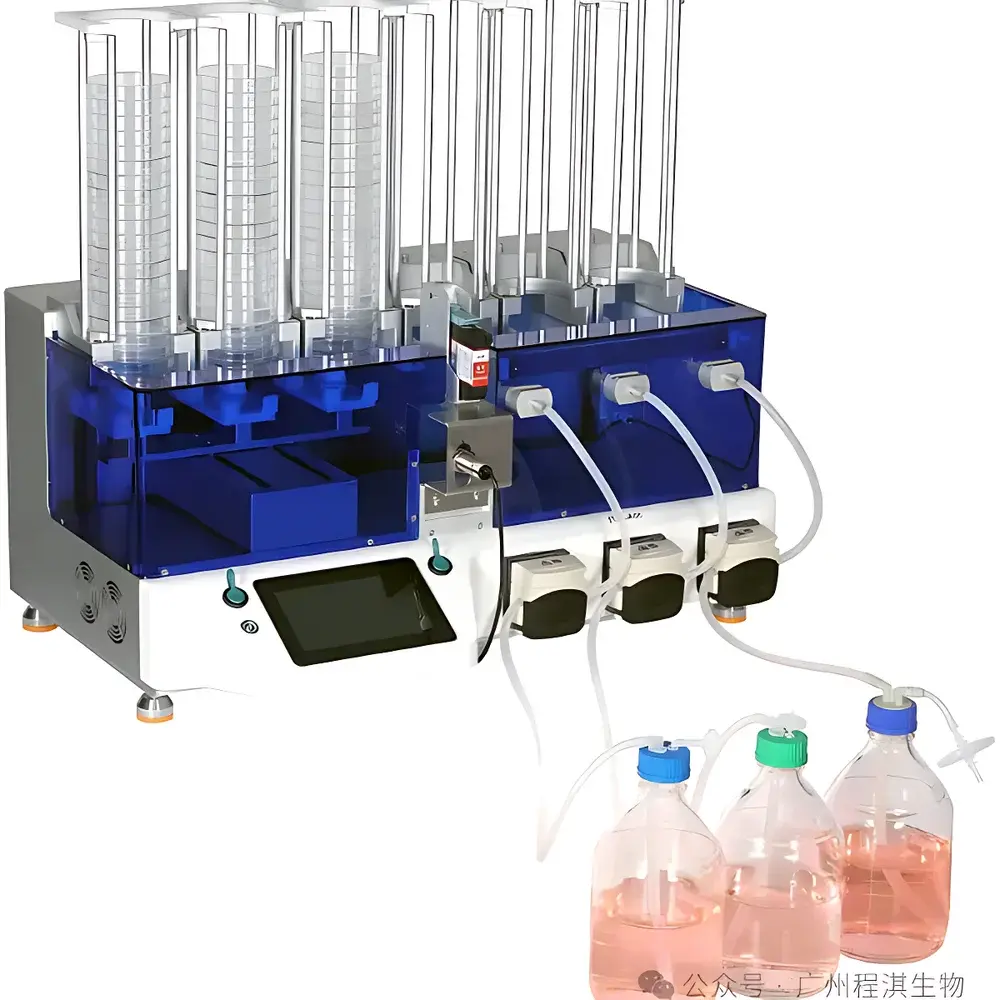
FLUIDOT FDT-MF120 Fully Automated Petri Dish Dispenser
| Brand | FLUIDOT |
|---|---|
| Origin | Guangdong, China |
| Manufacturer | FLUIDOT (Original Equipment Manufacturer) |
| Model | FDT-MF120 |
| Configuration | Three independent peristaltic pump channels |
| Display | 10-inch capacitive touchscreen |
| Maximum dish capacity per stacker | 40 × 90 mm Petri dishes (3 stackers total) |
| Dispensing modes | 5 programmable modes (Auto-Dispense, Auto-Dispense + Manual Sample Addition, Auto-Dispense + Auto-Sample Addition, Manual Dispense, Label Printing) |
| Pump control | Individual on/off and speed control for each of 3 peristaltic pump heads |
| Parameter storage | Up to 5 complete dispensing & oscillation protocols |
| Oscillation control | Independent X/Y-axis oscillation speed, amplitude, cycle count, and repeat iterations |
| Sterilization | Built-in UV-C lamp in dispensing chamber |
| Optional accessories | Integrated sample auto-sampler module, media temperature-controlled stirring unit, footswitch interface |
| Compliance | Designed for ISO 13485-aligned laboratory environments |
Overview
The FLUIDOT FDT-MF120 Fully Automated Petri Dish Dispenser is an engineered solution for precise, reproducible, and contamination-controlled dispensing of microbiological growth media into standard 90 mm Petri dishes. Utilizing a dual-axis oscillatory mixing mechanism combined with three independently controllable peristaltic pump channels, the system ensures homogeneous suspension of particulate-containing media (e.g., blood agar, chromogenic formulations, or antibiotic-supplemented agar) prior to and during dispensing. Its compact footprint (W × D × H: 520 × 580 × 560 mm) enables integration within Class II biological safety cabinets or laminar flow hoods—meeting spatial constraints typical of ISO 14644-1 Grade 5 (Class 100) cleanroom workspaces. The instrument operates on a deterministic sequence logic: dish presence detection → lid actuation → volumetric dispensing → post-fill oscillation → UV-C decontamination cycle — all executed without operator intervention beyond initial setup.
Key Features
- Three independently addressable peristaltic pump heads, each configurable for flow rates from 1–25 mL/min (media-dependent), supporting simultaneous dispensing of up to three distinct formulations into separate dish stacks.
- Programmable dual-axis (X/Y) oscillation system with adjustable amplitude (±2–10 mm), frequency (0.5–5 Hz), and cycle count (1–99), enabling controlled resuspension of sediment-prone media prior to dispensing.
- Integrated UV-C (254 nm) irradiation module inside the dispensing chamber, activated automatically between runs to minimize cross-contamination risk — validated per ISO 15883-1 for surface microbial reduction.
- Modular, autoclavable fluid path: All wetted components—including silicone tubing, nozzle assemblies, and sample contact surfaces—are removable, chemically resistant, and compatible with steam sterilization (121°C, 20 min) or hydrogen peroxide vapor (HPV) decontamination.
- 10-inch industrial-grade capacitive touchscreen with intuitive icon-driven UI; supports multi-language localization (English, Spanish, French, Chinese) and password-protected parameter editing tiers (Operator/Supervisor/Admin).
- Real-time dish presence verification via infrared proximity sensors; automatic pause/resume logic prevents dispensing into empty or misaligned dishes.
Sample Compatibility & Compliance
The FDT-MF120 accommodates standard polystyrene or polypropylene 90 mm Petri dishes (including vented and non-vented variants) and supports optional adapters for 100 mm formats. It handles viscous media up to 15,000 cP (e.g., molten agar at 45°C) and particulate-laden suspensions (≤100 µm particle size). Fluid path materials comply with USP <88> Class VI biocompatibility and EU Regulation (EC) No. 1935/2004 for food-contact applications. System architecture supports audit-ready operation: all dispense events, parameter changes, UV activation cycles, and error logs are time-stamped and stored locally (SD card) with optional network export. Firmware implements role-based access control aligned with FDA 21 CFR Part 11 requirements for electronic records and signatures when paired with external LIMS integration.
Software & Data Management
Embedded firmware v3.2 provides full protocol management via the touchscreen interface. Each of the five dispensing modes is assigned a unique ID and stores complete metadata: target volume, pump RPM, oscillation parameters, UV dwell time, and timestamped execution history. Export formats include CSV (for Excel analysis) and XML (for LIMS ingestion). Optional Ethernet/Wi-Fi connectivity enables remote monitoring through FLUIDOT’s LabLink™ dashboard, which visualizes daily throughput, pump wear metrics, and calibration drift alerts. All software updates are digitally signed and installed via secure OTA (Over-The-Air) protocol.
Applications
The FDT-MF120 serves as a core automation node in regulated microbiology workflows across public health laboratories (CDC, WHO reference labs), food safety testing facilities (ISO/IEC 17025 accredited), pharmaceutical QC labs (USP <61>/<62> compliance), clinical diagnostics (CLIA-certified environments), and academic research groups conducting high-throughput antimicrobial susceptibility testing (AST), environmental monitoring per ISO 14644-2, or culture-based pathogen isolation. Its flexibility supports both routine batch processing (e.g., 500+ plates/day for water quality testing) and low-volume method development (e.g., optimization of selective media formulations).
FAQ
Can the FDT-MF120 dispense into tubes or other vessel types?
Yes — in Manual Dispense mode, the system can be configured for tube filling using optional adapter fixtures; maximum recommended tube height is 150 mm.
Is validation documentation provided for IQ/OQ/PQ protocols?
FLUIDOT supplies a comprehensive Validation Support Package including URS template, FAT/SAT checklists, and test scripts compliant with ASTM E2500 and Annex 11 principles.
What maintenance intervals are recommended for the peristaltic pumps?
Tubing replacement is advised every 500 operational hours or after 2,000 dispense cycles, whichever occurs first; pump head calibration verification is required quarterly.
Does the system support integration with laboratory information management systems (LIMS)?
Yes — via HL7 v2.5 or RESTful API endpoints; message schema includes plate ID, media lot number, dispense volume, operator ID, and UTC timestamp.
How is temperature control implemented for heat-sensitive media?
The optional Media Temperature-Controlled Stirring Unit maintains agar at 45 ± 1°C during dispensing using Peltier-based heating/cooling and continuous viscosity-compensated stirring — certified per ISO 8573-1 Class 3 for compressed air purity if used with pneumatic lid actuators.
Related Products