
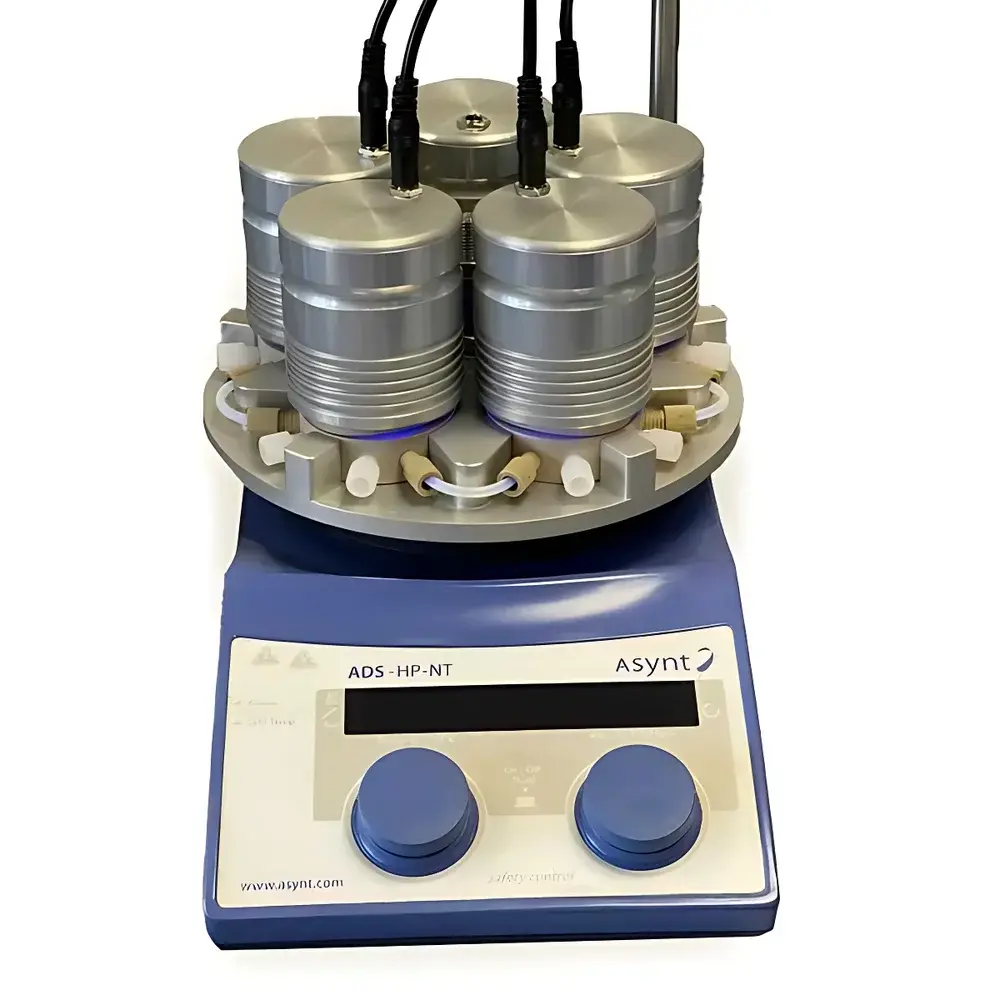
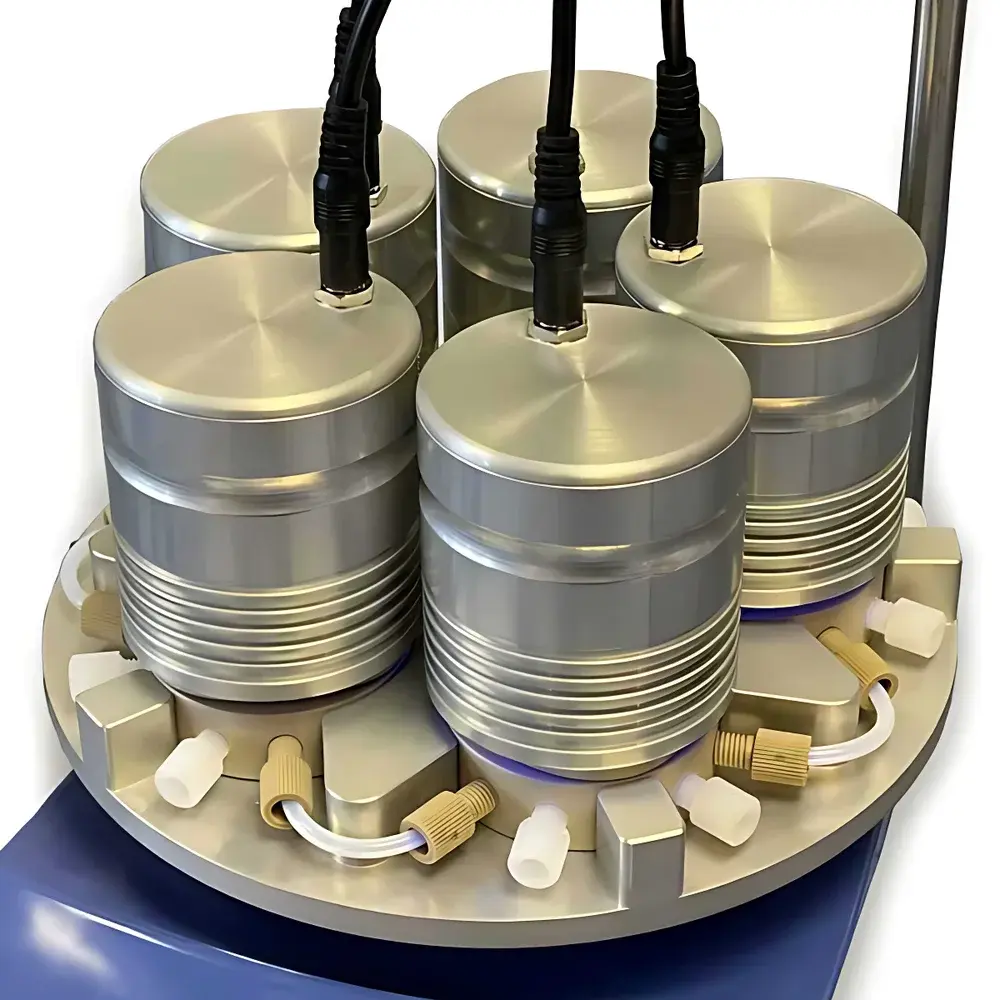
Asynt fReactor-Photo Module Flow Photochemical Reactor
| Brand | Asynt |
|---|---|
| Origin | United Kingdom |
| Manufacturer Type | Authorized Distributor |
| Product Origin | Imported |
| Model | fReactor-Photo Module |
| Pricing | Available Upon Request |
Overview
The Asynt fReactor-Photo Module is a modular, benchtop flow photochemical reactor engineered for reproducible, scalable, and operationally simple photochemistry under continuous-flow conditions. Developed in collaboration with the University of Leeds, this system integrates high-intensity solid-state LED illumination directly into the fReactor flow chemistry platform—enabling precise spatiotemporal control of photon delivery during reaction progression. Unlike batch photoreactors subject to light attenuation and thermal gradients, the fReactor-Photo Module leverages uniform LED chip arrays (COB technology) mounted adjacent to transparent fluoropolymer or quartz flow channels, ensuring consistent photon flux across the entire reactor volume. Its design adheres to fundamental principles of photochemical kinetics: photon absorption follows the Beer–Lambert law, and quantum yield optimization is achieved through controlled residence time, irradiance homogeneity, and minimized filter effects. The system supports both steady-state and segmented-flow photochemistry, making it suitable for mechanistic studies, reaction screening, and early-stage process intensification in academic labs and pharmaceutical development environments.
Key Features
- Modular integration: The Photo Module mounts directly onto any standard fReactor chassis position—single or up to five modules concurrently—without requiring external optical alignment or recalibration.
- Dual-wavelength illumination: Selectable 365 nm (UVA) or 450 nm (blue) high-power COB LEDs (10 W each), delivering >100 mW/cm² effective irradiance at the channel surface (measured at 1 cm distance, calibrated per ISO/CIE standards).
- Thermostatic compatibility: Fully operational within the fReactor’s integrated heating range (up to 55 °C), enabling combined photothermal reaction optimization while maintaining flow stability.
- Multi-phase readiness: Designed for gas–liquid (G/L) and liquid–solid (L/S) heterogeneous photochemistry, including photocatalytic slurry reactions using immobilized or suspended catalysts (e.g., TiO₂, Ru(bpy)₃²⁺, or organic photocatalysts).
- Plug-and-play architecture: No custom cabling or firmware updates required; powered via the fReactor’s central PSU—eliminating power supply proliferation and grounding inconsistencies.
- Material compatibility: Fluidic paths constructed from chemically resistant PFA or FEP tubing (optional quartz capillaries for UV-C transparency), rated for pressures up to 10 bar and solvents including DMF, THF, MeCN, and aqueous acidic/basic media.
Sample Compatibility & Compliance
The fReactor-Photo Module accommodates a broad scope of photoactive substrates—including aryl halides, diazonium salts, α-diazo carbonyls, and photoredox-active complexes—across residence times ranging from seconds to several minutes. It complies with ISO 17025-aligned laboratory practices for method development and is routinely deployed in workflows supporting ICH Q5, Q7, and Q8 guidelines. While not certified as GMP equipment, its digital logging interface (via optional fReactor Control Software) supports audit-trail generation compliant with FDA 21 CFR Part 11 when configured with user authentication and electronic signature protocols. All electrical components meet CE/UKCA marking requirements (EMC Directive 2014/30/EU and Low Voltage Directive 2014/35/EU).
Software & Data Management
When paired with the fReactor Control Software (v3.2+), the Photo Module enables synchronized logging of LED activation state, irradiance setpoint (on/off or pulse-width modulated), temperature, pressure, and pump flow rate timestamps. Exportable CSV datasets include column headers compatible with MATLAB, Python (Pandas), and JMP for kinetic modeling (e.g., determination of apparent quantum yield Φapp). No proprietary file formats are used; raw logs retain native timestamp resolution (100 ms). Optional integration with LabArchives or Electronic Lab Notebooks (ELNs) is supported via HTTP API endpoints for automated metadata ingestion.
Applications
- Photocatalytic C–N, C–O, and C–C bond formations under visible-light irradiation
- Photoinduced decarboxylative couplings and radical cascade cyclizations
- Sunlight-mimetic degradation studies of environmental pollutants (e.g., pharmaceutical residues in aqueous matrix)
- High-throughput screening of photocatalyst performance across wavelength and intensity gradients
- Scale-down validation of pilot-scale photochemical processes prior to continuous manufacturing transfer
- Teaching laboratories: Demonstrating photon efficiency, action spectra, and reactor engineering fundamentals in undergraduate physical organic chemistry courses
FAQ
Can the 365 nm and 450 nm modules be operated simultaneously on the same fReactor unit?
Yes—each module operates independently; wavelength selection is hardware-defined per module slot, and no spectral cross-talk occurs due to optical isolation between adjacent positions.
Is quartz required for 365 nm operation?
Standard PFA tubing transmits >90% of 365 nm irradiance; quartz capillaries are recommended only for applications demanding maximal UVA throughput below 350 nm or extended exposure durations (>24 h).
Does the system support pulsed illumination for triplet-state lifetime interrogation?
The base firmware supports TTL-triggered on/off cycling (minimum pulse width: 50 ms); advanced pulse modulation requires optional software license and external function generator synchronization.
What maintenance is required for long-term LED output stability?
LEDs are rated for 20,000 hours L70 lifetime at 25 °C ambient; no user-serviceable parts exist—output calibration drift is monitored via integrated photodiode feedback and reported in software diagnostics.
Can the fReactor-Photo Module be retrofitted to legacy fReactor systems?
All fReactor units manufactured after Q3 2020 (serial prefix FR-2020xx or later) support full backward compatibility; earlier units require mainboard firmware update (free of charge with valid service contract).



