
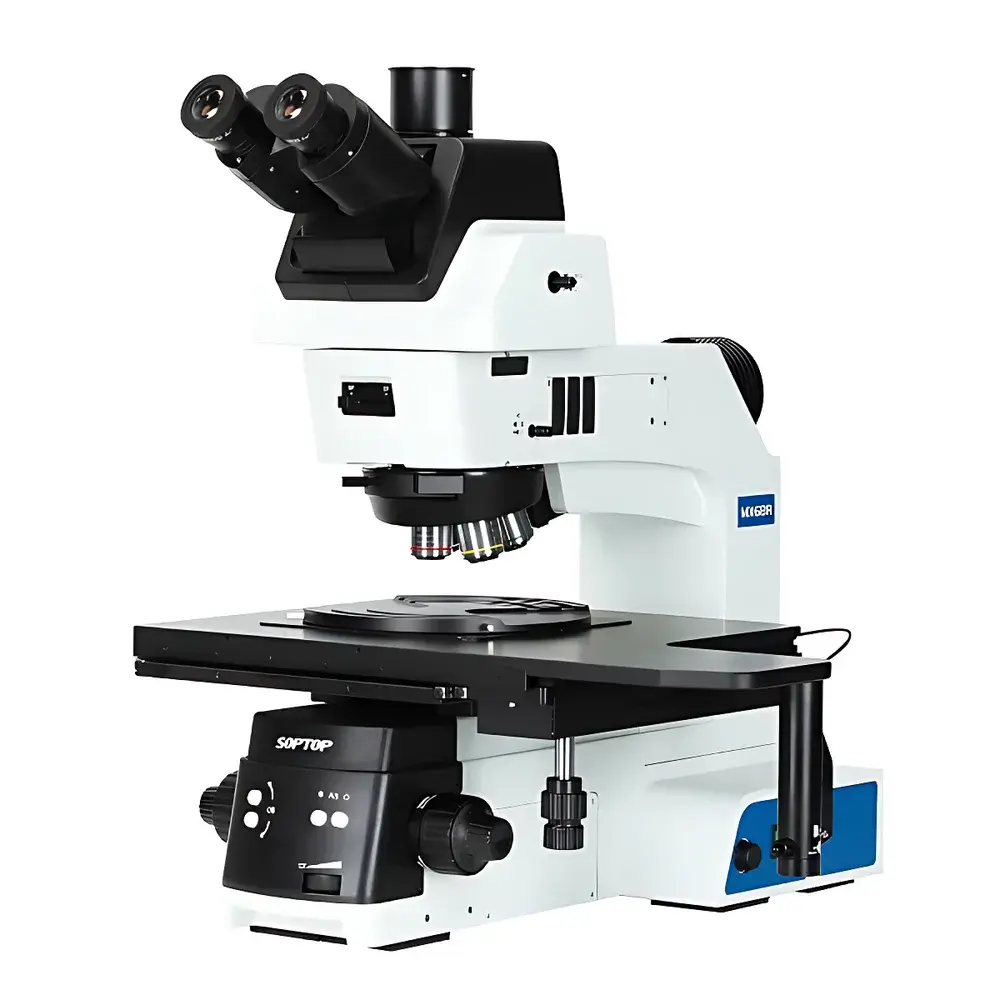
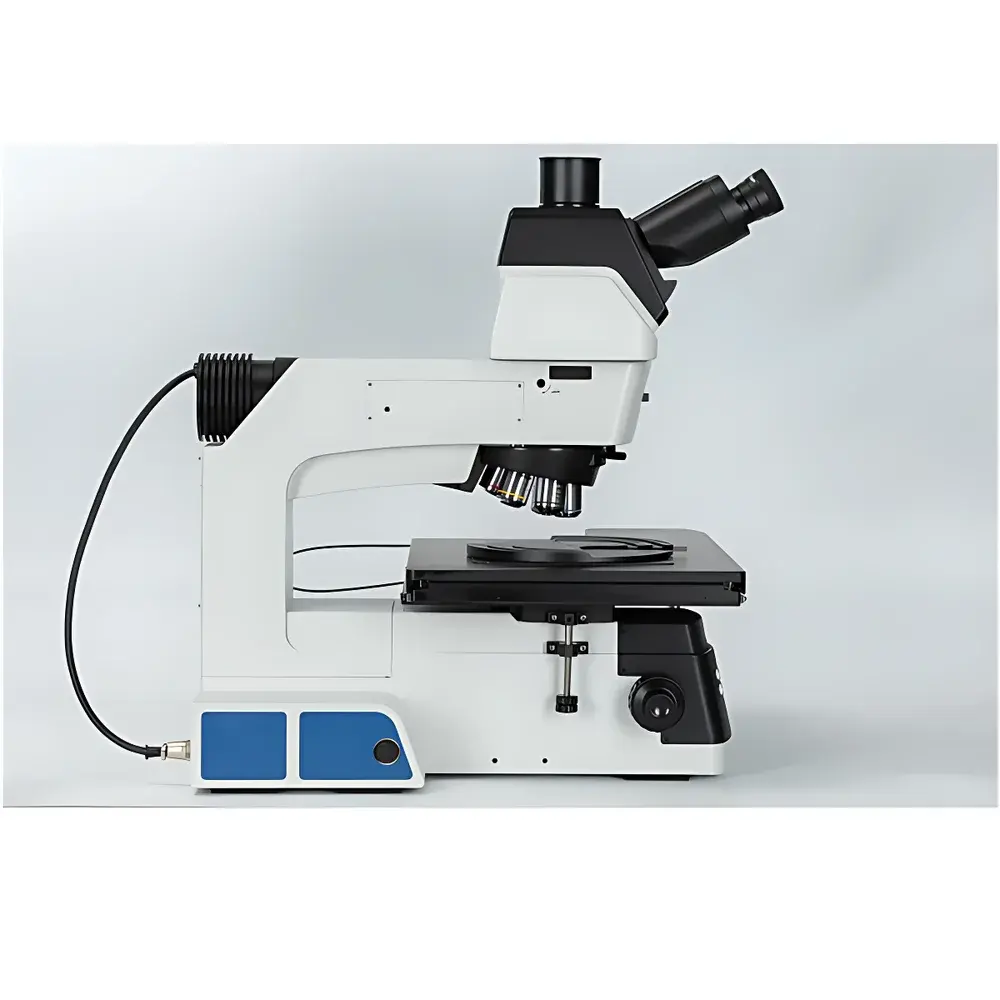
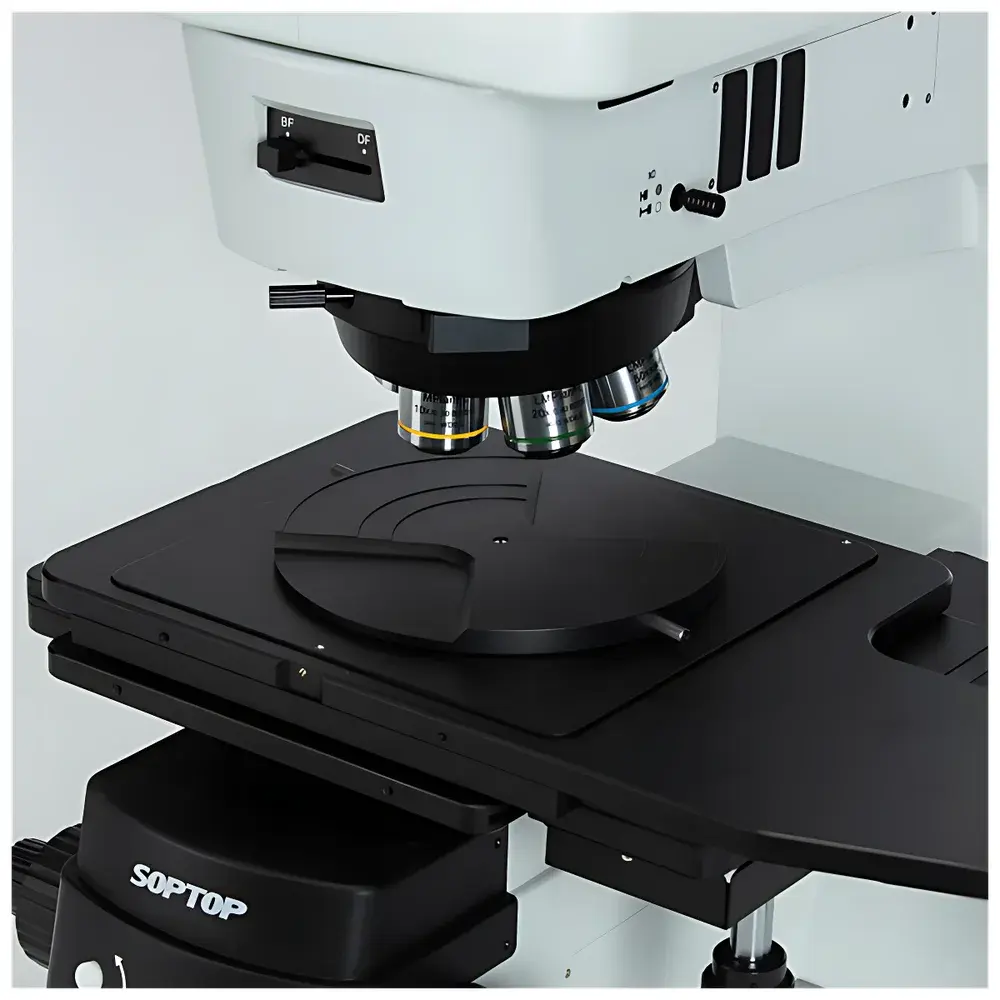
SOPTOP MX68R Upright Metallurgical Microscope
| Brand | SOPTOP |
|---|---|
| Origin | Zhejiang, China |
| Manufacturer Type | Direct Manufacturer |
| Product Origin | Domestic (China) |
| Model | MX68R |
| Configuration | Upright |
| Total Magnification Range | 50×–1000× |
| Eyepieces | High-eye-point wide-field plan eyepieces PL10×/22 mm and PL10×/23 mm |
| Objectives | 5×–100× |
| Illumination Modes | Brightfield, Darkfield, Polarized Light, Differential Interference Contrast (DIC) |
| Wafer Compatibility | Up to 200 mm diameter |
| Structural Design | Full-metal frame with integrated ergonomic carrying handles |
| Objective Turret | Motorized, dual-direction (forward/reverse), high-repeatability positioning |
| Aperture Diaphragm & Objective Control | Front-panel motorized actuation |
| Optional Upgrade | NIR-compatible configuration (NIR-MX68R) for near-infrared imaging with broadband IR-sensitive cameras |
Overview
The SOPTOP MX68R is an upright metallurgical microscope engineered for high-precision microstructural analysis of opaque, reflective specimens—particularly in semiconductor fabrication, flat panel display (FPD) manufacturing, advanced packaging, and advanced materials R&D. It operates on the principle of reflected-light microscopy, utilizing Köhler illumination with parfocal, apochromatic objectives to deliver diffraction-limited resolution across its full 50×–1000× magnification range. Unlike inverted configurations, the upright design enables direct access to large-format samples—including 200 mm silicon wafers and 11-inch LCD panels—without requiring specimen inversion or complex stage adaptations. Its rigid all-metal optical chassis minimizes thermal drift and mechanical vibration, ensuring long-term alignment stability essential for quantitative metallography and failure analysis workflows.
Key Features
- Motorized objective turret with dual-direction indexing (forward/reverse), delivering ≤ ±0.5 µm repeatability in objective positioning—critical for multi-modal image registration and automated focus stacking.
- Front-panel motorized control of both objective selection and aperture diaphragm, eliminating manual repositioning and reducing operator-induced parallax or misalignment during sequential imaging.
- Ergonomic, full-metal structural architecture with integrated, retractable carrying handles—designed for safe relocation within cleanroom or metrology lab environments without compromising optical axis integrity.
- Modular illumination system supporting brightfield, darkfield, polarized light, and Nomarski-type differential interference contrast (DIC), enabling simultaneous phase, topographic, and birefringence characterization of grain boundaries, precipitates, and coating interfaces.
- Interchangeable rotating stage inserts for 4″, 6″, and 8″ wafers—facilitating rapid setup changes between process control and defect review tasks while maintaining calibrated centering and tilt compensation.
- NIR-ready optical path (optional NIR-MX68R configuration) with AR-coated optics transmitting from 400 nm to 1700 nm, compatible with scientific-grade InGaAs or extended-range CMOS cameras for non-destructive subsurface inspection of flip-chip interconnects and through-silicon vias (TSVs).
Sample Compatibility & Compliance
The MX68R accommodates specimens up to 200 mm in diameter and 50 mm in height, with stage travel of 100 × 100 mm (X–Y) and coarse/fine focusing ranges of 25 mm and 200 µm respectively. Its mechanical stage includes vernier scales and optional motorized encoding for traceable coordinate mapping. The system complies with ISO 9001 manufacturing protocols and meets mechanical safety requirements per IEC 61000-6-2 (EMC immunity) and IEC 61000-6-4 (EMC emissions). While not certified as medical or diagnostic equipment, its optical performance aligns with ASTM E3–22 (Standard Guide for Preparation of Metallographic Specimens) and ISO 4967 (Micrographic Determination of Non-Metallic Inclusions in Steel), supporting GLP-compliant documentation when paired with validated digital imaging software.
Software & Data Management
The MX68R integrates seamlessly with SOPTOP’s proprietary ImagePro®-MX acquisition suite (Windows-based), supporting time-stamped image capture, multi-channel overlay (BF/DF/POL/DIC), measurement annotation (grain size per ASTM E112, inclusion rating per ASTM E45), and batch export in TIFF, PNG, and vendor-neutral NDPI-compatible formats. Audit trail functionality records user ID, timestamp, objective used, illumination mode, and exposure parameters—enabling compliance with FDA 21 CFR Part 11 requirements when deployed in regulated QC/QA environments. Optional API support allows integration into factory MES systems via TCP/IP or RS-232 for automated report generation and SPC data logging.
Applications
- Semiconductor: Defect localization on BEOL metallization layers, trench depth verification in etch processes, solder bump morphology analysis.
- FPD Manufacturing: Pixel electrode integrity assessment, TFT gate line continuity, black matrix edge uniformity evaluation.
- Advanced Packaging: Wire bond heel cracking detection, underfill void quantification, die attach layer delamination mapping.
- Materials Science: Grain boundary engineering validation in Ni-based superalloys, carbide distribution analysis in tool steels, phase identification in sintered ceramics.
- Quality Assurance: Cast porosity classification per ASTM E505, inclusion content grading per ISO 4967, heat-affected zone (HAZ) microstructure documentation per AWS D1.1.
FAQ
Is the MX68R compatible with third-party camera systems?
Yes—the C-mount interface conforms to standard 1″ sensor format specifications (flange distance 17.526 mm), supporting most industrial and scientific cameras from FLIR, Basler, and Teledyne DALSA.
Can the motorized turret be programmed for automated multi-objective workflows?
Yes—via TTL or USB command protocol, enabling synchronization with stage movement and illumination switching in custom script-based inspection routines.
Does the system support calibration traceability to NIST standards?
While the microscope itself is not a measuring instrument, its stage encoders and software measurement tools can be validated using NIST-traceable stage calibration rulers (e.g., Thorlabs R1L10) and certified micrometer standards.
What is the maximum working distance achievable at 100× magnification?
The standard 100×/0.90 NA oil-immersion objective provides a working distance of 0.15 mm; dry 100× objectives (0.85 NA) offer 0.28 mm WD—suitable for coated or encapsulated samples.
Is service and technical support available outside mainland China?
SOPTOP maintains authorized service centers in Germany, Singapore, and the United States, with remote diagnostics and on-site engineer dispatch available under extended warranty agreements.





