
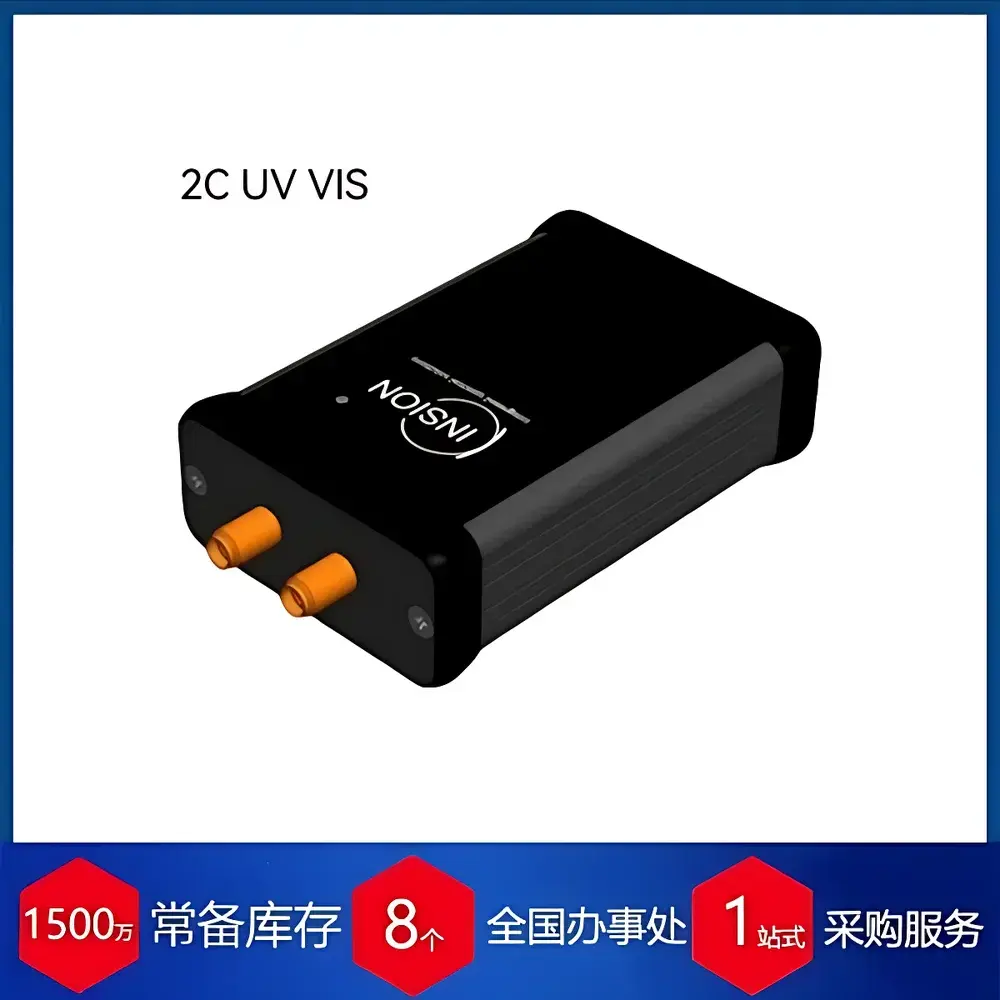
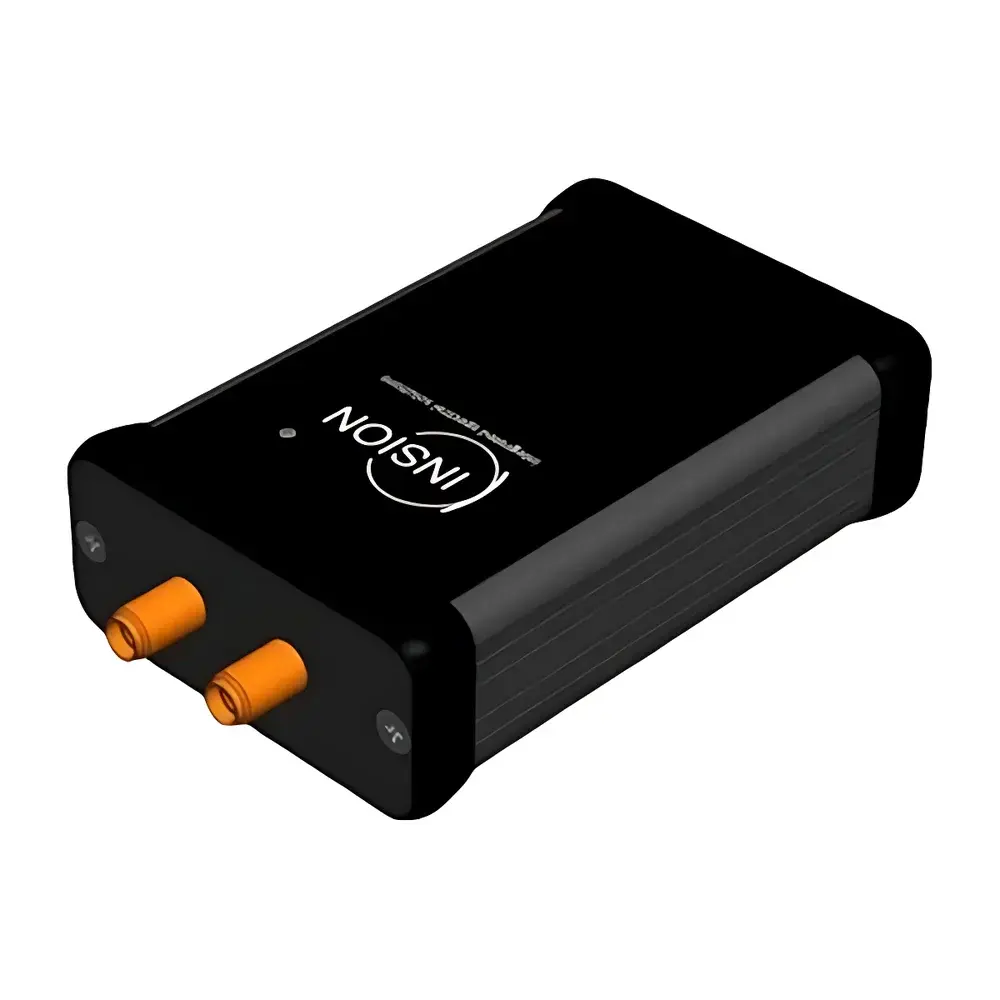
INSION 2C UV VIS Dual-Channel Miniature UV-Vis Spectrometer
| Brand | INSION |
|---|---|
| Origin | Germany |
| Model | 2C UV VIS |
| Optical Architecture | Single-beam |
| Detector Type | Photodiode Array |
| Spectral Range | 2 × 350–1050 nm |
| Wavelength Accuracy | < 10 nm FWHM |
| Spectral Resolution | < 10 nm FWHM |
| Sensitivity | > 2.0 × 10¹⁵ counts·nm/W·s at 650 nm |
| Optical Interface | Dual SMA 905 connectors |
| Calibration | Factory-calibrated, no user recalibration required |
| Mechanical Stability | Solid-state design, no moving parts |
| Operating Temperature Range | 5–40 °C |
| Dimensions | ≤ 65 × 45 × 25 mm |
| Weight | < 120 g |
Overview
The INSION 2C UV VIS is a dual-channel, single-beam miniature spectrometer engineered for embedded OEM integration in analytical, industrial, and point-of-care systems requiring robust, compact UV-Vis spectral acquisition across two independent optical paths. Based on monolithic micro-opto-mechanical design principles, it employs fixed-grating dispersion and linear photodiode array detection—eliminating mechanical actuators, motorized slits, or wavelength-scanning mechanisms. Its core optical architecture delivers simultaneous, time-synchronized spectral measurement from two distinct sample channels (e.g., reference + sample, or two parallel process streams), enabling real-time differential absorbance, ratio-based colorimetry, or dual-path calibration compensation. Designed and manufactured in Ober-Sulm, Germany, the instrument adheres to ISO 9001-certified production protocols and meets IEC 61326-1 requirements for electromagnetic compatibility in laboratory and industrial environments.
Key Features
- Dual independent spectral channels—each covering 350–1050 nm with identical optical path length and detector geometry, ensuring matched responsivity and thermal drift behavior.
- Fixed-grating monolithic optics with no moving parts: guarantees long-term wavelength stability and resistance to shock, vibration, and thermal cycling.
- High quantum efficiency photodiode array with integrated low-noise analog front-end and 16-bit ADC, optimized for signal-to-noise ratio in low-light PAT and clinical applications.
- Factory spectral calibration traceable to NIST-traceable standards; delivered with full wavelength and intensity calibration coefficients embedded in firmware—no field recalibration required under normal operating conditions.
- Compact form factor (≤65 × 45 × 25 mm) and ultra-low mass (<120 g) enable seamless integration into handheld diagnostics, inline process sensors, and space-constrained instrumentation.
- Low power consumption (<500 mW typical), USB 2.0 interface with CDC-class virtual COM port, and support for trigger-synchronized acquisition across both channels.
Sample Compatibility & Compliance
The 2C UV VIS is compatible with standard 400 µm core optical fibers terminated with SMA 905 connectors, supporting liquid cuvette holders, flow cells, diffuse reflectance probes, and integrating spheres. It operates effectively with absorbance ranges of 0–3 AU (depending on path length and source intensity) and is suitable for transmission, reflectance, and fluorescence excitation monitoring (when paired with appropriate excitation sources). The device complies with CE marking directives (2014/30/EU EMC, 2011/65/EU RoHS), meets essential requirements of IEC 61010-1 for electrical safety in measurement equipment, and supports audit-ready data integrity workflows when deployed under GLP or GMP frameworks—particularly relevant for pharmaceutical process analytical technology (PAT) applications governed by FDA Guidance for Industry (2019) and ICH Q8(R2)/Q9/Q10.
Software & Data Management
INSION provides a cross-platform SDK (Windows, Linux, macOS) with C/C++, Python, and LabVIEW APIs, enabling deterministic control of exposure time, averaging, dark subtraction, and channel synchronization. Raw spectral data are output as ASCII or binary arrays with calibrated wavelength vectors (nm) and intensity units (counts or relative irradiance). The SDK supports timestamped metadata embedding (including temperature sensor readings from onboard thermistor), enabling correlation with external process variables. For regulated environments, optional firmware extensions provide electronic signature capability, audit trail logging (per 21 CFR Part 11 Annex 11 principles), and secure firmware update signing. No proprietary runtime or license server is required—data files are fully interoperable with third-party analysis tools including MATLAB, OriginLab, and open-source libraries such as SciPy and Pandas.
Applications
- Real-time pharmaceutical blend uniformity monitoring during continuous manufacturing—dual-channel operation allows simultaneous reference beam normalization and sample stream interrogation.
- Point-of-care blood oximetry and biomarker quantification using multi-wavelength absorbance ratios in microfluidic cartridges.
- Inline color consistency verification in food processing lines (e.g., beverage tinting, sauce pigment stability) per CIE 1931 XYZ and L*a*b* color space standards.
- UV-Vis kinetic assay monitoring in automated clinical analyzers, supporting enzyme activity, protein concentration (Bradford/Lowry), and nucleic acid quantification (260/280 nm ratio).
- Embedded spectral feedback in LED lighting systems for closed-loop spectral power distribution (SPD) correction and CCT stabilization.
FAQ
Is the 2C UV VIS suitable for quantitative absorbance measurements in compliance-critical environments?
Yes—when integrated with stable broadband sources and calibrated cuvettes, it achieves repeatability of ±0.005 AU over 8-hour periods at 550 nm (tested per ASTM E275-20). Full traceability documentation is provided with each unit.
Does the device support external triggering for synchronized multi-instrument acquisition?
Yes—TTL-compatible trigger input/output pins enable hardware-level synchronization with pumps, valves, or other spectrometers in modular analytical platforms.
Can spectral data be exported in formats compliant with LIMS or ELN systems?
Yes—CSV and HDF5 export modes include embedded metadata headers conforming to ISA-Tab and AnIML v2.0 schemas, facilitating direct ingestion into laboratory informatics infrastructure.
What is the recommended warm-up time before achieving thermal equilibrium?
Less than 90 seconds from ambient start-up; spectral shift remains within ±0.3 nm across the full range after stabilization.
Is fiber optic coupling alignment critical during installation?
No—SMA 905 interfaces are standardized and self-centering; coupling efficiency variation remains within ±3% across 50 insertion cycles when using grade-A fibers.







